Arcadia
The AxArcadia is a small mill town in New York State whose paper plant becomes the focus of Burke Devore’s search for work and his fixation on the man he believes stands between him and a job. The town’s apparent industrial success offers Burke hope, while its streets, mill, and nearby roads give him a real landscape in which to investigate Upton “Ralph” Fallon. Arcadia thus functions at once as a potential workplace, a subject of economic reporting, and the destination toward which Burke’s increasingly dangerous plans converge.
Setting and industrial geography
Arcadia is described as a compact, old-fashioned settlement of roughly twenty clapboard houses on slopes beside the Jandrow, a small but lively stream that feeds into the Hudson. The mill buildings occupy the stream corridor, where the plant can draw on the water it needs. A dam lies just upstream from the mill. The town’s east-west road dips down one slope, crosses the dam, then climbs the opposite slope and continues out of town, making the waterworks part of the everyday route through Arcadia rather than a distant industrial feature.
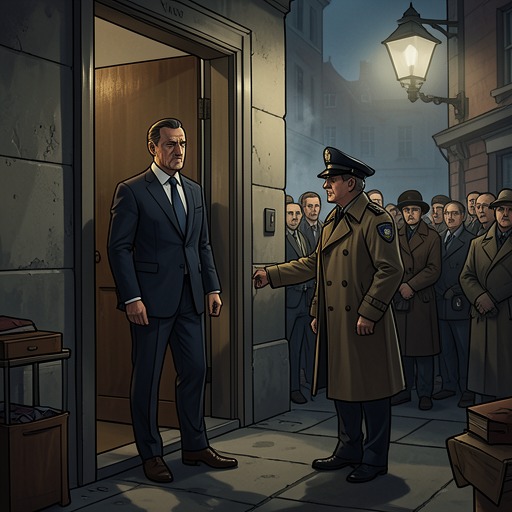
The commercial landscape is sparse. Above the mill on the western slope stands Betty’s, a luncheonette that also sells newspapers, cigarettes, and a few basic groceries. Farther up, at the edge of town, is a Getty gas station. On a later evening drive Burke notices neon from two bars, the brighter lights of the gas station, and worklights around the mill. The luncheonette is closed, and the mill’s interiors appear dark. These details give Arcadia a modest civic center and a conspicuous industrial presence, but not the activity of a large manufacturing complex operating around the clock.
The mill and its changing business
Arcadia Processing is the plant’s operator and a wholly owned subsidiary of one of the largest American paper companies, a corporation known for making toilet paper and tissues. The magazine article Burke reads presents Arcadia Processing as a success story: its parent company has left the operation alone because it is doing well. For much of the twentieth century, the mill specialized in cigarette paper made from tobacco scraps, including shreds and stems left over from cigarette production. Because tobacco fibers are short, turning them into paper required specialized processes. Early forms of tobacco paper strengthened cigar ends; a later bleached and aerated variant became the paper surrounding ordinary cigarettes.
A few years before the article, Arcadia Processing’s management decided to diversify beyond tobacco products. It chose the same polymer-paper specialty on which Burke had spent sixteen years working at Halcyon Mills. The article attributes the plant’s expansion partly to sales beyond the established domestic market: rather than directly compete with mills already producing that specialty, Arcadia Processing pursued overseas customers. NAFTA helped it find Mexican manufacturers able to buy its products, and the company subsequently developed customers across South America as well.
The article’s account of a new manufacturing method unsettles Burke. He recognizes the described system as the one installed at Halcyon Mills in 1991, and considers the claim that it is superior mistaken. The detail makes Arcadia’s success personally charged: the plant is not merely in a familiar industry, but is prospering in a line of work Burke regards as his own. The article also introduces Fallon, the production-line manager. Known by his middle name, Ralph, Fallon had started at the tobacco-paper machine almost thirty years earlier, apparently straight out of high school, and remained with the company.
From reported opportunity to imagined employment
Burke encounters Arcadia through Pulp, an industry magazine he now studies closely because he fears falling behind. The article revives his attention at a point when he is struggling to find the energy to send out his own résumés. He reads it more than once, focusing on Fallon’s position and background, and concludes that he would be the stronger candidate in a fair competition. Yet Fallon already holds the job Burke wants. The distance between that judgment and the fact of Fallon’s employment becomes the seed of Burke’s fantasy that the incumbent might be dismissed, become ill, or die.
The road atlas turns the fantasy into a destination. Burke estimates that Arcadia is no more than fifty miles away, just across the Connecticut state line, and close enough to commute without relocating. The magazine and atlas lie open on his desk while the house is quiet, with the children at school and Marjorie at Dr. Carney’s office. In that private moment, Burke first remembers the Luger pistol stored in his father’s trunk and imagines aiming it at a person. The small town has not yet become a place he knows firsthand, but its proximity helps collapse the distance between desperate thought and contemplated action.
Burke later drives to Arcadia to look it over, taking rural roads through suburban towns and farm villages. He imagines the route as a regular five-day-a-week commute and pictures the job at the far end as work he could love. When he reaches town around noon, he eats at Betty’s. Seated alone at the counter, he realizes from the conversations around him that the people at the tables are mill workers. This first visit joins the plant’s public image to its local workforce: Arcadia is not just a company described in a trade magazine, but a small community organized around the mill.
Reconnaissance and the prospect of a vacancy
Burke’s understanding of Arcadia also rests on his interpretation of corporate change. He sees computers replacing the information and coordination work once performed by middle managers: relaying orders to workers, reporting results to executives, and connecting production with suppliers and distributors. In his view, automation has not eliminated every supervisory job. A production line still requires one or two experienced people to manage it and communicate with the workers. Because Arcadia has only one shift, Burke reasons that it will need an experienced replacement if Fallon leaves; a night-shift employee cannot simply move to days while training an assistant to take over at night. That inference sustains his belief that the position will remain available.
On an evening visit, Burke treats the drive as the beginning of a prospective commute and a chance to locate Fallon. At the Getty station he fills the Voyager’s tank and asks for a phone book. The attendant silently produces a thin, worn directory. Burke finds Fallon listed at County Route 92, with the place abbreviated as “Slt,” which he takes to mean Slate. When he asks for directions, the attendant points him toward the road and says the route is six miles away; Burke says he is going to Slate and is told to take the left.
The approach confirms how rural the area around Arcadia is. Burke passes a house he believes may be Fallon’s, turns around, and leaves his vehicle at a broad cattle gate so he can walk back. He has prepared an excuse in case anyone questions him: he is lost and looking for Arcadia. Under a star-filled sky, he follows a blacktop driveway through trees toward the dimly lit house. The target residence is outside the town itself, but Arcadia supplies the route, the phone-book lead, and the explanation Burke plans to give if his presence is noticed.
The town as workplace and narrative hinge
Burke’s later return to Fallon’s house deepens the connection between Arcadia’s employment prospect and his intended replacement of its manager. Searching Fallon’s office, he finds work records and newspaper and trade-journal clippings marked with underlined passages and mostly sensible marginal comments. The materials show Burke that Fallon takes the industry seriously and keeps up with it. Other papers indicate that Fallon has been divorced three times, has three adult children in California who write occasionally, and has two younger children who visit in summer and at Christmas. He earns a good living at Arcadia, though less than Burke made at Halcyon Mills, but is in debt, receives collection letters, and tends to fall behind on child support before scrambling to catch up ahead of the younger children’s visits.
The house and its paperwork complicate Burke’s earlier judgment of Fallon as a lightweight. When they later talk over beer and rye, Fallon discusses the owners of Arcadia Processing and the production line. He speaks approvingly of the company’s owners and asks Burke about the equipment at his former line. Burke finds the conversation enjoyable and recognizes Fallon as bright and technically knowledgeable; he even regards some of Fallon’s methods as worth preserving when he takes over. That recognition sharpens the irony of the rivalry: Fallon is not simply an unqualified obstacle in Burke’s account, but a capable worker whose experience and practical knowledge are visible at close range.
Arcadia remains a one-shift operation, with worklights outside and no visible lights inside the mill on Burke’s evening approach. He takes that pattern as evidence that the company will hire rather than shift an existing night worker into Fallon’s place. After further planning, while distracted during a marriage-counseling session, Burke considers returning to the luncheonette at noon to listen to the workers and learn more about the plant. Before he carries out that plan, an answering-machine message arrives from John Carver’s office at Arcadia Processing, asking Burke to return a call by the following day. Burke tells Marjorie that it is his new job. The call is a concrete opening, though the message itself asks for a return call rather than confirming an appointment or an offer. Arcadia’s decisive significance lies in this unresolved overlap: it offers Burke a real employment possibility even as he has made Fallon’s removal part of his imagined route to that same position.