Berkshire Way
The AxBerkshire Way is a country road extending north from Longholme through open Berkshire countryside. In Burke Devore’s approach to Edward George Ricks’s home, the road’s sparse traffic and scattered properties shape a patient roadside vigil; that vigil ends in a shooting at the Ricks residence, turning an unassuming rural route into the setting for a decisive act of violence.
Route and rural setting
On Burke’s Massachusetts road atlas, Berkshire Way appears as a winding line running north out of Longholme, about twenty miles west of Springfield and north of the Massachusetts Turnpike. To avoid the town, he takes country roads around it and turns onto Berkshire Way close to noon. The detour lengthens his drive, but brings him into a landscape markedly different from the wooded countryside he has crossed in Connecticut: farms, cleared fields, and broad valleys open between the houses.
The homes along the road are mostly large but unpretentious, set in a place that feels neither suburban nor close to the northeastern cities. One modern house on a traditional plan, numbered 7911, stands on the right-hand side as Burke approaches. The surrounding quiet is not absolute—delivery vans and pickup trucks pass—but traffic is light enough for a parked car to seem plausible rather than conspicuous.
A roadside vantage point
Burke first drives beyond the Ricks home, turns around in the parking area of a convent school, and returns looking for somewhere unobtrusive to wait. Near the house is an empty field scattered with shrubs and low pines, marked for sale by a white-on-red sign with a telephone number written on it in black marker. Beyond the field stands a squash-colored stucco house with a large real-estate sign and an unmowed lawn, giving the property an abandoned appearance.
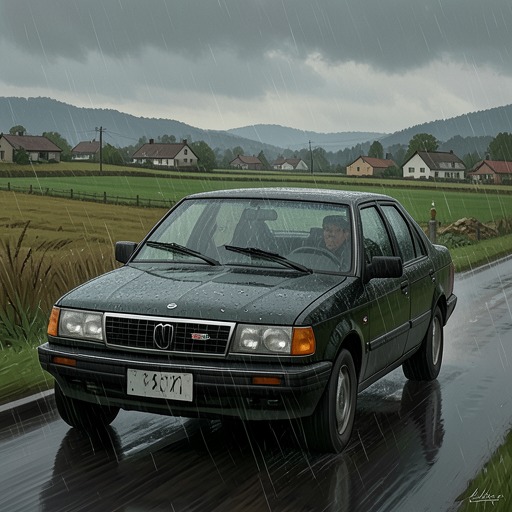
Burke uses that vacant-looking property as his vantage point. He turns into its driveway and backs out so the Voyager sits off the road, facing across the field toward the front of the Ricks home. He deliberately leaves the for-sale sign visible, making it seem to passing motorists that he is waiting for a real-estate agent. From this position he can watch the house without parking directly outside it.
The mailbox and the shooting
The mailbox is on the same side of the road as the Ricks home, which gives Burke less warning than he had during an earlier attempt to watch the house. He waits for a chance that Edward George Ricks will come out to collect the mail. On a later visit, Burke arrives before ten and sees the mailbox flag raised. He reads it as a sign that outgoing letters are waiting to be collected and that the mail has not yet been delivered; the Luger pistol lies beside him on the seat beneath a folded raincoat as he waits.
After about twenty minutes, another vehicle brakes to a stop behind him. A woman jumps out and runs toward Burke. Fearing that she has recognized him and seen the gun, he grabs it and pursues her across the lawn of a yellow aluminum house. She is also struggling to run, and calls for Ed as Burke catches up and fires once from behind her. She falls on the lawn. The front door opens and Edward George Ricks appears; Burke raises the gun and fires again, but the bullet strikes the aluminum beside the doorframe. Ricks slams the door and runs into the house.
Narrative significance
Berkshire Way’s open fields and infrequent traffic make it possible for Burke to observe the Ricks home while disguising his presence as an ordinary roadside wait. The practical details that guide his plan—the driveway, the field between the houses, the mailbox flag, and the approach to the front door—also make the setting part of the violence rather than a neutral backdrop. A landscape first presented through road directions and property descriptions becomes the stage on which surveillance collapses into exposure and gunfire.