Billy
The AxBilly is the son of Burke Devore and Marjorie Devore, and his arrest for a planned computer-store burglary brings his parents face to face with a crime they had not known he was committing. His story is shaped by the distance between the boy they thought was safely asleep at home and the teenager who had secretly joined Jim Bucklin in a series of thefts. Burke’s attempts to protect his son—first by insisting this was Billy’s first offense, then by hiding the stolen software—make the episode as much a test of parental loyalty as a legal crisis.
Identity and Introduction
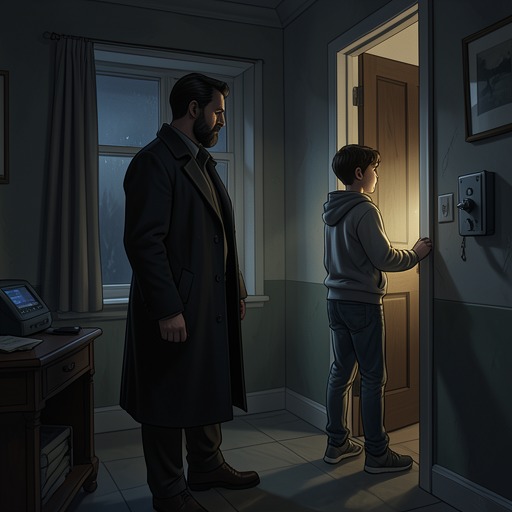
Billy is presented through the crisis of his arrest rather than through an account of his earlier life. He is a school friend of Jim Bucklin and lives with his parents. On the night of the burglary, Burke and Marjorie believe he is asleep in his room; the news that he has been arrested therefore overturns their immediate assumption about where he is and what he has been doing. Burke’s first thought is that an accident has happened, before he remembers that Billy should be in bed at home.
The arrest also changes the household’s existing roles. Since Burke lost his job, Marjorie has been the one to wake when the telephone rings, alert to news and responsibilities that she can no longer leave to her husband. When the call reports Billy’s arrest, she handles the detective’s questions calmly, taking notes while Burke struggles to concentrate. His attention is fixed on seeing his son. The family’s precariousness is already part of the scene: the news arrives in a home where unemployment has shifted both practical burdens and a sense of security.
The Burglary and Arrest
Billy and Jim Bucklin first entered the computer store in the mall where Marjorie works for Dr. Carney during the afternoon. They got into the rear of the premises and tampered with the delivery-and-trash door so that it would appear locked while remaining open. Later, after the family thought Billy had gone to bed, he left the house and was picked up by Jim, who had a car. The two returned to the mall and entered through the back.
The boys did not know that the store had already been robbed three times in the same way. After those burglaries, a silent alarm had been installed to alert the State Police barracks. When Billy and Jim entered, the alarm brought four police cars to the site: two from the state trooper barracks and two from the local town police. The boys were leaving with canvas tote bags full of software when the officers arrived. They abandoned the bags and ran, but were immediately apprehended.
The police already had substantial evidence against them for this burglary: Jim had made an admission, officers had proof that the door was deliberately rigged, and police witnesses had seen the boys carrying the stolen goods before they fled. Their remaining question was whether Billy and Jim were responsible for the three earlier break-ins. Burke joined the detective’s conversation to insist that this was Billy’s first time. He distinguished his son from Jim, whose account he could not predict, and repeated that Billy had never broken into this store—or any other store or place—before.
Burke’s Intervention
When Burke speaks with Billy after the arrest, he points to his ear and then gestures toward the walls, warning his son that they are not alone. The gesture frames their exchange as something that may be overheard. Burke does not begin with recrimination or tears; instead, he tells Billy that this was the first time he had ever gone along with anyone to break into the store. He signals Billy to answer, and Billy responds, “Yes.”
Burke then presses him to keep to that account regardless of what Jim might say or how much blame Jim might try to shift. His advice is presented as an insistence on the truth, but the surrounding evidence makes its protective purpose plain: the police are trying to connect the boys to earlier burglaries, and Burke wants Billy’s involvement confined to the present one. The conversation shows Billy responding to his father’s lead, while leaving open how much he understands about the risk of the strategy.
After the parents collect him, Billy is silent in the car, abashed, ashamed, and afraid. Burke warns that the police may soon return with a search warrant because they want evidence tying Billy to the earlier thefts. On the way home, Billy’s startled eyes meet his father’s in the rearview mirror as he asks why the police would want a warrant. The question marks the moment when the consequences expand beyond the arrest itself: the household may contain evidence the officers can use.
The Hidden Software and Court Proceedings
At home, Burke searches Billy’s room with Marjorie and opens the closet. Behind the clothes, he finds a case Billy has built for software, arranged on three shelves. The collection is worth thousands of dollars—enough, Burke fears, to raise the charge from petty larceny to grand larceny. Marjorie reacts as though she might faint. Burke says they must get rid of it before the police arrive in the morning with a warrant, and reaches for the supermarket plastic bags Marjorie has been saving. The orderly stash makes the earlier account of a first offense harder to sustain and turns the parents’ effort to protect Billy into active concealment.
Two weeks after the arrest, the evidence has also caught up with Jim. In the police car after his arrest, Jim made statements that could be taken as confessions to earlier robberies, and he continued talking to detectives at the station until his lawyer advised him to stop. Afterward, Jim too claimed that the latest burglary was his first. The story the boys were telling therefore briefly aligned, but the police searches of the Bucklin home and the Devore home found computer software at both houses, undercutting that claim.
The court proceedings separate Billy’s outcome from Jim’s. A judge rules against both the defense lawyer and the assistant district attorney, and Jim’s case is held over alone for trial or, more likely, a later plea bargain. Billy, Marjorie, and Burke return before a different judge. The judge seals Billy’s indictment and speaks severely to him about his thoughtlessness. Billy keeps his head bowed and gives short, respectful answers. The legal crisis is over by twenty to four that afternoon, though that resolution depends on his staying honest from then on.
Change and Significance
Billy’s experience frightens him, and the account emphasizes that he understands how fortunate he has been. Jim’s situation supplies a nearby example of how much more serious the consequences might have become. Billy is grateful to his parents and does not want to let them down. His silence in the car and subdued conduct before the judge give way, by the end of the episode, to an explicit sense of obligation toward them.
Billy’s story also exposes the mixed character of Burke’s protection. Burke presents a first-offense account to the detective, coaches Billy to maintain it, and hides the software that might worsen the charge. Yet the concealment is not merely an abstract strategy: the three shelves of stolen goods reveal the scale of what Billy had brought into the house, while Jim’s loose talk and the police searches threaten to expose the earlier burglaries. Billy’s arrest thus forces the family to confront both his secret activity and the limits of what his parents can control. When the sealed indictment brings relief, Burke reads the outcome as proof that persistence can prevail against the legal system; for Billy, the sharper lesson is the frightening example of Jim and the desire not to disappoint the parents who have intervened for him.