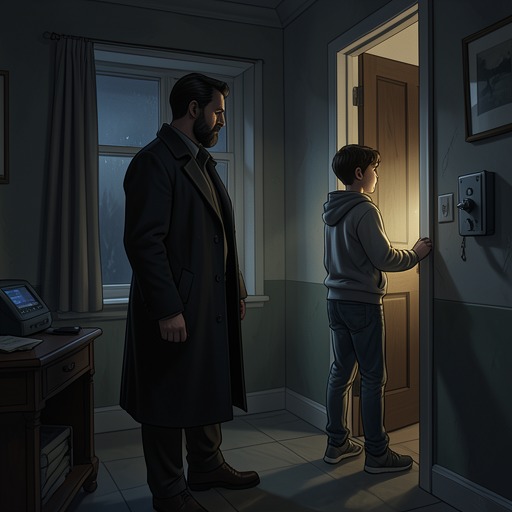
Billy Devore’s Legal Predicament
The AxBilly Devore’s legal predicament turns a single nighttime burglary into a threat to his future: arrested with a school friend, he faces not only the consequences of the break-in but police suspicion that the boys were responsible for three earlier burglaries. His parents’ efforts help keep his case distinct from his friend’s and lead to a sealed indictment rather than a public felony record. The episode leaves Billy frightened and chastened, while his father’s encounter with the police and courts becomes part of a more personal reckoning with institutional power.
Arrest and the burglary
Billy’s parents learn of the arrest at home, where they had believed he was asleep in bed. The burglary took place at a small computer store in the same mall where Marjorie Devore worked. The previous afternoon, Billy and his friend had slipped into the rear of the store and rigged its delivery door so it would appear locked while remaining open. Later, the friend picked Billy up in a car, and they entered through that door.
The boys did not know that the store had already been burglarized three times in the same way. After those break-ins, a silent alarm had been installed to alert the State Police barracks in Raskill. When Billy and his friend entered, four police cars converged: two from the state trooper barracks and two from local police. The boys were leaving with canvas tote bags full of software when officers arrived. They abandoned the bags and ran, but police caught them immediately.
The evidence for this burglary was substantial. The police had the friend’s admission, proof that the entry had been planned and the door deliberately rigged, eyewitnesses who saw the boys carrying stolen goods, and evidence that they had tried to flee. What investigators still wanted was proof connecting them to the three earlier burglaries. That distinction became central to Billy’s defense: an established first offense carried different stakes from a pattern of repeated thefts.
His parents confront the police
At the State Police barracks, a detective questioned Billy’s parents in a small, pale-yellow office with plastic walls and a bare concrete-block wall. Burke Devore fixated on the room’s easily cleaned surfaces and imagined how quickly it could be hosed down. The setting sharpened his awareness of his own developing capacity for violence, a thought he did not want to pursue while trying to concentrate on the detective and reach his son.
Marjorie was calmer and more focused. She asked questions, took notes, and followed the detective’s account while Burke struggled to attend. When he understood that the police hoped to connect Billy to the earlier break-ins, he insisted that this was Billy’s first offense. He argued that the distinction mattered because a judge might give a first-time offender probation, whereas a fourth offense could mean jail. His insistence was not merely a denial of the earlier crimes: he explicitly distinguished what he knew about Billy from what the other boy might say.
The detective urged the family to encourage Billy to confess and suggested that doing so would let everyone return to normal life. Burke interpreted this appeal as bureaucratic convenience rather than concern for the people involved. He concluded that the detective treated the family as paperwork and identified him as an enemy. Marjorie, initially sympathetic to the officer, understood Burke’s objection and withdrew some of her warmth. When she asked whether they could take Billy home, the detective refused for the night, explaining that Billy would appear before a judge in the morning and that their lawyer could request his release into their custody.
Release and legal strategy
Burke came prepared for the next stage with a folder marked HOUSE, Billy’s birth certificate, and his and Marjorie’s passports for identification. The family met Porculey, an elderly lawyer in a maroon pinstripe suit whose slurred telephone manner had led Burke to suspect that he was drunk. Burke instead found a diminished but still capable lawyer, and understood the immediate task as getting Billy out of custody and home with his parents. The hearings and procedures felt to him like an unfamiliar religious service: a ritual whose language he could not follow but whose participants treated it as binding.
After the proceedings, Porculey directed the family to a corridor where they could collect Billy by presenting the necessary paper. A uniformed officer inspected it contemptuously before returning with their son. Billy was quiet and appeared ashamed and afraid during the drive home. Burke warned him that police might soon return with a search warrant because investigators wanted evidence linking him to the other burglaries. The prospect made the unresolved investigation part of the family’s immediate life even after Billy had been released.
By the court proceedings, the principal issue was no longer whether Billy would go to jail, but whether he would receive a felony conviction. Porculey emphasized that Billy had never been in trouble, was a good student, had a bright future, and came from poverty. He proposed a sealed indictment as a possible second chance. Under that arrangement, a judge could keep an indictment unpublished and inactive, usually for a year. If the defendant stayed out of trouble until the term expired, it could be quashed as though it had never existed; another arrest during the term would instead bring the indictment into force alongside the new case.
The court’s decision and aftermath
The court ultimately separated Billy’s case from Jim Bucklin’s. Police had found no illicit software at the Devore home, while the evidence at Bucklin’s home supported treating the boys’ cases separately. Porculey argued that Bucklin should face his own case rather than rely on Billy’s cleaner record; Bucklin’s lawyer and the assistant district attorney both resisted the separation. The judge nevertheless held Bucklin’s case over on its own for trial or a possible later plea bargain, and considered Billy’s case in chambers.
The judge sealed Billy’s indictment. He spoke sternly to Billy about his thoughtlessness, while Billy kept his head bowed and answered briefly and respectfully. By twenty to four that afternoon, Billy’s immediate troubles with the law were over, conditional on his remaining honest. The experience had frightened him; seeing the more serious position of Jim Bucklin made the possible consequences tangible. Billy was grateful to his parents and did not want to disappoint them.
For Burke, the outcome brought relief and a lesson in persistence: the family had endured the process and obtained a result that spared Billy a public felony record, at least so long as he stayed out of trouble. Yet the episode also changed the meaning Burke assigned to legal procedure. He had once assumed the police existed to safeguard his family and community; during the questioning, he came to regard their priorities as self-protective and their reassuring language as a means of closing paperwork. The sealed indictment complicates that new distrust: the system appears both as an impersonal threat and as a source of conditional mercy, which the family secures through preparation, legal advocacy, and the court’s willingness to distinguish Billy from Bucklin.