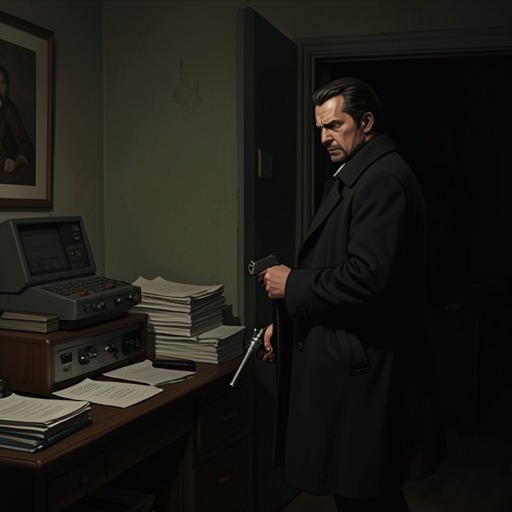
Burke Devore
The AxBurke Devore, an experienced production-line manager left unemployed for nearly two years, responds to corporate downsizing by using a false job advertisement to identify and kill people he regards as stronger candidates. His account makes him both the perpetrator of a murder campaign and its self-appointed analyst: he presents violence as a practical answer to a brutal employment contest, even as moments of terror and attachment to his family reveal how little that explanation can contain.
Identity and Background
Devore gives his age as fifty-one and his address as 62 Pennery Woods Road in Fairbourne, Connecticut. In the résumé he reproduces, he describes himself as unemployed for close to two years through no fault of his own, and says that he had remained continuously employed from his Army service until losing his job. His self-presentation is deliberate: he says he chose simplicity, truth, and clarity rather than disguising his age or boasting about his qualifications, while including his college interests to suggest a rounded character.
His experience is in industrial production, including management of a polymer-paper line. When he later introduces himself to Ralph Fallon, he claims to be the line manager at Halcyon Mills in Belial, Connecticut. The job title is not merely a credential. It identifies the professional world in which he locates his worth, and the work from which prolonged unemployment has separated him.
Devore’s thoughts about killing turn briefly toward his father, a Second World War infantryman who had seen combat during the march across France into Germany in 1944–45. His father had shot at enemy soldiers and, Devore believes, probably killed some; in retrospect, he seemed calm about the experience. Devore wishes he could ask him how a person knows in advance that he can kill. But his father is dead, having died at sixty-three after cigarettes and lung cancer caught up with him. The question therefore remains unanswered as Devore approaches his own first murder.
Unemployment and the Murder Scheme
The job search first appears as a pattern of silence. Devore studies advertisements and sends out résumés, usually receiving no answer and no way to know whether his salary request, wording, or omissions have cost him an opportunity. Against that impersonal rejection, he devises a scheme that makes employers’ competition visible to him: a false advertisement in a trade journal brings him the résumés of other unemployed people in his field.
He says he selects people he fears are better qualified than he is for one particular job and decides to kill them. In his own account, the goal is specific—he wants that job and wants to be employed again—but the method turns professional comparison into a lethal ranking. He describes the scheme as something unemployment made him do, while also acknowledging the planning, files, and expense he has put into it. Before his first killing, he recognizes that all that preparation will have been wasted if he cannot carry it through; he imagines the alternative as retreat into a herd of people moving blindly toward an unknown end.
In a written confession, Devore calls the period of unemployment an experience that has made him do things he would never have thought possible. He admits to four murders and identifies Herbert Everly as the first victim, shot in front of his house on Churchwarden Lane in Fall City, Connecticut, on Thursday, May 8, two weeks before the confession. The stated date, location, and manner of death give a concrete beginning to the campaign he had previously treated as a plan whose feasibility remained uncertain.
Fear, Rationalization, and Change
Devore’s account does not present his transformation as a single settled decision. After waking in the dark with a sudden feeling of terror, he realizes that he is afraid of himself. The immediate trigger is the idea of a boyfriend whose identity he does not yet know. In his sleeping thoughts, he has calmly classified the unknown man as a problem and concluded that he will kill him. What frightens Devore is not simply the possibility of violence but the ease with which murder has entered his reasoning as an ordinary solution.
He insists to himself that he is not a murderer and does not want to become soulless, ruthless, or empty. At the same time, he describes his actions as forced upon him by a chain of logics: those of shareholders, executives, the marketplace, the workforce, the new millennium, and finally his own. He says that he would take an alternative if one were shown to him, yet maintains that he must continue in order to save his life. The contradiction is central to his self-understanding: he claims both that violence is horrible and frightening and that it is necessary, while recognizing that it is becoming a normal way to handle a problem.
Devore’s relationship with Marjorie Devore offers another measure of that change. At a marriage-counseling session, he realizes that the counselor’s account of therapy allows for the possibility that the couple may end their marriage and later understand that as the outcome they wanted. Devore registers the prospect with professional detachment, comparing the session to a job interview. The scheduled weekly meetings and the arrangement to use insurance while coverage lasts place the crisis within their ordinary financial pressures as well as their emotional life.
Family, Distrust, and Responsibility
When police investigate a burglary involving Billy, Devore interrupts the detective’s sympathetic presentation of the evidence to insist that it is Billy’s first offense. The police have evidence of a planned robbery, a rigged door, stolen goods, and an attempted flight; they still want proof connecting the boys to three earlier burglaries. Devore distinguishes his concern for Billy from any claim about the other boy, and argues that Billy should not be blamed for crimes beyond this incident.
He later reflects that, before unemployment, he would have trusted the law or society to treat Billy fairly. That trust, he believes, might have left Billy facing four burglaries and possible jail time. Devore regards his intervention as the right thing to do, and explains that he could see the problem clearly only because he no longer trusts institutions to protect him or his family. His conclusion that no one will take care of them except himself connects his protective conduct as a father to the solitary logic driving his crimes: responsibility becomes inseparable from distrust.
In a conversation with Marjorie, Devore describes himself as having nobody to count on but himself and says this is why he has been distant and focused, fighting for his life. He apologizes for becoming cold toward her. Marjorie answers that he is not alone and that she is there for him. His response turns their painful exchange back toward employment, asking whether she has a job for him. The pivot exposes how completely work has become the measure through which he understands security, intimacy, and his own prospects.
The Job and the Novel’s Moral Argument
Devore’s most systematic defense of his conduct rests on the claim that ends justify means. He surveys changing moral ideals, from honor and grace to reason, emotion, work, and property, and concludes that contemporary society endorses results over methods. He connects his own reasoning to public defenses of corporate downsizing: executives explain the damage caused by layoffs by pointing to the goals they claim to serve. Devore adopts the same structure of justification for himself.
The ends he names are ordinary and socially approved: caring for his family, contributing to society, using his skills, earning his way, and avoiding dependence on taxpayers. Because he regards those ends as good, he tells himself that the difficult means require no apology. The force of the argument lies in the resemblance between his private justification and the corporate logic he condemns. His violence does not stand outside that logic; he recasts it in personal terms and applies it to the contest for a job.
After Ralph Fallon’s death, Devore spends the weekend in a satisfied daze, convinced that the position is open and that a call will come. When Monday passes without one, he begins to imagine that another résumé has won the job or that Arcadia Processing may promote from within. On Tuesday, July 1, a message from John Carver’s office asks him to return a call. Devore tells Marjorie that it is his new job. Carver explains that the company has an unexpected need for a product-line manager with Devore’s history and experience, and mentions a tragic accident and a funeral held the previous day. Employment finally returns to him through a vacancy created by death, making the reward he sought inseparable from the human consequences his reasoning has tried to subordinate.