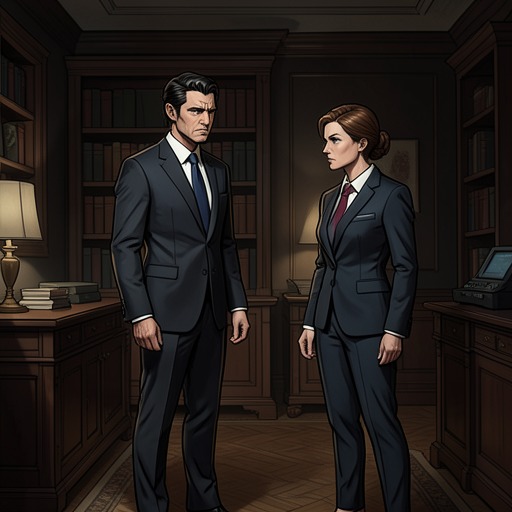
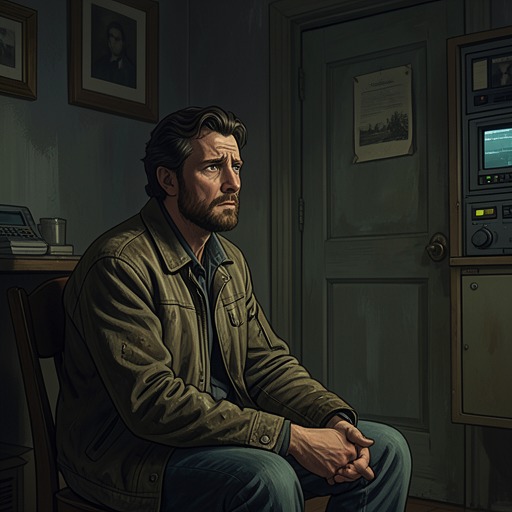
Burke Devore and Ralph Fallon
The AxBurke Devore and Ralph Fallon are competitors for a management position at Arcadia, but their rivalry becomes more than a contest between résumés. Burke studies Fallon as an obstacle to be removed, then discovers a capable colleague whose company he enjoys and whose expertise he intends to preserve. That recognition does not stop the murder: Burke subordinates the person before him to the job he believes he needs, exposing the human cost—and the self-serving logic—of his campaign.
Rivalry and Covert Appraisal
Burke’s interest in Fallon begins with the prospect of employment. He wants the new employer to have someone first-rate against whom to measure him, so that Burke’s own value will be unmistakable. In this calculation, Fallon is at once a rival and a benchmark: Burke recognizes that being compared with a strong manager could help make the case for hiring him. Yet the same competitive logic makes Fallon a target when Burke decides that the position must be opened for him.
Before confronting Fallon, Burke enters his home and spends about half an hour examining his papers and belongings. What he learns complicates his first impression. Fallon has been divorced three times and has five children: three grown children living in California, who write only occasional and impersonal letters, and two younger children who visit in summer and at Christmas. He earns a good living at Arcadia, though less than Burke formerly earned at Halcyon Mills, but is persistently in debt. A folder of collection letters records that strain; he often falls behind on child support, then scrambles to catch up before the younger children visit.
The inspection also reveals Fallon’s seriousness about his work. Burke had taken him for a lightweight after reading an article about him, but finds a file of newspaper and trade-journal clippings about their industry. Fallon has underlined passages and added mostly sensible marginal comments, evidence that he follows developments in the field closely. Burke’s judgment shifts: Fallon is not merely the name attached to a job opening but a knowledgeable manager whose methods may be worth keeping. Even as he plans to replace him, Burke imagines his future employer comparing the two men.
The younger children’s visit gives Burke’s plan a deadline. Their summer stay appears to begin around July 1, about a week away, and he decides he must finish before they arrive. On June 26, after nearly two months of living with his pursuit, he returns to Fallon’s house determined to kill him. The pressure is not only practical: Burke describes the sustained work of planning and carrying out killings as wearing him down, flattening ordinary pleasures. His rivalry with Fallon has become part of a campaign that consumes the life Burke says he is trying to recover.
The Encounter and Its Reversal
On an earlier night, Burke watches Fallon return home drunk in a dark Subaru station wagon. Burke considers several ways to kill him inside the house and make the death look accidental, but leaves after Fallon comes in and the house lights come on. The pause does not amount to abandoning the plan. When Burke returns on Thursday, June 26, he is resolved to act even if Fallon has company.
Fallon catches Burke inside the house and points a revolver at him. Burke answers the danger with a fabricated appeal for help, presenting himself as a production-line manager from Halcyon Mills in Belial, Connecticut. Fallon wonders whether an ex-wife named Edna sent him; Burke remembers her from Fallon’s tax papers but denies knowing her. His chosen story gives the unannounced visitor a reason to be there and redirects the meeting toward their shared profession.
At Fallon’s kitchen table, the conversation turns to equipment and production-line methods. Fallon retrieves rye, brings beer from the refrigerator, and invites Burke to describe his line. The meeting becomes an extended shop talk rather than the brief deception Burke had needed to avoid suspicion. By the time Fallon falls asleep after midnight, Burke is sorry the conversation is over. He regards Fallon as crude in comparison with college-educated managers, but also as bright and deeply knowledgeable. Fallon describes interesting methods he has used at Arcadia, and Burke thinks he will keep them when he takes over.
That practical admiration is accompanied by an attachment Burke calls stupidly sentimental. Fallon was already drunk when he arrived and drinks eight more beers mixed with rye during their conversation. Burke has five beers without whiskey, though he pretends otherwise, and feels the effects of the beer, the hour, and the knowledge that the killing is near. In his wooziness, he imagines alternatives in which Fallon lives: retirement, a job as co-manager, or a new night-management position. He recognizes that none will happen. The pleasant conversation ends, and he returns to the plan that brought him there.
Murder and Justification
Fallon sleeps slumped in his chair at the table. Burke takes duct tape from his windbreaker and binds Fallon’s torso to the chair back, choosing not to move his arms for fear of waking him too soon. He then places tape over Fallon’s mouth and nostrils. Fallon wakes in alarm, struggling to understand why he cannot move, while Burke turns away to search the kitchen drawers. Fallon dies as Burke looks for a candle.
Burke’s reluctance is explicit: he does not want to kill Fallon. But he folds that reluctance into a rule that makes action seem unavoidable, treating unwanted acts as things people must do. The intimacy of the evening does not revise his objective. Instead, Burke carries the conversation’s knowledge into his fantasy of taking over the line, retaining Fallon’s methods while removing Fallon himself. Professional respect and lethal competition coexist without reconciliation.
Afterward, Burke frames his campaign through the principle that the end justifies the means. He names his ends as caring for his family, contributing productively, using his skills, working, paying his own way, and avoiding dependence on taxpayers. Because he considers those goals good, he concludes that he has nothing to feel sorry for. The argument echoes the corporate defenses of downsizing that he has criticized: in both cases, a desired outcome is made to excuse the harm imposed on others. Fallon’s death gives that reasoning a personal and immediate victim.
The Expected Reward
The weekend after Fallon’s death passes in what Burke describes as a contented daze. He assumes that the vacant position will bring a call. But Monday passes without one. By midafternoon, alone at home while Marjorie is at Dr. Carney’s, Burke paces and listens to a phone that does not ring. He begins to imagine that another résumé may have been overlooked or that Arcadia may promote someone from within. The immediate aftermath therefore unsettles the certainty that had sustained his decision: Fallon is dead, but Burke has not received the job or the confirmation he expected. Their relationship ends not in a clean transfer of professional standing, but in the gulf between Burke’s claimed necessities and an outcome still beyond his control.