Burke covers up Billy's burglary
The AxBurke Devore’s cover-up of Billy’s burglary turns a father’s defense of his son into a deliberate effort to mislead investigators and destroy evidence. After Billy and Jim Bucklin are caught in a planned computer-store robbery, Burke presses the claim that Billy has never committed a burglary before, removes the stolen software with Marjorie, and conceals a weapon before the police search their home. His actions protect Billy in the immediate crisis, but they also expose how readily Burke applies to family the same ends-justify-the-means logic that has shaped his own crimes.
The Police Interview
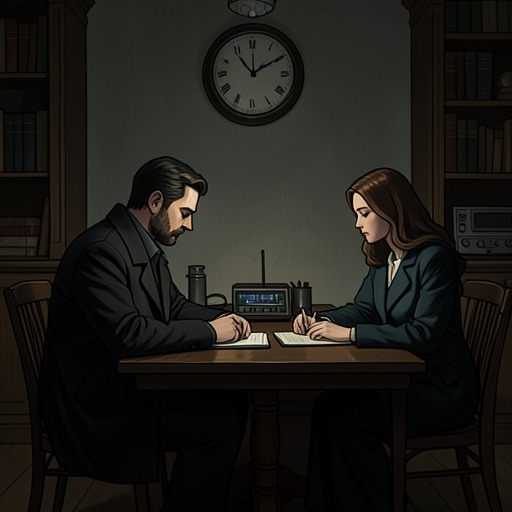
The cover-up begins while the police are explaining what they already know about the burglary. They have an admission from Jim Bucklin, proof that the robbery was planned and that the door had been rigged, police witnesses who saw the boys carrying stolen goods, and evidence of their attempted flight. What investigators still lack is proof that either boy committed three earlier burglaries. Burke listens as the detective presents the matter sympathetically, describing the effort to finish the paperwork and put the case behind them. He sees Marjorie responding in kind, prepared to help the apparently reasonable officer, and intervenes with a firm assertion that this is Billy’s first time.
The detective cautions that the police cannot yet know whether that is true. Burke narrows his claim: he cannot speak for Jim Bucklin, but he insists that Billy has never done this before. He then makes the stakes explicit. In Burke’s view, a first offense may bring probation, whereas a fourth could send Billy to jail; his concern is not simply to deny the burglary, which the evidence makes difficult, but to prevent the police from attaching prior crimes to his son. He asks to speak with Billy, attempting to take control of the account before the other boy’s statements can complicate it.
Coaching Billy’s Account
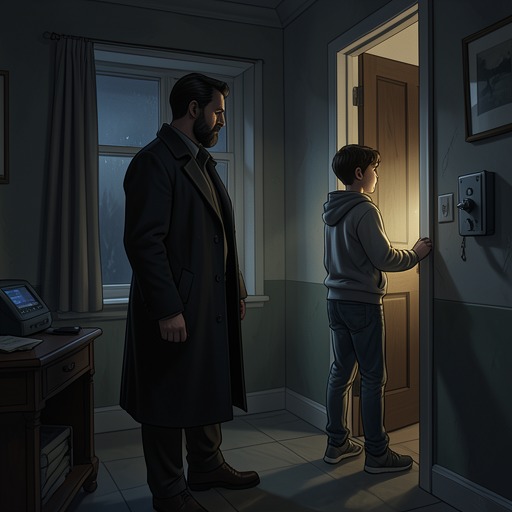
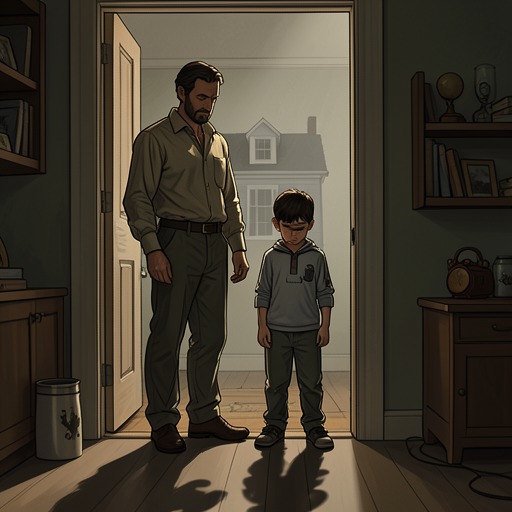
When Burke addresses Billy, the boy appears abashed and defiant, while Marjorie watches, white-faced, unsure what Burke intends. Burke points to his ear and then around the walls to indicate that they are not alone. The gesture changes the exchange: rather than reprimand or console Billy, Burke signals that the conversation may be overheard and that every word must serve a purpose. Billy, who had seemed to expect anger or tears, becomes attentive.
Burke tells him to say that this was the first time he had gone along with anyone to break into the store. He prompts Billy to confirm the claim, then warns him not to change it regardless of what Jim Bucklin says or how much blame the other boy tries to shift. Burke extends the story beyond this one store: Billy is to maintain that he has never broken into any store or any other place. Billy agrees, looking to Burke for direction. Burke’s reassurance is therefore also an instruction in consistency, supplying his son with a version of events designed to limit the case against him.
Removing the Stolen Software
After leaving the car outside because the night’s work is not finished, Burke goes to Billy’s room with Marjorie. The room has been unusually neat, a change Burke had attributed to Billy’s reduced ability to buy things. In the closet, behind clothing, Burke finds a bookcase-like structure with three shelves of software. He estimates that the goods are worth thousands of dollars, enough to risk elevating the charge from petty larceny to grand larceny. The concealed stock turns the burglary from an episode with a limited haul into a more serious exposure for Billy.
Burke tells Marjorie they must get rid of everything before the police return with a search warrant. He makes the cleanup a joint operation: they fetch the plastic shopping bags she has saved, pack the bright-colored software boxes, and carry the bags out through the side door. Six bags fill the backseat of the Voyager. Marjorie chooses to accompany Burke, and he welcomes her company as they drive nearly thirty miles through dark, empty surroundings, meeting only two other cars. Their destination is a larger shopping mall Burke noticed on an earlier drive toward Fall City. He circles the closed complex to check for police or private security vehicles, then chooses the supermarket dumpster because its unpleasant smell and the uncollected refuse make it a place where the bags can disappear among ordinary trash. He throws them in one by one; the software is no longer visible.
Concealment and Consequences
The disposal does not end the cleanup. After returning home, Burke and Marjorie pull the now-empty bookcase out of Billy’s closet because it would look suspicious there. They move it to the garage and pile paint cans and old rags around it to make it appear long stored. While Marjorie is in the bathroom, Burke retrieves his Luger pistol from the bottom drawer of his filing cabinet and hides it inside the Voyager’s backseat. When the police arrive, the weapon is concealed beneath the seat where Billy had been sitting on their drive home. Burke’s concealment extends beyond the stolen property to an object connected to his own criminal history.
Five uniformed local officers come to the house in a police van. Burke waits with Marjorie as they search, convinced that the cleanup has left them nothing to find; he even considers the folder of résumés in his office harmless if the officers inspect it. His confidence rests on concrete alterations made overnight: the software has been discarded, the closet emptied, the bookcase disguised in the garage, and the pistol hidden in the car. The cover-up is not merely a false statement to police but a coordinated rearrangement of the physical evidence and the story the house can tell.
Burke’s protection of Billy sits uneasily beside his wider account of unemployment and violence. Earlier, he had framed killing a rival as self-defense undertaken for his family, and he had identified corporate leaders and stockholders, rather than the competing jobseekers, as the true enemies. After the murders, he recognized that the victims should have been allies against a system that set them against one another. Yet when Billy faces possible punishment, Burke again treats the desired end—keeping his son out of jail—as justification for deception and concealment. His final reflections make the pattern explicit: he understands his actions through a contemporary morality in which the end justifies the means, and applies that reasoning to his own conduct just as he condemns it in corporate executives. The episode thus makes his paternal loyalty real without making the cover-up innocent: his care for Billy becomes the motive and the instrument of further wrongdoing.