Burke deceives Ralph Fallon after being caught in his house
The AxBurke Devore deceives Ralph Fallon after being caught in his house by converting an armed trespass into a supposed job consultation. The encounter exposes the two competing purposes of Burke's visit: he has come to kill Fallon, but he presents himself as a fellow production-line manager seeking professional advice. That lie succeeds not through an elaborate scheme but through small, verifiable details—an unlocked door, an old employee ID, and a convincing account of industrial uncertainty—and it gives the intended victim enough trust to share a meal and shop talk with his would-be killer.
A renewed attempt under pressure
On Thursday, June 26, at nine-thirty at night, Burke returns to the same parking place he used on Tuesday and walks down the dark country road toward Fallon's house. This is not an exploratory visit: he has decided that Fallon must die that night, regardless of who else might be there. Burke's schedule makes the attempt feel urgent. Weekends, Mondays, and Wednesdays are unavailable because of Marjorie's job and the demands of collecting her and getting home; if this opportunity passes, he expects to wait five days before he can try again, by which time Fallon's children might have arrived.
The urgency is also wearing him down. Burke reflects that nearly two months of planning and carrying out deadly acts have drained pleasure from ordinary life: food, music, television, driving, sunlight, and sex have become flat or diminished. He distinguishes this damage from the original blow of downsizing, even while acknowledging that the trouble with sex began with the layoff. The distinction frames his return to Fallon's house as part of a grim, accumulating ordeal rather than as a single isolated decision.
Burke has learned from the earlier visit. He passes the parked vehicles and the enclosed porch, enters by the original front door, moves through the TV room without hitting the sofa, and reaches the dark office. He keeps his windbreaker on because its pockets contain a coil of picture wire, a small roll of duct tape, a short length of heavy iron pipe with one end wrapped in electrical tape, and cotton gloves. Yet he has no fixed plan for using them; he intends to decide what to do after seeing the circumstances. He sits at Fallon's desk and waits, still expecting Fallon to come home.
Caught in the office
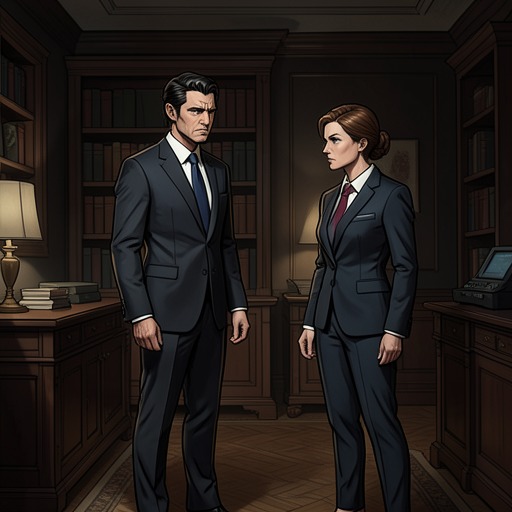
Burke falls asleep. When Fallon returns, he wakes him by switching on the overhead light and shouting at him. Fallon stands in the doorway with the revolver Burke had previously seen in the bedside table, while Burke sits jolted forward in the swivel chair, groggy and momentarily unable to recall Fallon's name. Fallon orders him not to move. The danger is immediate, but Burke notices that Fallon is drunk and weaving as he stands.
Fallon asks how Burke got in. Burke says that he knocked at the large door by the living room and found that it was not locked. He concedes that entering the house was trespassing, whether he broke in or simply walked in, and apologizes for having waited there and fallen asleep. This admission does not explain his real purpose, but it makes the initial account sound less like a threat. Fallon remains bewildered and suspicious, with his revolver still aimed toward Burke, while Burke searches for a plausible reason to be in an empty house at night.
His first account shifts from the unlocked door to a request for help. Burke remembers from Fallon's tax returns that Edna is Fallon's ex-wife, but does not claim to know her when Fallon asks whether she sent him. Instead, he gives his name and describes himself as the production-line manager for the polymer paper line at Halcyon Mills in Belial, Connecticut. The identification is specific enough to begin a professional explanation, but it also places Burke within an industry Fallon knows.
The employment story
Burke builds the deception around the real pressures of corporate change. He tells Fallon that Halcyon Mills has been merged and that the company may move the entire line to Canada. He portrays himself as competent at running the line but poor at describing his work, and says that an interview is coming in the summer in which the future of the line and his own position will be decided. He claims he came to learn from Fallon because an article in Pulp showed that Fallon could explain his work effectively.
The account exploits both the truth Fallon can recognize and the falsehood Burke conceals. Halcyon's merger and the threat of relocation supply a credible reason for anxiety; Burke's claimed admiration and need for instruction supply a reason to make an unannounced visit. He even flatters Fallon by telling him that the article made him look good at his job, although Burke knows he is lying. Fallon responds with anger at the owners and then, after considering the request, agrees to see what Burke means.
The movement through the house helps Burke sustain the story. At Fallon's direction, he goes first, leading them through rooms now lit throughout the house to the door beyond the TV room. He uses the door as evidence that his account of entering is possible. Fallon tests it himself: he slams it, opens and slams it again, and examines the lock, whose small handle will not move because it has been painted stuck. The defect confirms the narrow claim Burke made—that the door was not effectively secured—without revealing why he came through it.
Trust through ordinary details
Even after the door explanation, Fallon asks to see Burke's wallet. Burke hands it over and takes a seat on the sofa while Fallon puts the revolver on the television and peers through the cards and papers. Among them is Burke's old Halcyon employee ID, which he had never discarded. When Fallon finds it, his suspicion gives way to a friendlier manner, and he apologizes. The forgotten card is a material credential Burke did not need to invent: it lends the fabricated employment story the proof of an ordinary life.
Fallon returns the wallet, offers Burke a beer, and asks if he wants something added to it. He introduces himself as Ralph, and Burke confirms his own name. Burke watches Fallon put the revolver away in the bedside table drawer. Fallon then offers to try to help, complaining that owners often show little loyalty. Their shared vocabulary of industrial work and resentment gives the encounter a social footing that the false job consultation alone could not guarantee.
Shop talk and the renewed decision
At the kitchen table, Fallon begins asking about Burke's line and its extruder, then fetches rye and two more beers from the refrigerator. Their talk develops into a substantive exchange about the work Fallon does at Arcadia. Burke says he is sorry when Fallon eventually falls asleep, because, despite the danger and the lateness, he has enjoyed the conversation. He regards Fallon as bright and knowledgeable, if cruder than the college-educated people he usually knows, and notes that Fallon has described methods on the line that Burke intends to keep when he takes over.
The conviviality has a measurable edge: Fallon was already drunk on arriving home and drinks eight more beers laced with rye, while Burke has five beers and pretends to drink whiskey without keeping pace. Burke feels the alcohol, the late hour, and his awareness that he is nearing the end of his series of trials. He also recognizes a sentimental attachment to Fallon, and briefly imagines alternatives in which Fallon lives while Burke still gets what he wants: retirement, a job as co-manager, or a night-manager opening if Arcadia adds a second shift. None of these possibilities materializes; they are wishes prompted by the conversation, not changes to the plan.
When the pleasant exchange ends, Burke stands and reaches for his windbreaker. He removes the duct tape from its right pocket and looks at Fallon, slumped across the table with his chin on his chest. Burke does not want to continue, but tells himself that people sometimes do what they do not want to do. The deception has therefore accomplished two things at once: it has disarmed Fallon's suspicion and allowed genuine professional rapport to form, while bringing Burke back to the act he came to commit. The scene ends at that threshold, with Fallon asleep and Burke holding the tape; the subsequent killing is not part of this episode.