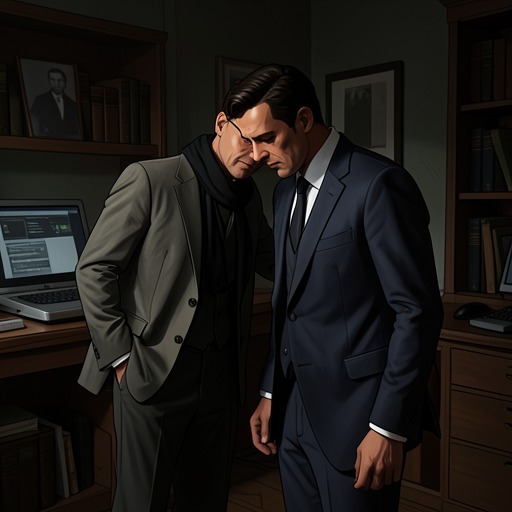
Burke infiltrates Upton Fallon's home
The AxBurke Devore’s infiltration of Upton “Ralph” Fallon’s farmhouse is a deliberate reconnaissance mission, not a chance visit: as Burke begins commuting toward a prospective job in Arcadia, he finds Fallon’s address, enters the house without permission, and studies its layout and signs of its occupant’s life. The episode converts a professional rivalry into a physical trespass, with the quiet, methodical inspection revealing both Burke’s planning and the assumptions he makes about the stranger he is watching.
Purpose and Approach
The visit follows a morning in which Burke and Marjorie have returned their attention to their marriage during counseling with Longus Quinlan. Their relationship seems to be improving, but Burke considers his other business impossible to disclose to Marjorie. That evening, after dinner, he drives west toward Arcadia, recognizing that he is beginning a new commute. The ordinary rhythm of the journey runs alongside the concealed purpose of his trip.
Burke has seen Fallon once before in a luncheonette. He now treats finding Fallon’s residence as the first practical step in learning about the man. Burke is uncertain whether Arcadia’s apparent success will translate into hiring: perhaps the company is reducing staff through attrition and will not replace Fallon. He reasons himself back toward confidence, concluding that the single-shift production line will need an experienced operator and that the company will hire. The speculation gives the reconnaissance its employment stakes, even as it exposes how much of his plan depends on an outcome he cannot yet verify.
Locating the Farmhouse
Burke’s car has less than half a tank, so he stops at a Getty station, refuels, and asks for a telephone book. The attendant silently produces a thin, worn directory from beneath the counter. Burke finds Fallon listed at a county route address in Slate. This small, practical discovery moves his search from conjecture to a specific rural road.
The road is winding and hilly, with only occasional house lights visible. Burke considers returning in daylight, perhaps on a weekend when Marjorie is working at the New Variety or when the couple would ordinarily be at home with the newspaper. He also thinks a new acquaintance, Upton Fallon, might prove useful in getting there. Then the name Fallon appears on a roadside sign shaped like a log cabin, with a red metal band above the roof. Burke brakes, backs up, and confirms the name before noticing the dark driveway and a dim light farther back.
Rather than stop immediately at the house, Burke drives on and leaves his Voyager beside a cattle gate leading into a field. He walks back along the road and enters the blacktop driveway on foot. With no traffic or other people in sight, he sees the house through trees under a star-filled sky. The setting gives the approach an exposed stillness: Burke is alone, but the darkness does not remove the possibility that someone may notice him.
Entering the House
The farmhouse appears to have been built centuries earlier, when the surrounding land was cleared for farming. Additions have widened it over time, making the driveway-facing side seem more like the back of the house than its original front. Two vehicles stand outside: a large pickup and an old, wide car that appears not to have moved for years. These details help Burke read the property, but do not tell him conclusively who is inside.
He first tests the enclosed porch entrance. Its door is locked but loose in its frame, and the house gives no response. Burke decides against forcing it, preferring not to damage anything or alert Fallon that something has happened. Around the corner, he finds the original Colonial entrance, partly obscured in importance by the house’s later additions. Leaves remain piled on its stone landing. The door is not locked so much as stuck; Burke braces himself and applies steady pressure until it gives with a ripping sound and opens.
Inside, he closes the door behind him and moves through dark, cool, damp rooms toward a faint light. He avoids disturbing the furniture, though his knee catches a sofa arm. At the end of a corridor, he discovers that the light comes from a bedroom: a lamp glows beside a double bed, and a dresser, a chair heaped with clothes, and scattered shoes furnish the room. From these signs Burke begins to think Fallon lives alone. The impression is immediately complicated by a second bedroom, clearly set up for two children, with bunk beds, low dressers, posters, and toys.
Surveying the Rooms
Burke crosses to the kitchen and positions himself where he can watch the road through the enclosed porch. He intends to see Fallon’s headlights when he returns and to judge whether he is coming home alone or with family. The refrigerator contains milk, cold cuts, soft drinks, and beer, with little else; to Burke, it looks unlike a family refrigerator. His reading of the house proceeds by fragments, and the fragments do not settle into a single clear account of its occupant.
To continue exploring, he opens and closes kitchen drawers until he finds a flashlight, relying on his expectation that a country kitchen will have one because electricity there goes out fairly often. Its beam lets him examine the rest of the house without turning on more lights. Several rooms are empty or sparsely furnished. Burke concludes that Fallon inhabits only four of the house’s ten rooms, all on the first floor: the bedroom and its attached bathroom, the kitchen, a sitting room with a sofa, television, tables, a floor lamp, and telephone, and a former guest room now used as an office.
The office contains Fallon’s tax records, work records, and other papers of everyday life. Burke spends time there with the flashlight, looking for information he has not gathered through a résumé or a public-records check. The office windows face both driveway and road, so he can keep watch for Fallon’s return while examining the materials. The scene ends with Burke still inside the house, waiting and investigating; it does not yet establish what he learns from the papers or what happens when Fallon comes home.
Significance of the Reconnaissance
The episode’s tension comes from the gap between Burke’s controlled procedure and the incomplete picture he can construct. He selects a stopping place, approaches on foot, tests one entrance, finds another, and limits the light he uses. Yet the house resists easy interpretation: the solitary-looking bedroom coexists with a children’s room, and the sparse refrigerator complicates the evidence of family life. Burke converts those details into tentative judgments rather than confirmed knowledge.
The farmhouse also makes the rivalry tangible. Fallon has been a name associated with the job Burke hopes to obtain; now the name marks a particular road, a particular entrance, and a private home whose rooms Burke has crossed without invitation. His new commute is therefore already entangled with covert observation. By ending during the search, before any confrontation or resolution, the episode leaves Burke’s intrusion suspended as preparation: the reader has seen how far he will go to reduce uncertainty, but not yet what the information will enable him to do.