Devore family home
The AxThe Devore family home is the setting where the Devore family’s private crises become material and dangerous. Billy’s closet holds valuable stolen computer merchandise; the house becomes the place where Burke Devore and Marjorie conceal it before police arrive; and, later, the garage serves Burke as a place to hide the tools and body connected to his crimes. Its ordinary rooms and routines do not shield the family from the outside world. Instead, they give Burke familiar spaces in which to manage what he wants others not to see.
Identity and Layout
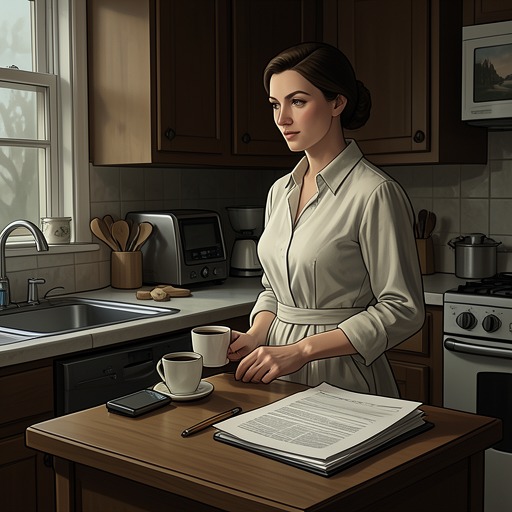
The home is shared by Burke Devore, Marjorie, and their son Billy. The rooms that matter in these episodes are specific and functional: Billy’s bedroom and closet, the kitchen, the living room, Burke’s office, the garage, and the stair landing. The narrative supplies no broad architectural portrait. It makes the home legible instead through movement between these spaces, and through the changing uses to which Burke puts them.
The garage is a particularly important threshold. Burke leaves the Voyager outside when he returns, because he is not finished with the night’s work. Later, when he brings a body home, he chooses the garage as a place where he can prepare it without stopping in an unfamiliar location. He reasons that a seemingly deserted place can cease to be safe if people appear, lights come on, or police pass by; at home, he can work behind a closed garage door while his family is in bed. The garage’s usefulness comes from its position within the household and from the privacy Burke believes that familiarity affords him.
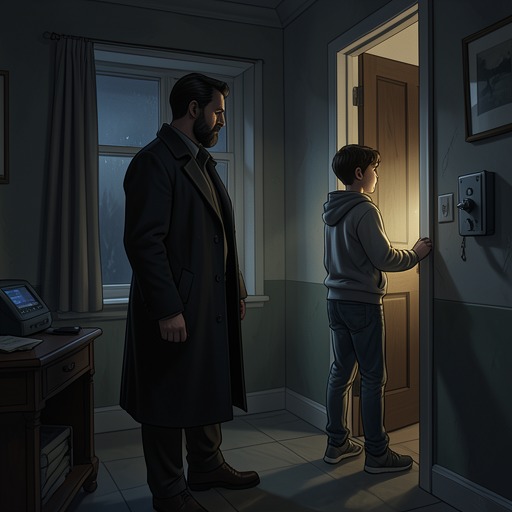
That privacy is not absolute. At another point, the home’s lights reveal that the family is inside: a table lamp burns in the living room, a reading light is on in Billy’s bedroom, and a light shines at the head of the stairs. Burke reads these small signs as evidence that Marjorie has gone to bed and that Billy remains in his room. For him, the house is not simply shelter but a space whose occupants’ locations and waking hours must be taken into account.
Billy’s Room and the Stolen Merchandise
Billy’s bedroom initially appears to have become neater. Burke has assumed that the change reflects Billy’s inability to afford new possessions. When Marjorie follows him into the room, however, Burke opens the closet and pushes clothing aside to expose a shelving unit Billy has built. It contains three shelves of computer software, worth thousands of dollars—enough, Burke judges, to raise Billy’s charge from petty larceny to grand larceny.
The discovery revises Burke’s interpretation of the tidier room. Its order has concealed an expanding stock of stolen goods, while the closet has become storage for merchandise that Billy’s parents fear the police will find. Marjorie’s distress is immediate. Burke responds by turning the household’s accumulated plastic shopping bags into a means of removing the evidence: the couple fill them with the brightly colored software boxes and carry them through the house to the side door. They are not sleepy, and the task continues into the night.
Burke’s thoughts make the room more than a hiding place. He believes Billy ought to have access to the technology and experience needed to keep pace with a changing world, and faults himself for not providing it. At the same time, he distinguishes helping his son escape the consequences from approving or encouraging the theft. That distinction does not stop him from intervening: six shopping bags fill the backseat of the Voyager, and Marjorie insists on accompanying him on the drive to a larger, distant mall. The family home thus contains both the evidence of Billy’s crime and the parental response that carries it out of sight.
Concealment and the Police Search
The trip does not end the cleanup inside the house. After returning from the mall, Burke and Marjorie pull the now-empty shelving unit from Billy’s closet because, left there, it would look suggestive. They move it into the garage and bury its appearance among paint cans and old rags, making it seem like long-standing garage clutter. The closet is therefore cleared not only of the merchandise but of the structure that had held it; the garage absorbs the displaced object by making it appear ordinary.
Burke also uses the home to conceal evidence of his own. While Marjorie is in the bathroom before returning to bed, he takes the Luger pistol from the bottom drawer of his filing cabinet and hides it inside the rear seat of the Voyager. The act links the private office, the family car, and the larger effort to control what a search might uncover. The house is not merely where the family’s trouble begins: Burke uses its compartments and moments of domestic privacy to prepare for scrutiny.
The next time the family returns, a police van is parked outside. Five uniformed local policemen get out. Burke and Billy enter a house that Burke believes has been cleared of the incriminating merchandise and altered to look unremarkable. As the police search, the family waits in the living room. Burke thinks they can examine the folder of résumés in his office without learning anything from it. The rooms that had offered him opportunities for concealment are now subject to official inspection, and his confidence depends on the cleanup having succeeded.
The Garage as Refuge and Exposure
The home’s role changes again when Burke returns late with a body in the Voyager. The family is inside: Marjorie has gone to bed, while Billy is awake in his room but will not come out. Burke opens the garage door with the visor remote, drives in, and waits for the door to close before getting out. The automatic light is set to switch off three minutes after the door closes, so he turns on the main garage light before beginning his work.
He has brought large dark-green lawn-and-leaf bags and white cotton gloves from the mall. In the garage he opens the Voyager’s sliding side door, removes a green blanket covering the body, and begins packing away the blanket and tools, including the hammer and Mace. He puts on his own work gloves when moving the two full bags into a garage corner, where surrounding clutter makes them less conspicuous. Before leaving the space, he looks around and decides that everything seems normal; he turns out the light and goes to bed.
That judgment gives the home a double significance. Its familiar clutter and enclosed garage help Burke disguise what he has done, but the same domestic setting is continually threatened by other people’s presence: Marjorie may still be awake, Billy is nearby, and police have already searched the house once. The house’s ordinary details—closet shelves, saved bags, paint cans, lights, a filing-cabinet drawer—become part of a system of concealment. In the family’s story, the home is at once the place Burke wants to protect and the place where his attempts to protect it expose how deeply crime has entered their lives.