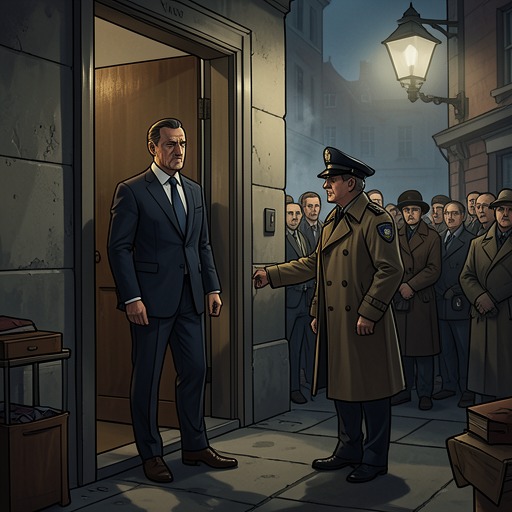
Hauck Curtis Exman
The AxHauck Curtis Exman is a long-serving paper-industry manager, a former Marine, and the last résumé competitor Burke Devore sets out to eliminate. He appears chiefly through the particulars of a résumé and through Burke’s surveillance: a worker displaced after decades of service, still looking for employment and still willing to answer an apparent opportunity. That search makes him vulnerable to Burke’s fabricated invitation, which promises an interview and instead leads toward a carefully planned murder.
Identity and Employment
Exman’s résumé lists him as manager of polymer paper applications at Oak Crest Paper Mills from 1987 to the present. The dates place him in a specialized, established career rather than at the beginning of a working life. Burke reads the résumé as evidence of a loyal employee: Exman had gone directly from the Marines to Oak Crest and stayed until the company dismissed him. Burke estimates that he may have been only a year and a half short of a pension, but that is the narrator’s conjecture, not a confirmed detail of Exman’s employment terms.
The brief career record also gives the dates 1981–1987 for an earlier position, though the available account does not identify that job. What is clear is the contrast between Exman’s long service and his need to seek another position. In Burke’s view, Exman’s loyalty to his employer outlasted the security the employer offered him. His résumé therefore serves both as a practical record Burke studies and as a stark example of work abruptly severed from a worker’s sense of continuity.
Home and Personal Details
The résumé identifies Exman’s address as 27 River Road in Sable Jetty, New York. The house stands on the uphill side of River Road: a large brick structure with a curved porch, thick pillars, a sloping lawn, and a white picket fence. The property has been crowded by smaller neighboring houses, and its former plantings have given way to a narrow strip of lawn. These details locate Exman within a once more spacious residential setting, but the account does not establish his feelings about the house or his history there.
Burke notices a red-haired woman mowing the lawn when he drives past on a Monday morning. The scene does not identify her as Exman’s wife, so her relationship to him remains unstated. A résumé entry refers to “self and current wife”; Burke seizes on the word current and speculates about how many marriages Exman may have had. That inference belongs to Burke’s suspicious, contemptuous reading of the document. The résumé confirms a current wife, but it does not confirm the marital history Burke imagines.
The False Opportunity
Burke uses Exman’s job-seeking history to construct a trap. A letter dated to an earlier response to a help-wanted advertisement says that the company’s initial choice for the position had been mistaken and asks whether Exman is available to meet a personnel director, Ms. Laurie Kilpatrick, on Friday, June 20. The invitation offers the possibility that a previous rejection has been reversed. Its premise is false: Burke is using a promise of work to make Exman’s movements predictable and bring him within reach.
On Tuesday, June 17, Burke sits in the Voyager in front of the Wildbury post office with Exman’s returned letter in his hands. Exman has sent it back immediately, and Burke reads the speed of the response as proof that he wants the job badly. He had worried that Exman might keep the body of the letter and return only its detachable response section, potentially preserving evidence for the police. Instead, Exman’s prompt reply seems to Burke to show that he has accepted the bait. The episode exposes the imbalance between them: Exman believes he is pursuing employment, while Burke interprets each ordinary act of application as a step in his plan.
Encounter and Death
Burke selects the Coach House in Regnery as the intended setting for the supposed interview. He values its prominent location, convenient parking, and large street-facing windows, which allow him to observe people arriving without attracting notice. On Friday, five minutes before one o’clock, he waits nearby, expecting Exman to meet Ms. Kilpatrick. The planned appointment gives Burke a timetable and a place from which to monitor his target.
The encounter that brings Exman into view, however, occurs at Dolmen’s. Burke finds him in the menswear department and initially does not recognize why Exman approaches him. Exman is wearing an oval blue-and-white name tag identifying him as “Mr. Exman”: he works there as a suit salesman. His well-kept suit, which Burke had taken as a personal detail, is explained by the job. Exman greets Burke with the bright, solicitous manner expected of a salesperson, a manner Burke considers false to Exman’s nature. The moment gives Exman a second, precarious employment identity: he is not only the experienced paper manager seeking a position but also a salesman working in the store where Burke encounters him.
Burke later attacks Exman beside a car. Exman turns toward him and reaches for a flashlight when Burke sprays Mace into his face, then strikes him twice on the temple with a hammer. Burke catches the falling man, carries him to the vehicle, and loads him onto a plastic-covered seat. The assault is swift and concealed from nearby observers; Exman’s attempt to help with the apparent car trouble has become the opening Burke needs. The account presents him as killed, not merely injured: Burke subsequently transports his remains in plastic bags to the recycling center, where garbage is compacted and sent to a landfill operation near Long Island Sound. Burke calls this disposal a sea voyage and notes Exman’s Marine service, converting a fact about Exman’s past into a bitterly ironic final image.
Narrative Role and Significance
Exman is one of the people Burke reduces to a résumé, a job history, and an obstacle between himself and employment. The role is especially pointed because Exman’s record resembles the kind of professional history Burke scrutinizes: years of service, a specialized managerial position, and the forced search for another job. Yet Exman is not developed through an independent account of his thoughts. His circumstances reach the reader through Burke, whose observations combine concrete details with resentment, speculation, and calculated deception.
That limited perspective matters. The letter’s apparent generosity, Exman’s quick response, and his courteous behavior at Dolmen’s can all be read as ordinary attempts to secure work; Burke instead treats them as useful openings. Exman’s death is thus not the outcome of a personal quarrel described between the two men. It is the consequence of Burke’s campaign against employment competitors, and of a scheme that turns the promise of a job into a weapon. The résumé that records Exman’s professional life becomes the instrument by which Burke identifies him, studies him, and finally lures him to his death.