Herbert Coleman Everly
The AxHerbert Coleman Everly is a 49-year-old unemployed paper-products manager whose résumé turns him into a target for Burke Devore. Seen only through Burke’s preparations, observations, and confession, Everly is both a particular man at his mailbox and a competitor reduced to the qualifications on a page. His killing begins Burke’s campaign to clear away people he fears may be better suited to a job he wants.
Identity and Introduction
Herbert Coleman Everly lives at 835 Churchwarden Lane in Fall City. Burke knows him as a middle-aged job seeker with a substantial background in the production and sales of specialized polymer paper products. His résumé presents an intense professional history and enough managerial experience, in Burke’s judgment, to make him plausible for an interview at a paper manufacturer. Burke rates it as middling rather than exceptional, but considers it good enough to get Everly through the door—and that possibility is enough to make him dangerous in Burke’s eyes.
Burke’s first physical impression complicates the résumé’s efficient professional image. At the mailbox marked 835, Everly looks older than his 49 years. Burke notices a receding, thinning black hairstyle gone gray at the sides, a pale complexion, a pepper-and-salt mustache, and dark-rimmed glasses that seem too large for his face. Everly wears a blue-and-white striped office shirt beneath an open gray cardigan, along with baggy, grass-stained khakis. His hands are unexpectedly thick and big-knuckled. Burke speculates that he may help his wife with the garden now that he has so much free time, but this is the killer’s conjecture, not confirmed biography. For a moment, the mismatch between the man before him and the résumé in his possession makes Burke wonder whether he has found the wrong person.
Résumé and Unemployment
Everly’s résumé reflects the job-search advice circulating among the newly unemployed. Such specialists teach applicants how to present themselves in an increasingly competitive market, and Everly appears to have followed that guidance. He includes no photograph and suppresses details that might disclose his age: instead of listing employment years, he offers only the clues of “23 years” and a college graduation in 1969. He also leaves out marital status, children, and outside interests, keeping the document focused on professional matters. The omissions suggest deliberate presentation, not a full account of his private life.
Burke understands the résumé as an effective piece of self-marketing. It does not strike him as the strongest he has seen, yet it advertises precisely the sort of manager-level expertise that might interest a paper manufacturer. In Burke’s reading, Everly’s experience is not merely evidence of past work; it is a claim on the same scarce future he wants for himself. That judgment reveals more about Burke’s murderous calculation than about any personal failing in Everly: the résumé need only make its owner a credible competitor to become a sentence of death.
Murder at Churchwarden Lane
Burke approaches Everly at his home after taking elaborate precautions to avoid being seen on the expected route of his trip. Everly has collected the day’s letters, bills, catalogues, and magazines from his mailbox when Burke draws alongside him and calls to him through the open car window. The ordinary errand leaves Everly holding a handful of mail as Burke initiates the encounter.
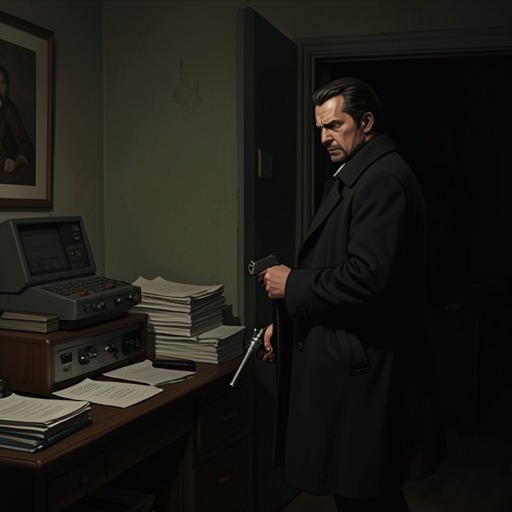
Burke raises a Luger pistol from beneath his raincoat and fires through the window. The bullet shatters the left lens of Everly’s glasses and kills him; he falls backward, and the mail drifts away in the breeze. Burke drives on, trembling, and only afterward registers the immediate implication of what he has done: he is capable of killing. In his later confession, he identifies Everly as his first victim, murdered on Thursday, May 8, in front of his house on Churchwarden Lane. The shooting is direct and sudden, while Burke’s preparations have been prolonged and meticulous.
Narrative and Thematic Significance
Everly has no narrated voice or independent account of his circumstances. Readers encounter him through Burke’s selection of résumé details and his scrutinizing gaze, which turns a person into a bundle of possible interview credentials, physical clues, and risks. That narrow perspective matters: Everly’s age, experience, and unemployment are known only insofar as they enter the killer’s calculation, while his private character remains largely unavailable.
His death gives concrete form to the zero-sum logic of Burke’s job hunt. Burke has endured lengthy unemployment and resents the structures that have made middle-management work scarce, yet he redirects that desperation against individual applicants whose résumés might win an interview. Everly is the first person to die because Burke treats professional competition as a threat that can be removed by force. His résumé, designed to improve his chances of employment, becomes the document that helps Burke identify him.