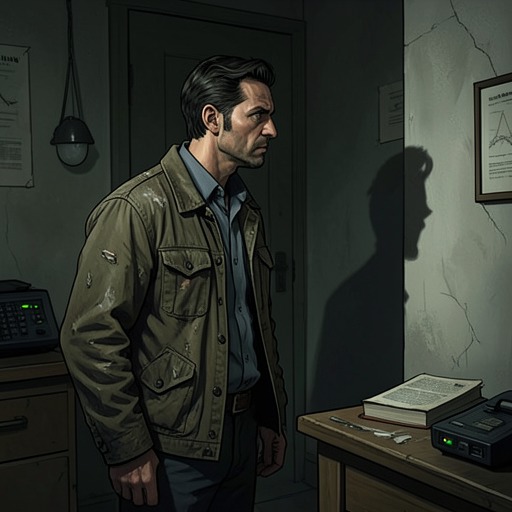
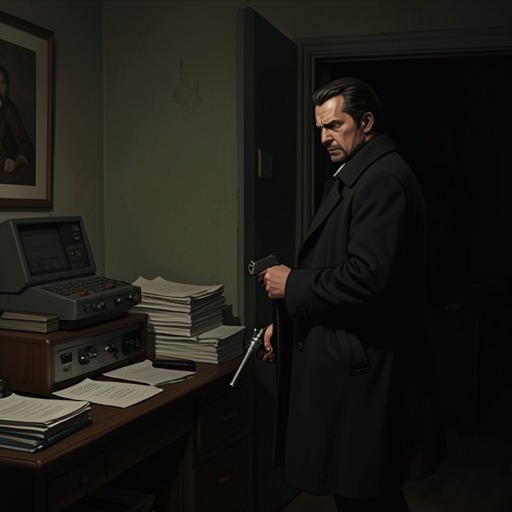
Kane Bagley Asche
The AxKane Bagley Asche enters the story as a name on a résumé and a man seen at work in his garden, but those fragments establish the stakes of Burke Devore’s campaign against competing job seekers. His long industry record, advanced education, and current pursuit of a doctorate make him a credible rival; Burke’s reconnaissance turns that professional qualification into a sentence of death.
Identity and Introduction
Asche is introduced through the résumé Burke carries on a reconnaissance drive to Dyer’s Eddy, a small Connecticut town less than thirty miles away. The document identifies its subject as Kane B. Asche and gives his address as 11 Footbridge Road. Burke has decided to start with the nearest target, making the trip to learn what he is dealing with and how he might proceed. At this point, Asche is therefore known to the reader through the same carefully collected information that Burke uses to assess and locate him.
The résumé describes Asche as not yet fifty, eager to share his experience, and seeking a long-term commitment from a reliable employer. Burke’s response to that age claim is chilling: he thinks Asche will remain under fifty forever. The document’s optimistic language about experience and future work is thus set against the violence Burke has already decided to contemplate.
Career and Qualifications
Asche’s résumé presents a substantial career in paper manufacturing. Most recently, from 1991 onward, he has worked as a product manager at Green Valley Paper & Pulp, where he introduced a new line of industrial polymer-paper applications. Before that, from 1984 to 1991, he served as an assistant plant supervisor, handling regulatory paperwork for federal and state agencies and overseeing the second shift in the home-products line. The record makes him more than a manager with a title: it emphasizes product development, compliance, and plant operations.
The résumé also lists a distinctive earlier responsibility. In 1984, Asche oversaw the dissolution of Champion Pulpwood after its bankruptcy, dismantling machinery, negotiating with purchasers, and keeping records of the machinery, money, and materials dispersed. His experience includes not only running production but managing the orderly dismantling of a failed business. In a story shaped by layoffs and industrial contraction, that detail gives his résumé an especially pointed breadth: he has worked both within an operating company and through the aftermath of collapse.
His education further strengthens the profile. After earning a high-school diploma in 1962, Asche received a bachelor’s degree in business administration through extension study while serving as an enlisted man in the Army, including two tours between 1963 and 1971. He completed a master’s degree at Connecticut Tech in 1985 and is pursuing a doctorate part-time. Burke’s inspection of these credentials ends not in admiration alone but in a bleak assessment of how difficult Asche would be to outcompete: if jobs existed in their shared industry, Burke believes, Asche would get one before him.
The Reconnaissance
Burke finds Asche’s address on a road atlas and drives from Fairbourne to Dyer’s Eddy by back roads. On reaching the neighborhood, he checks the résumé for the house number, leaves his cap on the car seat, opens his windbreaker, and walks uphill. Number eleven stands back from the road; its blacktop driveway is edged with railroad ties, and the mailbox is built into the wooden post at the entrance. These practical details turn the address from a line of print into a specific place Burke can find again.
From farther up the slope, Burke sees a husband and wife gardening. The property has several gardens, including a fenced vegetable plot with different kinds of lettuce growing in small green clumps. The scene gives Asche an ordinary domestic presence, though the reader learns nothing further about his wife or their life together. Burke decides that he will not act while she is there. He also judges that speaking to Asche would be a mistake: after meeting Everett Dynes and getting to know and like him, Burke does not want another personal connection to make his plan harder to carry out.
Instead, Burke watches from a distance and memorizes the license number of a black Honda Accord in the driveway. His reconnaissance is deliberate and limited: he learns what Asche looks like, notes the house and its occupants, and leaves without approaching him. The restraint is not mercy. It is part of Burke’s effort to make the planned violence simple and to avoid allowing familiarity to disrupt it.
Significance and Fate
Asche’s characterization is built around a contrast between professional evidence and Burke’s private interpretation. The résumé presents a capable, experienced applicant with a lengthy record and continued ambition. Burke recognizes that strength accurately, but processes it through a job market he experiences as a contest with too few positions. His own account of middle management’s disappearance under computerization and corporate restructuring gives that contest a wider context: workers like him have become unnecessary even as companies prosper. Asche is not shown causing Burke’s unemployment; he becomes a target because Burke sees another qualified person standing between himself and scarce work.
The narrative gives Asche little opportunity to speak or act beyond the life glimpsed in the garden. That limited point of view is consequential: readers encounter him first as a résumé, then as a house, a garden, and a vehicle observed by a man who refuses to make contact. Burke’s decision not to know him preserves the anonymity on which his scheme depends. The story identifies Burke as Asche’s killer, making the promise of a long-term professional future on the résumé bitterly ironic. Asche’s qualifications are presented in detail, while his voice and fate are largely withheld; the imbalance exposes how completely Burke’s competitive logic reduces another person to a rival.