Lichgate
The AxLichgate is a north-central New York town built around a river and a vanished factory, its solid old streets preserving the appearance of prosperity after the work that sustained it has gone. For Burke Devore, it is also a distant, carefully mapped destination: he chooses it as the next place to pursue a résumé rival, then finds the town’s ordinary streets and residents pressing against the abstraction of his plan.
Regional setting and industrial past
Lichgate lies north of Utica, roughly 300 miles from Burke Devore’s starting point and about 250 miles from Arcadia. The distance makes commuting impossible but, in his calculation, leaves relocation within New York manageable. Choosing another state separates this intended attack from the first two incidents, although he recognizes that he cannot keep changing states indefinitely. The trip itself is part of his plan: he expects to drive for five or six hours, stay overnight, and see what happens.
The town stands on the Black River. Its former prosperity and factory have long since departed, leaving an imposing brick factory building to molder beside the water. Parts of its ground floor remain in use as antique, coffee, and card shops, alongside a county museum. Burke sees the conversion as a diminished imitation of employment: people making believe they are at work in a place where the original work has disappeared. The surviving businesses occupy a fragment of the industrial structure rather than restoring the industry that gave the town its shape.
Arrival and the work of mapping
Burke reaches Lichgate after one o’clock. His road atlas supplies no town map, so he first eats lunch at the Red Brick Cafe, tucked into a corner of the old factory, and then buys a local map from the card shop down the block. This practical sequence—meal, map, route—shows how he turns an unfamiliar town into a landscape to be surveyed.
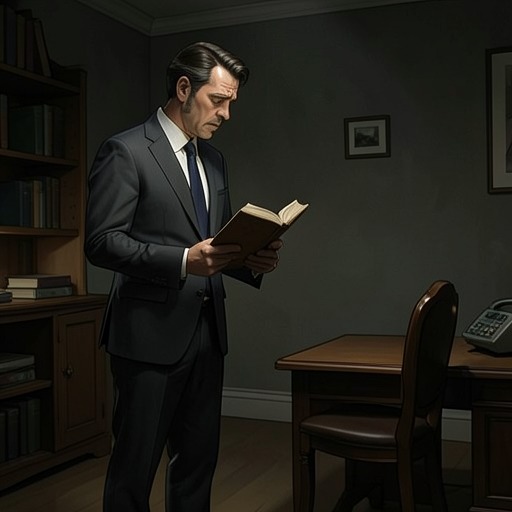
He avoids asking anyone for directions to Nether Street. A stranger asking for that street shortly before a murder there might be remembered, he reasons, and could later become the subject of an eyewitness-based artist’s depiction on television. His concern is not simply finding the target’s address; it is controlling what witnesses might recall. The map lets him proceed without making a conspicuous inquiry.
The map also corrects his assumption about the street’s name. He expects Nether Street to follow the river, as though it occupied the town’s lowest ground. Instead, it runs east from the southern city line toward the river. The town slopes downhill to the south, and the street takes its name from its position at the hill’s base. Lichgate’s geography is therefore not a backdrop he can rely on having guessed correctly: he must read the map and then verify it on the ground.
Houses and the town’s former order
The area around Nether Street is neither suburban nor rural but an established residential neighborhood. Its substantial houses are mostly about a century old: wide, two stories high, set on small plots, and built largely of native stone. Generous porches and steep A-shaped roofs suit the severe snow of the local winters. These are not new houses assembled for a changing town; they belong to the period when the factory was still producing goods.
Burke imagines the original residents as factory managers, shop owners, and dentists, people with comfortable, stable lives. He notes that the managers would not then have used the later label middle management, but considers them equivalent in social position. His image of the neighborhood rests on the assumption that its inhabitants would have believed their world secure. The town’s history undermines that confidence: a factory once central to local prosperity has disappeared, while its houses and converted buildings remain.
At 264, the house he has located looks much like its neighbors, wide, solid, and stone-built. The street’s small details confirm its older design. There are no roadside mailboxes; mail arrives through slots in front doors or small iron boxes beside them, and the mail carrier walks along a curb and sidewalk. Most garages were added decades after the houses, usually detached and placed beside or behind them. A few homes have enclosed passageways connecting house and garage, a practical response to the rough winters. The additions register change without erasing the older houses’ original form.
Nether Street and the interrupted plan
On his first drive down the block, Burke sees a father teaching his frightened but willing daughter to ride a two-wheeler. For a moment, he wonders whether the child could be one of Everett Boyd Dynes’s children; the résumé says Dynes has three nearly grown children, and Burke dismisses that possibility. The domestic scene briefly interrupts his target-selection process, but he measures it against information in the résumé rather than approaching the family.
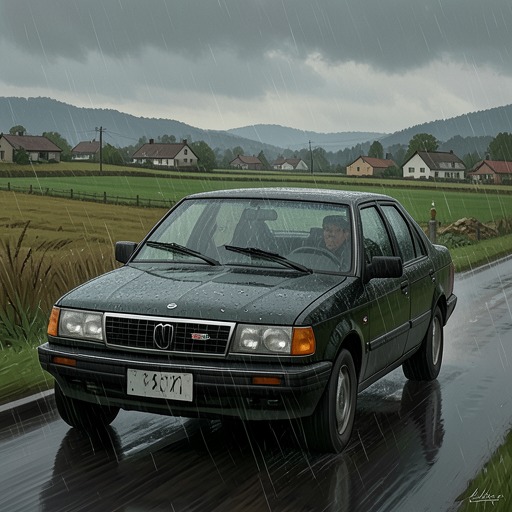
Later, in steady, heavy rain, Burke returns toward Lichgate. At the traffic light on Nether Street, a diner is open and the gas station nearby is closed. Across the intersection, he sees Dynes crossing in a windbreaker and cloth cap, hunched against the weather and inadequately dressed for it. Burke is on time, but Dynes is leaving early. The crossing turns the carefully arranged setting into an immediate, unstable encounter.
Burke had planned to switch off his headlights as he entered the diner parking lot, wait near its entrance, and shoot Dynes with a Luger as he came down the brick steps. The plan depends on a particular arrival and departure; Dynes’s early exit has already disrupted its timing. The available scene establishes both the intended method and the interruption, without making the town merely a location label: the intersection, diner, closed gas station, rain, and traffic light determine what Burke can see and when he can act.
Narrative significance
Lichgate’s industrial remains and residential streets place Burke’s pursuit of employment rivals against the history of a community already altered by the loss of its factory. The old brick building now contains shops and a museum, while houses built for the factory-era middle class continue to stand on Nether Street. That contrast gives the town’s past a physical presence, even as Burke treats its map, addresses, and sightlines as instruments for a planned killing.
The episode also exposes the limits of his attempt at control. He calculates distances, avoids asking directions, purchases a map, checks the street’s position, and imagines a precise attack. Yet a target crossing an intersection in the rain, earlier than expected, unsettles the sequence. Lichgate is at once a place shaped by economic transition and the real, particular setting in which Burke’s abstract campaign encounters ordinary people and unpredictable circumstances.