Luger pistol
The AxThe Luger pistol passes from Burke Devore’s father, a Second World War veteran, into Burke’s hands and becomes the weapon Burke prepares, carries, and uses against people who stand in his way. Its transformation from a hidden family relic into an instrument of murder—and then into evidence connecting separate killings—gives the object a decisive role in the novel’s movement from private desperation to criminal exposure.
Inheritance and Storage
Burke’s father had taken the Luger pistol from a dead German officer during the war; Burke does not know whether his father or someone else had shot the officer. The weapon was the father’s sole souvenir. He kept its clip apart from the gun, carrying the ammunition in a sock and the pistol in a small, dirty pillowcase taken from a partly wrecked house in France. This improvised separation becomes part of the gun’s inherited history: before Burke handles it, it has already traveled as a concealed remnant of violence.
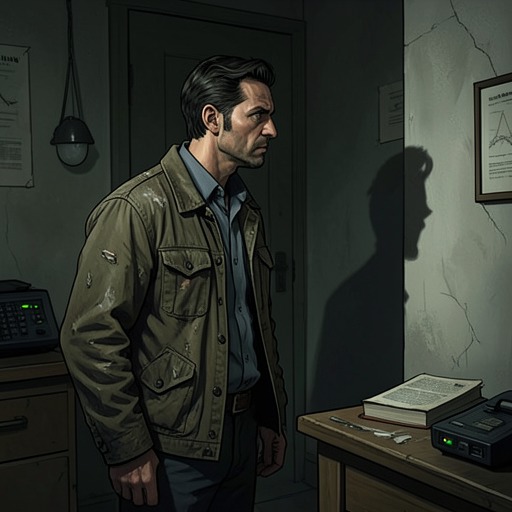
Burke later finds the pistol and its clip at the bottom of a trunk, beneath his father’s musty olive-drab uniform. The clip now lies beside the gun rather than inside the old sock. He takes both upstairs to the small spare room that has become his office during his long period at home. There, at a small wooden table bought at a lawn sale the previous year, he studies the pistol. Its apparent cleanliness and lack of visible damage contrast with the concealed, uncertain history carried by the weapon and its ammunition.
Preparation and Practice
The clip contains eight bullets. Burke registers its weight and examines the visible bases of the rounds, then confronts his lack of knowledge about operating a handgun. Rather than rely on instinct, he drives to a chain bookstore in a mall and buys a manual. The purchase is another expense, but it gives him instructions: he oils parts of the pistol with Three-in-One oil and tests the trigger without ammunition in place. The dry-fire produces a decisive mechanical click, confirming to him that he has a usable weapon.
Burke’s preparation continues beyond the office. On a sunny weekday in April, he drives more than thirty miles west, crosses the state line into New York, and searches out a deserted field beside a minor, winding two-lane road. He parks on the weedy verge and walks into the field with the Luger pistol in the inside pocket of his windbreaker. The episode makes clear that the gun is not merely a relic he has discovered: Burke deliberately learns to handle it and takes it away from home to practice.
Use in the Murders
The Luger pistol becomes a concealed threat during Burke’s later confrontations. At one point he slides it from beneath a raincoat and extends it partway through an open car window. In a subsequent attack, he waits inside his car with the pistol held in his lap, hidden by a raincoat whose unusual pockets allow access from inside or outside the garment. He keeps watch on a Honda Accord before bringing the weapon out and shooting the man he has been targeting. When the first shot does not kill him, Burke shoots again. The weapon’s use is presented not as a distant threat but as a deliberate escalation from preparation to lethal action.
Burke also considers taking the Luger pistol from beneath the raincoat and walking toward a man to shoot him if a woman goes indoors and appears likely to remain there. The plan makes the gun’s role in his calculations explicit: its use depends on the circumstances that would let him approach without interruption. At another turning point, when the clock reads 5:19, Burke decides that he must stop, confess what he has done, and make no further attacks. Yet the pistol remains part of the story’s continuing pattern of intention and violence; the stated resolve to end matters does not itself erase the weapon or its prior use.
Concealment and Forensic Link
After a later night of cleanup, Burke removes the Luger pistol from the bottom drawer of his filing cabinet and hides it inside the rear seat of his Voyager. The concealment takes place while Marjorie is in the bathroom before returning to bed, and Burke drives home with the weapon hidden beneath the seat where Billy is sitting. The placement ties the gun to Burke’s efforts to manage what the household might discover, while also showing that it remains close at hand rather than discarded.
The pistol’s hidden history becomes dangerous when Detective Burton tells Burke that two of the four people called for second interviews have been killed: Herbert Everly and Kane Asche. Burton reports that ballistics has identified the same gun in both shootings. Burke recognizes that investigators can connect murders he had treated as separate through the shared weapon. He also reflects that the connection might not have been made if a personnel man at Willis and Kendall had not intervened. What had seemed like a private advantage—the Luger’s availability and concealability—has become a material link between crimes.
Consequence and Significance
Once Burke understands the ballistic connection, he concludes that he cannot use the Luger pistol again. He has no other gun and doubts that he could obtain one without leaving an ownership trail. He knows that criminals have ways to acquire weapons anonymously, but considers that world outside his own and expects that entering it would end badly for him. The gun therefore marks a limit as well as an instrument: its traceability interrupts Burke’s attempted control of the murders and narrows the means he believes remain available.
Across its appearances, the Luger pistol changes function without changing form. It begins as a war souvenir stored beneath a uniform, becomes a mechanism Burke studies and practices with, and serves as a concealed weapon in murders that he tries to keep unconnected. Finally, its ballistic signature turns it into evidence. The separation of gun and clip in its inherited history gives way to Burke’s deliberate assembly and use; the careful concealment that once helps him act cannot prevent the weapon from recording a connection between victims.