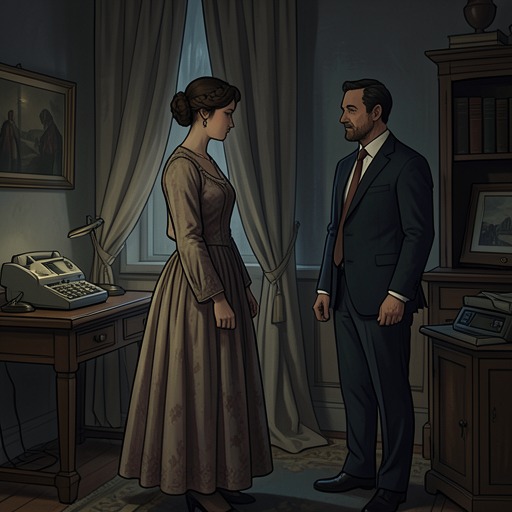
Marjorie confesses her affair and seeks marital counseling
The AxMarjorie Devore’s confession in marital counseling turns Burke Devore’s private, prolonged struggle with unemployment into an explicit crisis in their marriage. She explains that her affair grew out of loneliness and silence, not a settled wish to leave Burke: what she wants is a living, emotionally reachable husband, and the disclosure is her attempt to force their estrangement into the open.
Counseling and the Unspoken Problem
At their first appointment with Longus Quinlan, the couple spend most of the fifty-minute hour on preliminary information. Burke has expected to hear Marjorie describe her affair, and wonders whether she will identify the other man, but their conversation does not reach either subject. Instead, the session establishes that their difficulties appear connected to Burke’s having been out of work for almost two years. The central crisis is present from the start, but its most painful particulars remain unspoken.
Quinlan presents counseling not as a service that will repair the marriage for them, but as a way to help them examine what they want from one another and from life. He cautions that wanting what they used to have may not be the same as wanting what they now need. Burke understands the implication: the process could end in separation, and even that outcome might prove to be what they wanted. His dry assessment of the counselor’s flexibility does not resolve the uncertainty; it shows how quickly he can turn a vulnerable possibility into detached commentary.
Marjorie’s Account of the Unemployment
At a later session, Marjorie recalls that when Burke first lost his job, she regarded the setback as a temporary opportunity to prove herself as a wife and partner. She believed their comfortable life had spared them from having to struggle together. Expecting the crisis to be brief, she began making small economies around the household, imagining herself as someone plugging leaks before the water could get in. She did not expect the unemployment to continue, and she thinks Burke initially underestimated its duration too, though he understood more of the practical danger.
As the situation persisted, Marjorie says, Burke did not tell her directly that they were in a worse position than he had thought. He closed himself off instead. She first interpreted his silence as blame—as if he held her responsible for his inability to find work or for their dwindling money—but later reconsidered it as another attempt at perfection. In her account, Burke was trying to remain the perfect provider: to shoulder the burden alone and keep his family safe without letting them see how bad things had become. The protection he meant to offer left her unable to discuss their finances, their next steps, or the future.
The material strain reaches beyond the couple. Marjorie says she is too old and insufficiently skilled to know whether she could secure work, while the family cannot know when Burke will find another job or what kind he will accept. She worries about the children living through the same uncertainty and notes that Billy has got into trouble. She does not make Burke solely responsible for those consequences, but the household’s instability has become a shared condition that his silence prevents them from confronting together.
The Affair and Its Disclosure
Marjorie describes the emotional deprivation as a condition of living with a husband who has frozen himself until he can work again. She says that four months earlier, a man she knew treated her tenderly and she responded; an affair began. The other man offered what she felt was missing at home: conversation, openness, laughter, and the possibility of comforting someone who could admit to weakness. Marjorie also says that she is no longer seeing him. The confession therefore reveals both the breach in the marriage and its context, without presenting the affair as the solution she wants to keep.
Her account also makes clear why she insisted on counseling. Burke resisted the idea of discussing their problems with someone else. Marjorie then told him about the man, hoping the disclosure would force a decision rather than allow their deadlock to continue. She could not bring herself to say all of this to Burke without Quinlan present. Counseling becomes, in that sense, not only an effort to seek help but the setting in which she can finally speak directly about what their marriage has become.
What Marjorie Wants and Burke Hears
Marjorie distinguishes the end of the affair from the repair of the marriage. She says she wants Burke, but wants him emotionally alive and available rather than shut away, cold, and waiting for a miracle. She does not want to be protected by being excluded from the truth. Her request is not simply for the old arrangement to resume: she wants a husband with whom she can share fear and hardship, and admits that she does not know how to bring that relationship back.
After she speaks, Quinlan asks Burke whether he would like to thaw and bring down the wall. Burke answers that he had not known he was building one; he thought he was trying to hold himself together. He nevertheless recognizes glimpses of himself in Marjorie’s description. The exchange does not establish that the marriage has been repaired, or that Burke can immediately become more open. Its change is narrower but consequential: what he treated as solitary endurance has been named as a barrier between them, while Marjorie’s confession has clarified that she wants the marriage only if she can reach the person within it.