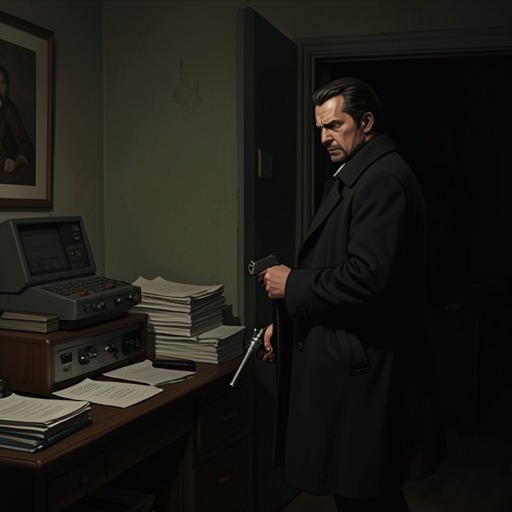
Never-Be-Suspected Principle
The AxThe Never-Be-Suspected Principle is Burke Devore’s governing rule for concealment: he aims not merely to avoid detection, but to prevent suspicion from arising at all. It shapes his travel, the pace of his planned killings, and the ordinary explanations he gives to people around him. Its reach makes anonymity less a single disguise than a discipline of managing every possible connection between his actions and his recognizable life.
Definition and Purpose
Burke states the principle as a demand for absolute anonymity: he must never be suspected, even briefly. The urgency is practical. Herbert Coleman Everly’s résumé is good enough, in Burke’s estimation, to win an interview for a manager-level position in the specialized polymer-paper industry; that prospect makes him a target. The rule therefore serves Burke’s campaign against people he regards as competitors, while also expressing his fear that one visible irregularity could expose the operation.
The principle is not limited to avoiding an obvious trail from a crime. Burke considers how an ordinary acquaintance might interpret an ordinary sighting, and how that interpretation might lead to further questions. A familiar vehicle, a neighbor, or a parent from Betsy or Bill’s school community could connect his movements to a story he has told at home. The danger, as he imagines it, is cumulative: one discrepancy invites inquiry, and inquiry threatens the identity he is trying to protect.
Routes, Timing, and Pattern Avoidance
Burke applies the rule to geography with deliberate excess. Although he is driving a gray Plymouth Voyager that he considers unremarkable—like roughly one vehicle in five—he travels about twenty-five miles toward Albany, crosses into New York State, and only then turns south on a circuitous route back into Connecticut. The detour is designed to prevent a chance observer from seeing him eastbound in Connecticut when Marjorie believes he is westbound in New York or already on a flight toward Pennsylvania. The vehicle’s commonness does not reassure him; it makes the possibility of being recognized by someone who knows his supposed itinerary more consequential.
The same concern governs the pace and distribution of his intended violence. Reviewing his list after showering and dressing, Burke decides that killing two people in the same state within a few days could encourage authorities to look for a pattern. He weighs that risk against his sense that the operation has begun and must proceed briskly before something disrupts it. He then selects a target in Massachusetts for the following Monday. The decision shows the principle operating as a constraint on sequence: urgency pushes him forward, while fear of a detectable pattern requires him to space and locate his actions carefully.
Concealment at Home and in Public
Burke’s effort to remain unsuspected reaches into his marriage. Because Marjorie has been told that he will be traveling elsewhere, a local sighting could make her suspect an affair. He considers that suspicion especially dangerous because it might cause her to question his movements and explanations until he felt compelled to disclose the actual purpose of his trip: killing Herbert Coleman Everly for the family’s sake, as he frames it. He concludes that a secret shared would cease to be a secret and that Marjorie should not be burdened with a problem she cannot solve.
That reasoning depends on a careful distinction between the explanation he fears and the truth he withholds. Burke notes that, apart from an affair eleven years earlier that Marjorie knows about, he has been faithful, and believes she knows this too. Yet he imagines that even a false suspicion could unravel his cover story. His secrecy thus protects the plan not only from law enforcement but from the intimate scrutiny that might follow a discrepancy at home. The family’s financial strain sharpens the context: Marjorie began household economies immediately after learning that Burke would be among the next reduction in force, before his final day at work or the exhaustion of his severance pay. Burke presents that care as evidence that there is no useful reason to involve her, while keeping the lethal purpose of his own actions to himself.
The same discipline appears in his false publishing scheme. After arranging an advertisement under the assumed name Benj Dockery III, he sends its wording and a money order to The Paperman. The first issue brings ninety-seven replies to his post-office box; by the May issue, there are 231, with more expected. Burke worries that anyone might suspect mail fraud and prompt an inspector to investigate. He considers the scheme possibly legal, but fears that exposure would be embarrassing and damaging to his employment prospects. The episode extends the principle beyond murder: he wants to control not just what he has done, but the interpretation others might place on it.
Contradictions and Significance
The principle rests on a tension between meticulous caution and self-justifying confidence. Burke plans routes, timing, and cover explanations to keep suspicion away, yet he treats his own account of the operation as purposeful and even protective of his family. His imagined confession to Marjorie would cast the killing as something done for them; his decision not to confess casts secrecy as consideration for her. The rule helps preserve that private logic by preventing other people from testing it against his actions.
Its reach also reveals how thoroughly Burke has made suspicion management part of daily conduct. He monitors what a neighbor might see, what his wife might infer, what authorities might connect, and what a postal inspector might investigate. At the same time, the details he cannot wholly control—the ordinary-looking vehicle, the possibility of recognition, the volume of replies, the need to keep moving—keep generating new risks for him to manage. The Never-Be-Suspected Principle is therefore both his method of concealment and a measure of the fear driving it: to remain unseen, he must continually imagine the many ways in which he might be noticed.