Raskill
The AxRaskill is the site of the State Police barracks that turns Billy’s arrest into a family crisis. The barracks is more than a point on the route between a burglary and a court appearance: its interview room and cell make the law’s institutional presence physically immediate, while Burke Devore’s response there reveals how quickly he comes to regard the police as adversaries rather than protectors.
Setting and Physical Layout
The barracks is identified as the place where Billy and another boy are held after police catch them leaving a computer store with bags of software. The arrest follows an alarm at the store, and the boys are taken to the State Police barracks in Raskill. The text does not establish that the store or the later court proceedings are in Raskill; the location’s clearest role is as the site of detention and the first police interview.
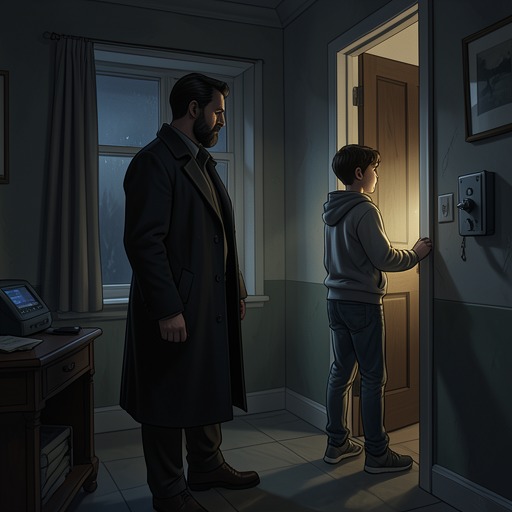
Burke and Marjorie meet a CID detective in a small, square office. Its surfaces make an unusually strong impression on Burke: three walls are smooth, shiny plastic, while the exterior wall is rough concrete block painted canary yellow. The floor is black plastic, the ceiling is covered in off-white soundproofing panels, and Burke sits in a green plastic chair facing a gray metal desk. He imagines that the sealed, washable room could be hosed clean in minutes if something terrible happened, and wonders whether the architect considered that possibility. The room’s cleanliness therefore feels less reassuring than deniable: Burke reads its surfaces through his own emerging capacity for violence.
The same institutional palette continues in the hall, where a uniformed trooper stands at a desk and unlocks a pale-yellow metal door. The detective asks the parents to keep their visit brief, explaining that Billy will be home in the morning and they can talk more then. The request makes the family’s access conditional even before they enter the cell.
Arrest and Police Inquiry
The burglary began with preparation rather than a sudden impulse. The previous afternoon, Billy and a school friend entered the mall computer store and tampered with its rear delivery-and-trash door so that it would appear locked while remaining unsecured. Later, after the family believed Billy was asleep, he left home, met his friend, and returned to the store. They did not know it had already been robbed three times in the same way. A new silent alarm alerted the State Police barracks, and four police cars—two from the state trooper barracks and two from local town police—converged on the store.
The boys abandoned their canvas tote bags, filled with software, and ran when police arrived. Officers apprehended them, and the evidence in the current burglary was strong: the friend had admitted involvement, the rigged door demonstrated planning, and police had seen the boys carrying stolen goods and attempting to flee. What the detective still wanted was proof connecting them to the three earlier burglaries. His questioning thus placed Billy’s present conduct alongside a possible history of repeated crimes, though the earlier offenses had not yet been established against him.
Burke struggles to follow the detective’s account. He wants to see Billy and cannot retain the detective’s name, while Marjorie listens closely, asks questions, and takes notes. When the detective presents himself as sympathetic and says the police want to finish the paperwork and move on, Burke finally speaks up: he insists that this is Billy’s first offense. The detective replies that they cannot yet be sure. Burke distinguishes Billy from the other boy, whose account may implicate him, and maintains that Billy has never done this before.
The Cell and the Family’s Visit
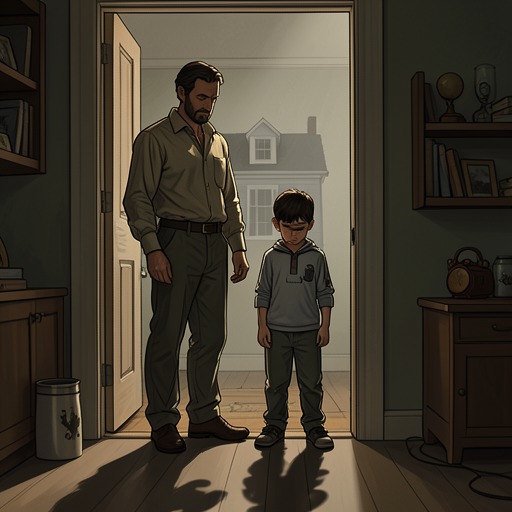
The family is allowed to see Billy only briefly. Burke had expected a visiting room; instead, the trooper opens a yellow door and leads them into an actual cell. Its entire inventory is starkly limited: a cot fixed to the wall, a chair fixed to the floor, and a toilet without a seat. Billy stands from the cot when they enter. He has no belt and is wearing only his socks. His puffy face suggests that he has been crying, though he is no longer crying; his closed, bruised, defensive expression shows him withdrawing into himself.
The confinement changes the meaning of the detective’s earlier assurance that Billy will be home in the morning. The parents can see him, but only inside the cell and for five or ten minutes; the trooper tells them to knock when they are ready to leave. Burke recognizes that leaving will not be simple. The visit gives the family a direct view of Billy’s vulnerability, while the cell’s fixed furniture and restricted access make the police station’s control tangible.
The detective will not release Billy that night. He says Billy must appear before a judge in the morning, when a lawyer can ask for his release into his parents’ custody. Marjorie asks whether they can take him home, but the answer remains no until the court acts. At the barracks, the family’s immediate wish—to bring their son home—meets the timetable and authority of the criminal process.
From Barracks to Legal Process
The arrest at Raskill sets off a scramble for legal representation. Billy is due to be arraigned, but the proceedings cannot go ahead until he has counsel. Burke and Marjorie spend the morning trying to find a lawyer, making repeated calls while Billy remains in a cell somewhere in the process. A Sunday makes the search difficult, and the uncertainty leaves both parents pacing at home, unsure how to start the case moving. The narrative does not locate those later calls or the court in Raskill; they are consequences of the arrest at the barracks, not further scenes securely assigned to the town.
Burke prepares against the possibility that the legal process will turn on missing paperwork. He brings a folder marked HOUSE, Billy’s birth certificate, and his and Marjorie’s passports for identification. The folder and documents contrast with the police station’s controlled spaces: the family gathers its own papers in an effort to navigate a system whose procedures they do not understand. When they eventually meet Porculey, he is an elderly lawyer in a maroon pinstriped suit, and Burke judges him capable enough to get Billy home.
The later legal resolution focuses less on a jail term than on whether Billy will acquire a felony conviction. Porculey argues that Billy has never been in trouble, is a good student, has a bright future, and comes from poverty. He proposes a sealed indictment: if Billy pleads guilty and the judge grants the measure, the indictment can remain unpublished and inactive for a specified term, usually a year. A new arrest during that period would unseal it and expose Billy to prosecution for both offenses; staying out of trouble until the term ends would allow the indictment to be quashed. The parents’ hope for this second chance grows out of the crisis that began at the Raskill barracks, although the decision itself belongs to the court proceedings.
Narrative Significance
Raskill brings two kinds of confinement into close focus. In the interview office, Burke imagines a room designed to be cleaned after horror and recognizes, with alarm, that he has acquired a new kind of skill. In the cell, Billy’s stripped-down surroundings turn the abstract idea of arrest into a cot, a fixed chair, a bare toilet, and a locked yellow door. The pairing makes the barracks a setting where Burke’s private violence and his son’s public vulnerability come uncomfortably near one another.
The place also marks Burke’s change in his understanding of the police. At first he believes that the police safeguard his family, home, possessions, and neighborhood. Listening to the detective describe the case as paperwork to be finished, he decides that the institution serves its own interests and treats the people involved as administrative burdens. He comes to call the detective an enemy and concludes that he and his family must not accommodate their enemies. Raskill is therefore the location of more than Billy’s detention: it is where Burke’s trust in ordinary civic protection gives way to suspicion, at the same moment that he is trying to protect his son from the consequences of a real crime.