State Police
The AxThe State Police are the investigating agency whose barracks receives Billy after he and a school friend are caught burglarizing a computer store. Their response brings the family into contact with criminal procedure, while their detective’s effort to connect the boys to earlier crimes turns a single arrest into a wider investigation. For Burke Devore, the encounter also marks a reversal: the police he had assumed protected ordinary families come to seem like adversaries concerned chiefly with clearing their paperwork.
Setting and institutional presence
The State Police are represented concretely by their barracks in Raskill and by the detectives who deal with the family there. After Billy’s arrest, Burke and Marjorie Devore are brought to a small square office in the barracks. Its pale-yellow walls, shiny plastic surfaces, black floor, gray metal desk, green chair, and off-white soundproofing panels give Burke an unsettling impression of a space built to be cleaned quickly after something terrible. He wonders whether the architect considered that possibility. The room’s details are not presented as proof of the agency’s practices; they show how Burke’s mind, under pressure, reads an institutional setting through his own increasingly violent sense of expertise.
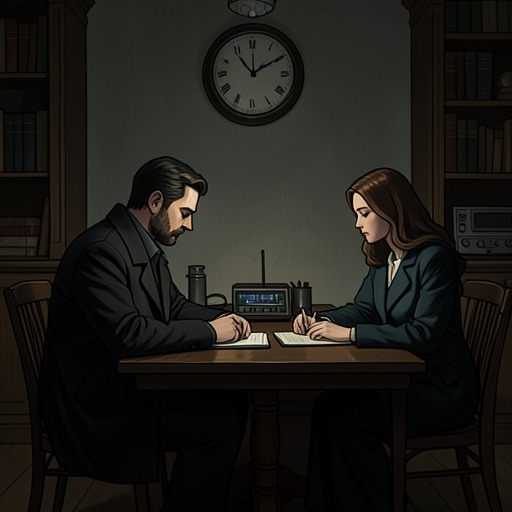
The barracks is also where the investigation is explained to the family. A soft-spoken CID detective speaks with them while Marjorie takes notes and asks questions. Burke alternates between following the conversation and withdrawing from it, until he understands both how the burglary happened and what the police still want to establish. The scene places official procedure—questions, notes, evidence, and forms—alongside the family’s immediate uncertainty about Billy’s fate.
Response to the computer-store burglary
The State Police converge on the mall after a silent alarm alerts their barracks. The computer store had already been burglarized three times in the same manner, so an alarm had been installed to notify police when someone entered through the rear. Billy and his friend had prepared that route by rigging the delivery-and-trash door to appear locked while remaining open. They returned later, entered from the alley, and filled canvas tote bags with software. Four police cars arrive: two from the State Police barracks and two from the local town police.
The boys abandon the bags and run when the police arrive, but are apprehended. The division between agencies matters in the account: the State Police respond alongside local police, rather than acting alone. The detective tells the family that the police have the friend’s admission, evidence that the door was rigged in advance, eyewitnesses who saw the boys carrying stolen goods, and their attempted flight. Those circumstances support treating this burglary as planned, not spontaneous. The investigators are still seeking proof that Billy and his friend were responsible for the three earlier burglaries, a question that gives the interview its particular pressure.
The family at the barracks
Burke insists that this is Billy’s first offense, distinguishing what he knows about his son from what the police may suspect about the other boy. The detective answers that they cannot yet be sure. He presents the investigation as something to finish and put behind them, and encourages Marjorie to urge Billy to confess so the family can return to normal life. Marjorie initially responds to him with sympathy, but Burke hears the appeal as a demand for a convenient resolution rather than concern for the people involved.
Burke’s interpretation hardens into a declaration of hostility. He decides that the detective sees Billy and the family as paperwork, and generalizes from the encounter to the police as a whole: he had believed they safeguarded his home and community, but now thinks they act for themselves and cannot be trusted. This is Burke’s judgment, not an independent account of the State Police’s motives. Its importance lies in how quickly a procedural disagreement changes his understanding of authority. Marjorie registers his objection and becomes less sympathetic toward the detective.
The family asks to take Billy home that night. The detective refuses, explaining that Billy will appear before a judge in the morning and that their lawyer can ask for his release into their custody. The distinction between immediate detention and a later request for release leaves the family waiting rather than taking their son home. The detective then brings out forms, making paperwork both a practical part of the encounter and the image through which Burke interprets it.
Investigation and narrative significance
The State Police’s inquiry extends beyond the arresting scene. Their interest in the three previous burglaries supplies a reason to seek further statements and to test whether the boys’ account will connect Billy to the earlier incidents. The family’s response, by contrast, focuses on limiting the consequences for Billy and securing his release. The agency thus stands at the point where evidence gathering and the family’s fear of lasting harm meet, although the later decisions about Billy’s case belong to the judge and legal process, not to the State Police alone.
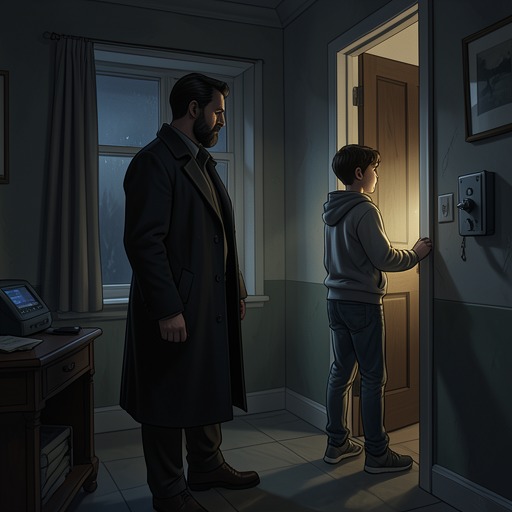
The State Police also recur through Detective Burton, whom Burke identifies as a state CID detective. Burton visits the Devore home and introduces himself in a friendly manner; Burke, despite that manner, tries to conceal his worry. This later encounter gives the agency a more personal face than the barracks interview, without erasing Burke’s distrust. Across these scenes, the State Police are neither described through a broad institutional history nor reduced to the arrest itself: they are encountered through specific investigators, an alarm-driven response, an evidence-based inquiry, and the family’s increasingly fraught dealings with procedure.