The murder of Ralph Fallon
The AxThe murder of Ralph Fallon turns a night of companionable shop talk into a calculated killing. Burke Devore spends hours listening to Fallon discuss the work at Arcadia, even recognizing his expertise and feeling a sentimental attachment to him; then, when Fallon falls asleep, Burke binds him to a chair and seals his mouth and nose with duct tape. The killing is brutal in its mechanics and revealing in its logic: Burke can acknowledge Fallon's humanity and still treat his death as a step toward employment.
The evening at the kitchen table
Fallon is already drunk when he returns home. At the kitchen table, he asks Burke about the extruder on his production line, then interrupts himself to fetch rye and more beer. The casual hospitality sets the scene for the violence that follows: Fallon offers drinks for later and invites Burke to talk shop, unaware that he is entertaining a man who intends to take his place.
Their conversation is not merely a performance of friendship. Burke enjoys it. He considers Fallon bright, knowledgeable, and more practically experienced than the college-educated people he knows, and he notes that Fallon's methods at Arcadia are ideas he will keep when he takes over the line. Fallon drinks eight more beers, each mixed with rye; Burke has five beers, adds no whiskey, and only pretends to drink it. The imbalance leaves Fallon heavily intoxicated while Burke remains able to act.
As the hour grows late, Burke imagines alternatives in which Fallon survives and Burke still gets the position: Fallon might retire, offer him a co-manager role, or mention a second shift that needs a night manager. The fantasies register a real reluctance, but none becomes an option. Burke decides that the pleasant conversation is over and that it is time to proceed with the killing.
Restraint and death
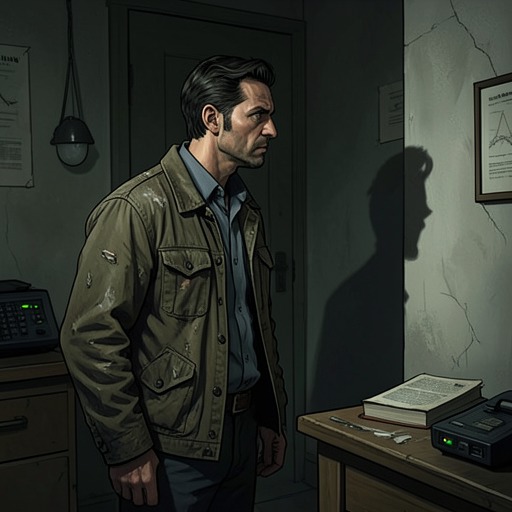
Burke retrieves a small roll of duct tape from his windbreaker pocket. He first tapes Fallon's right ankle to a chair leg, then crawls around the chair to secure the left ankle. Rather than risk waking him by moving his arms, Burke wraps tape twice around the chair back and Fallon's torso, just above the elbows. Fallon can still move his hands and forearms, but Burke judges that he cannot use them effectively.
Burke knows that covering Fallon's face will wake him, so he prepares two short pieces of tape and moves quickly. The first goes over Fallon's mouth; when Fallon opens his eyes, startles, and jerks against the restraints, Burke presses the second over his nose, closing his nostrils. He then turns away to search the kitchen drawers while Fallon struggles and dies. The scene's shift from careful, quiet restraint to sudden action makes the killing feel both premeditated and physically immediate.
Fallon does not simply suffocate. After returning, Burke finds him slumped and quiet, removes the tape from his ankles and torso, and sees his head fall forward onto the table. When Burke lifts it and removes the final pieces from his face, he discovers that Fallon has vomited into his mouth and then inhaled it through his nose into his lungs. The cause of death is drowning in his own vomit, not the suffocation Burke had intended. Burke calls it a miserable end either way, a judgment that recognizes the horror of what happened without changing his decision to cause it.
Concealment and the gas setup
Before discovering the precise manner of death, Burke searches for a candle, reasoning that unreliable electricity makes one an ordinary fixture in a country kitchen. He finds a short, fat candle among string, spare keys, and other household odds and ends, sets it on a saucer by the stove, and lights it with one of Fallon's wooden matches. Fallon's noises disturb him once the search is over, so Burke leaves the kitchen and puts on his windbreaker.
The windbreaker also holds gloves and an iron pipe. Burke says he will not need the pipe but takes it away, then puts on the gloves and wipes surfaces he remembers touching as he moves from the front door through the house. He switches off the lights as he goes, leaving only the bedside lamp in Fallon's bedroom lit. He places the pieces of duct tape in one of Fallon's small plastic trash bags and puts the bag in his pocket.
Burke then turns on the two front burners of the gas stove, leaves them on high, and blows out the candle. Because the stove has electric igniters rather than pilot lights, the lit candle is part of his handling of the kitchen before he leaves it. He closes the inner kitchen door, leaving no openings from that room. These actions extend the killing into an attempt to shape what will be found afterward; the murder is followed not by flight alone but by deliberate cleanup and preparation of the scene.
Justification and aftermath
Burke frames the murder through a broad claim about changing morality: he believes modern public life accepts the principle that the end justifies the means. He applies that reasoning to himself, describing his ends as caring for his family, contributing productively to society, using his skills, earning his own way, and avoiding dependence on taxpayers. In his account, those goals excuse the killing. The reasoning is especially stark beside the evening's conversation: Burke has just recognized Fallon as a capable, interesting person, yet reduces him to an obstacle between himself and a job.
After Fallon's death, Burke spends the weekend in what he describes as a contented daze, neither planning nor worrying because he expects Arcadia to call about the vacant position. When no call comes on Monday, his confidence gives way to suspicion. Alone in the house, he paces and wonders whether another résumé received the offer or whether Arcadia will promote someone from within. The anticipated reward has not arrived, and the murder's immediate consequence is not employment but renewed uncertainty.
Narrative significance
The scene's force lies in the distance between Burke's account of himself and his actions. His careful attention to Fallon's knowledge and his admitted attachment suggest that he understands the person he is killing; his restraint, concealment, and effort to stage the kitchen show how completely that recognition is subordinated to his purpose. His moral argument does not erase the violence it is meant to excuse. Instead, the warm, sustained exchange at the table makes the later murder harder to treat as an impersonal act of competition: Burke has enjoyed Fallon's company, imagined ways to spare him, and killed him all the same.