Upton Fallon
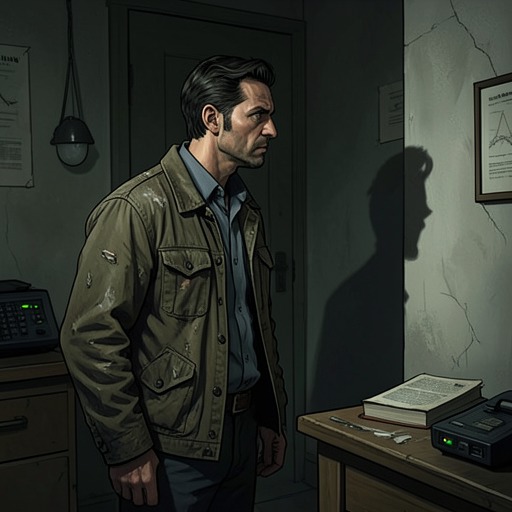
The AxUpton “Ralph” Fallon is a production-line manager at Arcadia, introduced through a trade-publication profile that makes him the imagined rival in Burke Devore’s first sustained fantasy of killing a competitor. Fallon is not shown meeting Burke or knowing of him. Instead, Burke builds a picture of the man from a short article, then turns the distance between them into a private contest over work, security, and survival.
Identity and Background
Fallon is identified in the article as a production-line manager at Arcadia. He is known by his middle name, Ralph, and has been with the company for almost thirty years. His working life began on its tobacco-paper machine, apparently straight out of high school. That history makes him a figure of unusual continuity: he has remained at one workplace from the tobacco-paper operation into the company’s later diversification, while the industrial world around him has changed.
The article presents Arcadia as a business that moved away from dependence on tobacco and into polymer specialty paper. The company found customers in Mexico and then across South America, aided by NAFTA. Its manufacturing approach was described as new, but Burke recognized it as the same system installed at Halcyon Mills in 1991. The distinction matters to his response: Arcadia’s success belongs to a field he knows intimately, and Fallon’s position is attached to a production process Burke considers familiar rather than beyond his own expertise.
The Profile and Burke’s Rivalry
Burke reads the profile twice. The article gives him only limited information about Fallon, less than a résumé would provide, but Burke treats what it says and implies as enough to assess the man. He concludes that he would outperform Fallon in a fair competition for the position. The article itself does not establish that judgment; it is Burke’s conviction, sharpened by the fact that Fallon already holds the job he wants.
This imagined rivalry is sharply unequal in knowledge. Fallon appears in public as an experienced manager answering questions about production and his background; Burke, reading from outside the company, converts that profile into a personal challenge. Nothing in the evidence indicates that Fallon knows Burke exists or regards him as a competitor. The contest that occupies Burke is therefore one-sided: Fallon is a real employee with a long history at Arcadia, while his supposed rivalry with Burke exists only in Burke’s interpretation.
From Daydream to a Murder Scheme
Burke first imagines that Fallon might leave the job through misfortune or scandal. The possibilities he cycles through include being fired, becoming seriously ill, or dying. He then considers killing Fallon himself, initially as a hyperbolic extension of the daydream and then as a possibility he tests more seriously. He frames the thought as self-defense, linking Fallon’s presence at the job to the financial danger facing his family: Burke’s income has stopped, expenses continue, Betsy is in college, and Billy is about to graduate from high school.
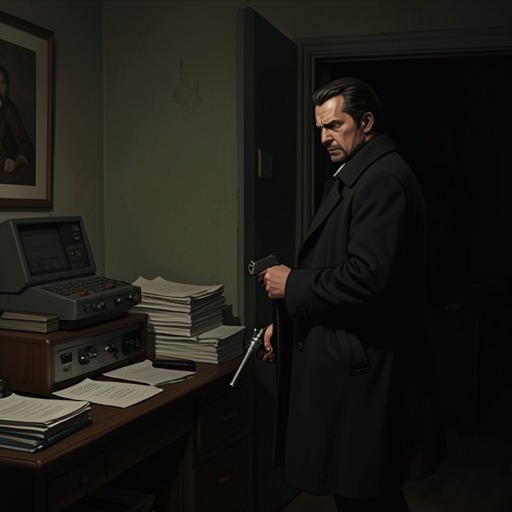
The imagined plan acquires a concrete object when Burke remembers the Luger pistol at the bottom of his father’s trunk. He pictures driving to Arcadia with the weapon, finding Fallon, following him, waiting for an opportunity, killing him, and applying for his position. The sequence is still a daydream, not an action Fallon experiences or an accomplished murder. Burke has no photograph of Fallon in the article, but treats that practical gap as something he could solve.
The fantasy breaks down at the point when Burke considers what would follow Fallon’s removal. Even if he believes he would beat Fallon in a direct contest, the actual competition would be against the other résumés. Fallon is thus a visible target but not the only barrier between Burke and employment. This recognition returns Burke from the temporary pleasure of imagining a solution to his underlying misery, and exposes the gap between revenge on one rival and escape from a crowded job market.
Narrative Role and Significance
Fallon’s significance lies in the way Burke’s reading transforms an ordinary account of workplace success into a possible target. His long tenure, starting on the tobacco-paper machine and continuing through Arcadia’s change of direction, contrasts with Burke’s unemployment and sense of lost professional standing. The same industry history that makes Fallon’s job seem attainable to Burke also makes the man feel intolerably close to a position Burke believes should be his.
The profile also establishes a limit in Burke’s reasoning. He casts the job as a direct contest with Fallon, then recognizes that the résumé pile would remain after Fallon was gone. The realization does not erase the violent idea: later, Burke still places Fallon after the four résumés he has yet to address. It does, however, reveal the incompleteness of the fantasy. Fallon is both a specific person Burke imagines killing and a convenient embodiment of a broader competition that no single act against him could remove.