
Hortense Daigle’s Bereavement
The Bad SeedThis thread follows Hortense Daigle’s movement from overwhelming grief toward suspicion and anger as the missing medal becomes a symbol of the unanswered questions around her son’s death.
increasing Bearing strength in each event
 decreasing
Bearing strength in each eventdecreasingThe Possessive Mother

The Possessive Mother
Anxious Care
Before the school buses leave, Hortense Daigle tends closely to Claude Daigle. She adjusts his clothes, checks his headache, and reminds him about the sun and his handkerchief. Her manner suggests a mother deeply invested in her only child’s safety and daily life.
A Prize with Emotional Weight
Claude wears the penmanship medal he has just won. Hortense holds it in her palm and associates herself with his achievement, a small gesture that foreshadows how important the medal will become after his death.
Her attentiveness is not presented as simple cruelty or vanity; it is part of an intense bond that leaves little room between mother and son. Once Claude is gone, that closeness makes ordinary consolation inadequate. The medal becomes one of the last physical links to a child whose presence had structured her identity and hopes.
News of the Drowning

News of the Drowning
A Death Announced
A radio report identifies Claude as the child who drowned during the Fern school picnic. His body was found among the pilings at the old wharf, and marks on his forehead and hands are tentatively attributed to contact with the structure. His medal is missing.
Grief and an Unanswered Detail
The death devastates Hortense and Dwight Daigle. In the first hours after the news, Hortense is sedated and unable to speak steadily, but she returns repeatedly to the absent medal. She believes it was securely pinned to Claude’s shirt and cannot accept that it simply fell away unnoticed.
The missing object gives her grief a concrete question to pursue. It cannot explain why her son died, but it is something that can still be searched for, argued over, and perhaps returned. Her attention to the medal is therefore both a practical demand for evidence and an attempt to preserve the bond that death has abruptly broken.
A Mother’s Demand

A Mother's Demand
At the Daigle Home
Christine visits the grieving family, and Hortense describes Claude as sensitive, artistic, and devoted to her. She says he called her his sweetheart and shared his thoughts with her, presenting their closeness as the defining fact of his life.
The Medal and the Funeral
Hortense insists that the men searching the water did not look carefully enough. She believes the medal’s clasp was secure and says Claude would want to be buried wearing it. She asks Christine to press for another search, making the missing prize central to the funeral she is trying to arrange.
Her demand may seem disproportionate to outsiders, but the medal is not merely an award to her. It represents Claude’s achievement and the intimate knowledge she claims of what he would have wanted. By treating the search as unfinished, Hortense resists the finality of the death and maintains the possibility that one last act of care remains available to her.
Suspicion Takes Shape
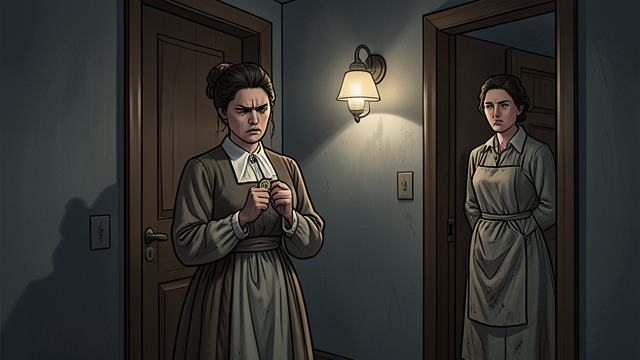
Suspicion Takes Shape
A Troubled Return Visit
When Christine brings the medal to the Daigle home, she finds Hortense volatile and suspicious. Hortense alternates between rejecting her visitor and embracing her, while accusing the school of withholding facts about Claude’s death.
The Guard’s Account
Hortense says she has spoken to the picnic guard and learned that he saw Rhoda near the wharf shortly before Claude was found. She asks Christine to question Rhoda, believing the girl may know something that has not been disclosed. The missing medal remains part of the question, but now it points toward a possible connection between the children.
Her suspicion arises from partial information and grief, not from a complete account of what happened. Nevertheless, she notices the same gaps that trouble Christine: the medal has vanished, the timeline is uncertain, and the adults have offered no satisfying explanation. Hortense’s insistence prevents the tragedy from settling into a simple story of misfortune.
The Unresolved Visitor

The Unresolved Visitor
Grief Turns Accusatory
Some weeks later, Hortense arrives at Christine’s apartment after drinking. She presses Rhoda about the picnic, the medal, and whether Claude won fairly, treating the child as a possible source of information she has been unable to obtain from the school.
No Answer Offered
Christine sends Rhoda away and tries to keep the conversation from becoming more damaging. Hortense says she believes Rhoda knows more than she has told and refers again to the guard’s report. Her anger turns toward Christine, whom she sees as privileged and evasive, and she leaves without receiving the explanation she wants.
The encounter shows bereavement becoming a persistent search for accountability. Hortense is not given confirmation of the truth, and her suspicions do not produce justice or closure. Her story remains suspended between accurate intuition and the helplessness of a parent who has lost the one person she most wants to protect.
June 7, before the picnic
June 7, afternoon
The evening of June 7
Several days after the funeral
Early August
