
Reginald Tasker’s Criminal Archive
The Bad SeedThis thread follows Reginald Tasker’s true-crime expertise from social conversation into the case files that give Christine Penmark a framework for recognizing her daughter’s conduct and her own buried history.
increasing Bearing strength in each event
 decreasing
Bearing strength in each eventdecreasingThe Murder Specialist

The Murder Specialist
Crime as Conversation
At lunch with Monica Breedlove and Emory Breedlove, Reginald Tasker recounts the case of a nurse who poisoned children for insurance money. His tone treats murder as a field of professional interest, complete with motives, methods, and details that Christine finds distressing.
Christine’s Unease
Christine admits that crime stories make her anxious and tries to block out the account. Monica encourages her to associate freely, as if discomfort itself were a clue, but Christine’s thoughts turn instead toward her uncertain past and the possibility that she was adopted.
The meal establishes the contrast between Reginald’s analytical detachment and Christine’s emotional vulnerability. His expertise supplies information without initially offering comfort; even so, the cases he describes begin to give her a language for questions she has never been willing to examine directly.
The Criminal Type

The Criminal Type
A Theory of Motive
During Christine’s party, Reginald explains his interest in criminals who kill for profit or to remove a threat. He distinguishes them from offenders driven by passion or revenge, describing a pattern of cold calculation, acquisitiveness, and limited capacity for affection.
A Fictional Cover
Christine asks to examine his research and claims she is considering a novel. She imagines a mass murderess whose violence damages both victims and survivors, while Reginald takes her explanation at face value and agrees to lend her his collected material.
Their exchange gives Christine a socially acceptable route into material she privately suspects may illuminate Rhoda. Reginald contributes a conceptual framework, but the theory does not settle questions of responsibility or cause. His archive can suggest patterns; it cannot tell Christine what she should do with the child who appears to fit them.
Case Files at Home

Case Files at Home
Patterns of Acquisition
Reginald lends Christine folders describing murderers whose crimes are linked to financial gain. She reads about offenders who kill relatives, spouses, and vulnerable dependents, and begins to compare the cases with the cold acquisitiveness she has noticed in Rhoda.
An Uneasy Education
The files make criminal behavior appear patterned rather than inexplicable, but their tidy classifications deepen Christine’s fear. They suggest that some offenders show their dispositions early and may not respond to ordinary moral instruction, an idea that makes her wonder whether upbringing can change what she sees in her daughter.
Reading becomes both research and compulsion. Christine tells herself that the material is for a novel, yet she keeps returning to it because she hopes one case will explain Rhoda and, increasingly, herself. Reginald’s archive provides knowledge while also intensifying the private burden of deciding what that knowledge means.
The Denker Connection
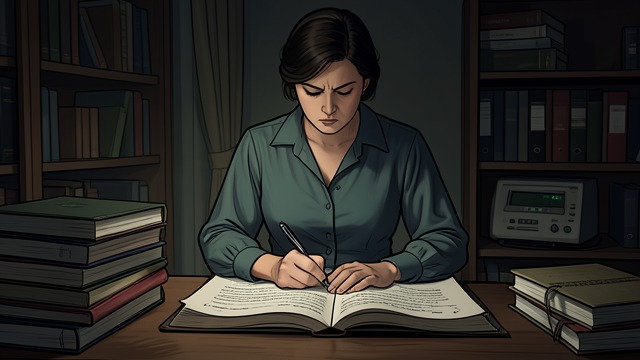
The Denker Connection
A Name from the Past
Christine finds the case of Bessie Denker among the files and recognizes names and fragments that seem familiar. When she asks Reginald about the case at Monica’s holiday gathering, he recounts its history and describes the surviving daughter, also named Christine.
A Personal Revelation
The detail that Bessie’s youngest daughter shared Christine’s name turns a distant criminal case into a threat to Christine’s sense of identity. Reginald explains what he knows as a true-crime researcher, unaware that his account is disclosing the history of the woman listening to him.
Christine leaves the gathering shaken and reads the case through to its conclusion. The archive has not merely offered a parallel to Rhoda’s behavior; it has supplied the missing link between two generations of violence. Reginald’s expertise is crucial to the discovery, although he does not realize how intimate its consequences are.
A Theory Without Certainty

A Theory Without Certainty
Heredity Under Question
Christine asks Reginald whether a criminal disposition can be inherited. He considers it plausible that a persistent lack of conscience might be transmitted, comparing it with other inherited conditions, while acknowledging that the question lies outside a settled scientific explanation.
Conflicting Authorities
When Christine asks what psychiatrists think, Reginald points out that specialists have disagreed even in prominent legal cases. He cannot give her a decisive judgment about whether her ancestry caused Rhoda’s behavior or whether Christine herself carries the same disposition.
His answer denies Christine the reassurance she sought. The archive and its theories help her name a possible pattern, but they cannot resolve responsibility, prediction, or moral choice. Reginald remains an informed but limited adviser, and Christine is left to face the consequences of her discoveries without an expert verdict to relieve her.
June 7, at Monica’s lunch
Late June, at Christine’s party
Early July
Independence Day evening
Early July, after Christine learns her ancestry
