Christine Penmark’s psychological crisis
The Bad SeedChristine Penmark’s psychological crisis is the inward counterpart to her growing recognition of Rhoda’s violence: as she comes to believe that her daughter inherited criminality through her, responsibility shifts in her mind from Rhoda to herself. The crisis moves through sleepless fear, concealment, and attempts to find reassurance, until Christine treats her own death as the only way to protect Rhoda from a future she imagines repeating the history of Bessie Denker.
The Crisis Takes Shape
After resisting Monica Breedlove’s concern, Christine remains awake for much of the night and falls into troubled sleep near morning. In her dream, she wanders through a white city crowded with people who do not acknowledge her. She feels both lost among them and, increasingly, like one of them. The dream’s final image is a house marked with her name, written in Rhoda’s neat hand, collapsing into dust. Christine wakes trembling and distressed. The sequence gives form to her fear that the violence in her family will not stop with Rhoda, and that she herself cannot stand outside it.
At dawn, Christine writes another detailed, impassioned letter to Kenneth Penmark, though she has no intention of sending it. She records the contradiction that governs her crisis: knowing the truth has relieved her from the torment of uncertainty, but she now wishes she could return to the possibility that Rhoda is innocent. The question is no longer only what Rhoda has done. Christine sees a future problem shared with Kenneth, who does not yet know the full truth: what their duty will be to their child and to the society around them.
Her letter reveals how urgently she wants Kenneth’s presence and judgment, but she also tries to sustain hope in his absence. She wonders whether Rhoda understands the meaning of her actions, whether she has learned from them, and whether the danger might pass. These are possibilities Christine wants to believe rather than conclusions supported by what she knows. Her thoughts circle between fear of recurrence and the wish to postpone a decision until Kenneth returns.
Inherited Guilt and the Burden of Secrecy
Christine’s discovery of her own identity changes how she interprets Rhoda. She comes to see herself as the carrier of an inheritance from Bessie Denker, and therefore as the person responsible for what Rhoda has become. The belief is not presented as a settled, independent diagnosis; it is the explanation Christine embraces as she tries to connect her family history with the child’s actions. Its emotional effect is decisive: rather than hold Rhoda accountable, Christine feels ashamed and guilty for having passed the inheritance on.
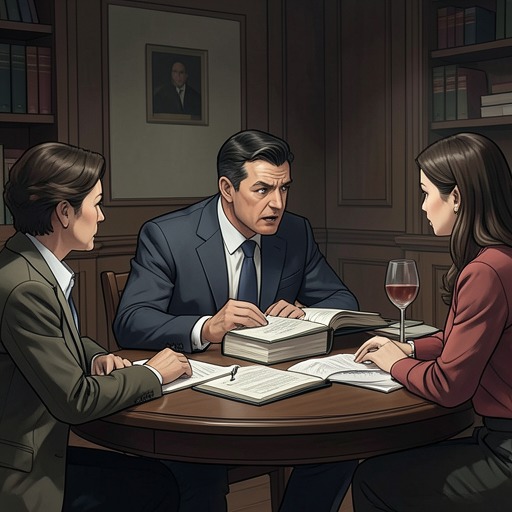
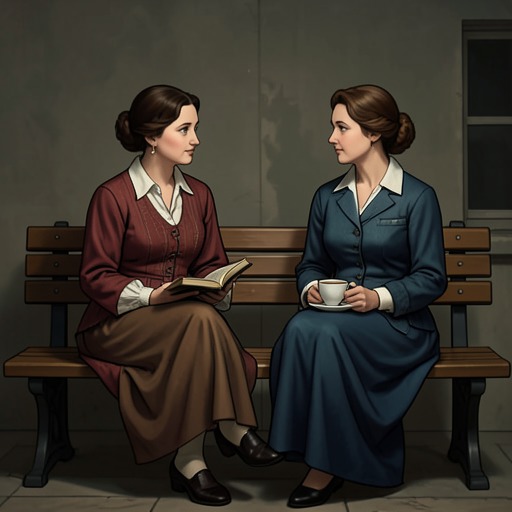
That conviction also damages Christine’s ability to confide in people who care for her. When Monica asks what is troubling her, Christine cannot disclose the truth, even to a trusted friend. She privately reproaches herself for blaming Rhoda and describes her own lineage as the source of the child’s condition. Monica’s ordinary questions about Christine and Kenneth’s marriage offer an opening for disclosure, but Christine denies that this is the problem. The gap between her private knowledge and the harmless explanations available to others becomes a defining feature of the crisis.
Christine briefly tests whether her conclusion might be mistaken. She considers whether the resemblance between Bessie Denker and Rhoda could be coincidence and whether she has assigned herself guilt without sufficient grounds. She thinks Reginald Tasker may be able to answer her question, but fears that asking him will expose the secret she means to keep. When she does seek reassurance about what psychiatrists think, Tasker points out that psychiatrists have disagreed sharply, citing opposing testimony in the Thaw case. His answer offers no stable verdict for Christine to rely on. She is left with uncertainty about the theory and certainty, in her own mind, about the danger posed by what she knows.
Protection, Isolation, and a Future Imagined
Christine’s first response to the crisis is to define protection as her duty. Rhoda is her child, and Christine believes she must shield her from the cruelty of the world while also watching to prevent further harm to others. The two obligations do not reconcile. Her promise to protect Rhoda depends on her hope that the child will not act violently again; at the same time, Christine recognizes that protection cannot simply mean ignoring the risk. The more she repeats that she must protect her daughter, the more plainly the conflict between maternal loyalty and social responsibility presses upon her.
As she understands her parentage, Christine’s language of shared responsibility gives way to isolation. In another letter to Kenneth, she says the problem is hers alone because she believes the inherited criminality came through her, not him. She imagines that Kenneth should leave her and Rhoda and begin another family, free of what she regards as the taint she has transmitted. This is not a decision reached through a conversation with him: he remains away, and Christine keeps the full extent of her knowledge from him. Her imagined sacrifice thus grows out of both guilt and the secrecy that prevents him from sharing the decision.
The crisis becomes visible to Monica in Christine’s changed appearance and habits. Monica observes that Christine has not attended to her hair or nails as usual, appears gaunt, and does not seem to be eating properly. These details register a deterioration noticed from outside, while Christine’s letters and solitary reasoning disclose its private logic. She continues to carry on with routine tasks, but her thoughts repeatedly return to the same unsolved questions: whether Rhoda can change, whether Christine herself is to blame, and what protection can mean when the threat is within the family.
Bessie Denker’s Example and the Final Decision
Christine’s reading about Bessie Denker brings her fear into sharper focus. After studying a photograph of her mother’s execution, she imagines Rhoda following a similar course: escaping detection for a time, harming others, and eventually being caught and publicly destroyed. This is Christine’s fearful projection, not knowledge of Rhoda’s future. Yet she experiences the imagined outcome as a pattern already laid out before her, and the prospect of Rhoda’s public death intensifies her resolve to prevent it.
A conversation recounted by Miss Glass gives Christine’s dilemma an unsettling parallel. A group discussing the ending of a novel based on Christine’s situation considers psychiatric treatment, reform school, and faith in the future before unanimously settling on an ending in which the mother keeps the secret, kills the child, and then dies by suicide. Miss Glass presents this as a discussion about the story, not as a direct instruction to Christine. Christine says that this ending has occurred to her too and may be the one she will use. The exchange turns her private crisis into an explicitly considered plot ending, while showing that the alternatives have not provided her with a way out.
Christine’s will, dated August 3, 1952, converts her sense of impending loss into practical arrangements. She leaves her jewelry and a 1912 Utrillo landscape to Monica, returns a Modigliani drawing to Kenneth with the wish that he find someone more worthy of it and marry again, and leaves her remaining property to Thelma Jessup. She treats these decisions as atonement. Before acting, she also destroys the unsent letters to Kenneth and other papers and photographs she had once imagined keeping for Rhoda. The destruction removes traces of the thoughts she could not bring herself to share and of a family past she had hoped her daughter might one day understand.
The Crisis Ends in Self-Destruction
Christine decides that she cannot use physical violence against Rhoda or cause her deliberate injury. Instead, she considers giving her daughter sleeping pills prescribed for Christine’s own discomfort, which she has not taken. Because she expects Rhoda to detect danger, Christine devises a way to make the pills seem ordinary: she takes Rhoda to a doctor on the pretext of concern about the child’s appetite and pallor. The doctor says Rhoda is healthy; on the way home, Christine tells her the doctor has recommended vitamin tablets. The plan shows how Christine’s maternal care and lethal intention have become entangled, though the supplied scene does not establish that Rhoda takes any pills.
At bedtime, Christine reads to Rhoda from The Five Little Peppers and How They Grew. Watching the child fall asleep, she briefly doubts the reality of the violence she has attributed to her, then forces herself back to the knowledge she has accepted. She turns to Kenneth’s photograph and frames her decision as an effort to prevent Rhoda from destroying him or meeting the public end Christine imagines for her. Her conviction does not resolve the moral contradiction at the center of the crisis; it enables her to act while believing she is protecting her family.
Christine kisses Rhoda, takes her pistol, and dies by suicide. The ending completes the movement from inherited guilt to self-punishment: having decided that her daughter’s future is hers to prevent, Christine acts alone and does not tell Kenneth the full truth before his return. Her crisis is therefore not simply a breakdown under fear. It is a destructive moral struggle in which maternal protection, secrecy, responsibility for others, and the conviction of inherited guilt become inseparable.