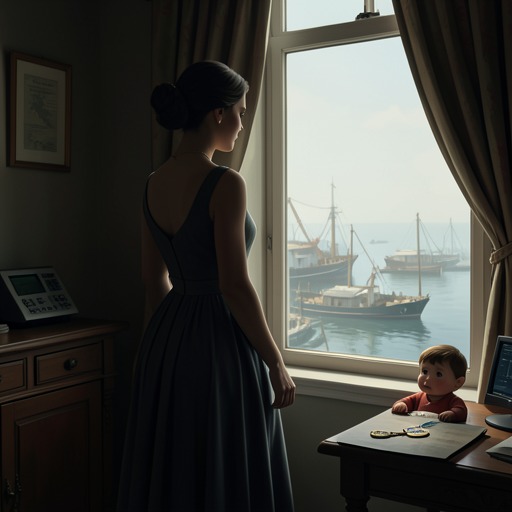
Claude Daigle's drowning
The Bad SeedClaude Daigle's drowning begins as a breaking-news announcement about an accidental death at a Fern Grammar School outing, but the details that accumulate afterward overturn that account. Claude's missing penmanship medal, the children's encounters at the old wharf, and Rhoda Howe Penmark's eventual admission establish that the drowning followed her attempt to take the prize. The event becomes the turning point in Christine Penmark's understanding of her daughter: an apparent tragedy exposes a deliberate killing and leaves Christine facing a choice between protecting Rhoda and acknowledging the harm done.
The Outing and the First Report
At three o'clock, while Monica Breedlove and Christine Penmark were at home, a radio bulletin announced that a child from the annual Fern Grammar School outing had drowned in the bay. The victim's name was withheld until the parents could be notified. Monica immediately rejected the possibility that the child was Rhoda, reasoning that Rhoda was too self-reliant to fit her idea of a child likely to suffer such an accident. Her confidence rested on Rhoda's composed manner, but that very composure would soon become part of Christine's unease.
The later bulletin named Claude Daigle, the only child of Dwight Daigle and Hortense Daigle. His body had been found among the pilings at an old wharf on Fern property, a place the children had explicitly been told to avoid. He had been marked missing at the routine lunchtime check; a guard found him and brought him ashore. The broadcast treated the bruises on his forehead and hands as likely consequences of his body striking the pilings. At this stage, listeners received the death as an accident with a few unexplained details, not as an attack.
The news also established a possible reason for the mystery surrounding Claude's final hours: only days earlier, he had received a gold penmanship medal at the Fern School closing exercises. He had been wearing it when last seen, but it was gone when his body was discovered. A search of the bottom near the wharf did not locate it. The missing award was initially reported as a small unresolved fact within the tragedy; later, it connected the death to Rhoda's fixation on the prize.
From Suspicion to a Reconstructed Encounter
When Rhoda returned, Christine tried to prepare her for the distress of having seen a child die. Rhoda said she knew what had happened and had been present when the body was brought from the water and laid on the lawn. She had even suggested that the guards search among the pilings. Rather than expressing grief or fear, she described the discovery and efforts to revive Claude as interesting. Christine had previously understood this coolness as a familiar family trait, called between her and her husband the Rhoda reaction; now it deepened her concern.
Accounts from the school later supplied the sequence behind the broadcast. On the bus, Rhoda repeatedly pressed Claude to let her hold his medal. When he refused, she continued to pursue the request until Claudia Fern moved Rhoda to a seat near the driver, away from him. Claudia Fern later spoke to Rhoda about courtesy and fair play. Less than an hour afterward, an older pupil serving as a monitor saw Rhoda block Claude's path, shove him, and reach for the medal. Claude broke away and ran toward the old wharf; Rhoda followed at a walking pace.
Around noon, a guard saw a girl in a red dress coming off the wharf and called out a warning. He did not know the children's names and could not identify the girl positively, but Rhoda was the only girl wearing a dress that day. At one o'clock Claude was found missing at roll call. In retrospect, the sightings joined the struggle over the medal to the place where Claude was found. At the time, each detail had been treated as incomplete or circumstantial, allowing the first account of an accident to stand.
The Medal and Rhoda's Admission
The missing medal became tangible evidence when Christine went to find Rhoda's locket in a tin in her dresser drawer. Beneath the oilcloth covering the drawer, she found the penmanship medal. Its presence in Rhoda's room contradicted the story Christine had heard about the award and made the earlier broadcast's unresolved loss newly significant. Christine put the medal back, recognizing that Rhoda had concealed it rather than simply found herself near the scene of an accident.
When Christine confronted her daughter, Rhoda first resisted and then calmly admitted that she had hit Claude with a shoe. She justified the attack by saying she had wanted the medal and that Claude had refused to give it to her. She further explained that, after he fell into the water, he tried to hold on to the wharf and threatened to tell on her. Rhoda said she struck his hands so that he would let go, and described the blood on her shoe as resulting from the blows. She continued to blame Claude, treating his refusal and threat as reasons that made her own actions his fault.
The confession clarified the bruises and the drowning without turning the radio bulletin into a reliable account of what had occurred: the broadcast had named the death accidental and attributed the marks to the pilings, while Rhoda's account revealed her role in causing Claude to lose his hold. It also exposed the medal not as a detached keepsake but as the object around which the confrontation began and as a clue Rhoda had hidden.
Christine's Dilemma and the Event's Consequences
The discovery and confession change the meaning of Christine's earlier efforts to comfort Rhoda. She had urged her daughter to put the distressing images out of her mind, while Rhoda insisted she had not been disturbed by what she saw. Once Rhoda admitted what she had done, Christine could no longer treat her calmness as simple insensitivity to an accident. Rhoda's statements placed the desire for the medal and the wish to prevent a report above concern for Claude's safety, while her repeated blame of Claude showed how she explained the harm to herself.
Christine considered whether Rhoda was insane and might need treatment, but concluded that she did not believe her daughter was insane. She also imagined going to the police and recognized that the authorities might remove Rhoda to an institution, although she did not know what procedures would follow. The question was therefore not an established legal outcome but Christine's unresolved choice: how to protect a child she loved while confronting what that child had done and the possibility of further harm. In a letter she did not intend to send to Kenneth, she framed the problem as a duty both to Rhoda and to the society in which they lived.
The episode's revelations also unsettle the reassuring signs Christine had relied on: Rhoda's school routines, her Sunday-school study, and her fluency in the language of ordinary childhood cannot establish that she understands or shares the moral concern those forms imply. The drowning converts the missing medal from a reported puzzle into a trail of evidence, and the first announcement's mistaken appearance of accident into a crisis of knowledge and responsibility. For Christine, the decisive change is not only that she learns what happened to Claude, but that she must decide what acknowledging the truth will require of her.