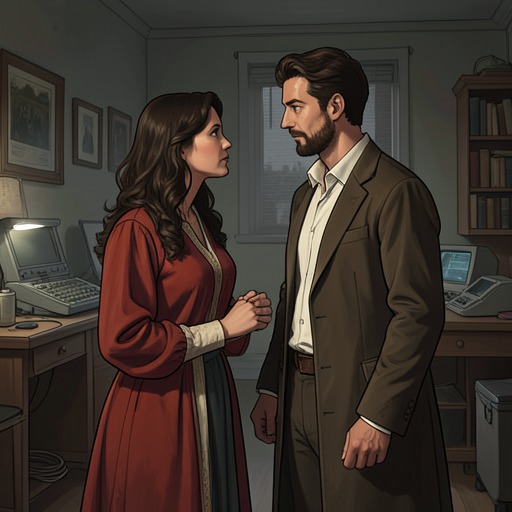
Kenneth Penmark
The Bad SeedKenneth Penmark is a naval officer, husband to Christine Penmark, and father to Rhoda Penmark. His work keeps him far from home for long stretches, making his absence a practical fact of family life and, during the crisis over Rhoda, a source of painful isolation for Christine. Kenneth is remembered through their courtship and her letters as a loving partner; at the story’s end, he returns to a family whose tragedy he cannot explain and embraces a daughter whose actions remain unknown to him.
Identity and Background
Kenneth is a young naval lieutenant when he first meets Christine in New York. At twenty-four, she is living with her seriously ill mother and working at an art gallery, having nearly concluded that she would never marry. She accepts an invitation to dinner chiefly to please her mother, who worries that Christine is too serious and rarely goes out. The host, Mrs. Bogardus, has arranged the party for her nephew Kenneth.
At the gathering, Kenneth and Christine find a brief private ease amid the other guests: they sit by the fire and discuss painters of the Paris School. The next afternoon he visits Christine at the gallery, ostensibly to see a Modigliani drawing she had admired. He tells her he is considering buying it for the woman he intends to marry, and Christine advises him that if the woman dislikes it, she is too dull for him. Kenneth buys the drawing. His playful declaration of intent becomes unmistakable when he gives it to Christine before leaving on Tuesday, kisses her in front of the people at the gallery, and departs. Christine’s mother dies that winter; Kenneth returns the following spring, and they marry.
Marriage and Family Life
Christine regards the marriage as deeply successful and believes she would not have married anyone else. The memory of their courtship remains vivid in her later letters: she recalls the evening they went dancing and the small gesture of Kenneth picking up his change, looking up, and smiling. Their affection is not merely backstory; when she is frightened and he is away, memories of their shared life become one of her principal sources of comfort.
Kenneth’s naval career requires frequent travel. During the events at Fern Grammar School, he is in South America surveying port facilities along the West Coast. He has embarked only the week before the school’s closing exercises, and Christine has received a cable confirming his arrival. The school’s staff have never met him, though Octavia Fern says they have heard pleasant reports of him and are eager to do so. Christine explains that he would have attended if he could, and that he has also expressed interest in meeting the Fern sisters.
The couple considers Christine accompanying Kenneth on this unusually long trip, but abandons the plan. They tell each other that the additional expense would be better put toward the house they hope to build; the deeper obstacle is Rhoda. They feel unable to take their daughter with them and unable to leave her with anyone else, even Monica Breedlove, who is tolerant and doting. Their concern is rooted in a history they have struggled to understand: Rhoda has seemed strange to them, and a previous school asked that she be removed after describing her as self-sufficient, difficult, persuasive in lying, and a thief. Kenneth shares Christine’s unease about their daughter, though the crisis itself unfolds while he is away.
Distance, Letters, and Shared Responsibility
The separation gives Kenneth a continuing presence in Christine’s thoughts but little direct access to what she is facing. In a long letter dated June 16, 1952, she recounts Rhoda’s failure to win the penmanship medal, Claude Daigle’s death, Fern Grammar School’s unwillingness to accept Rhoda for the next term, and the death of an elderly woman in Baltimore. She also recalls how calm Kenneth once considered her and confesses that she feels caught in a trap she cannot understand. Even as she names the troubling incidents, she warns him that they admit of more than one interpretation.
When a letter from Kenneth arrives, Christine reads that he misses her and Rhoda and wants to finish his work quickly so he can return. She studies his photograph in naval uniform and takes comfort in the love they share, but that comfort cannot bring him home. She writes again, detailing her growing fears and the medal she found, Rhoda’s evasiveness, and her visit to the Daigles. These letters are unsent: Christine imagines that, once her fears have proved groundless, they might read them together and Kenneth might gently laugh at her anxieties.
As her suspicions become certainty, the letters change from an outlet for ambiguous dread into a record of an unbearable decision. Christine wishes Kenneth were beside her to advise and sustain her, and initially reminds herself that responsibility for Rhoda belongs to both parents. She hopes that Rhoda is too young to understand what she has done and that the child may never repeat it. But after learning the truth about her own parentage, Christine revises her understanding of the family crisis: she sees herself, not Kenneth, as the source of what she calls the “bad seed,” and concludes that she must handle the problem alone. She also believes she cannot bring herself to tell him what she has discovered about Rhoda. His absence is therefore more than geographic: Christine’s shame and resolve prevent him from sharing knowledge that she considers central to their future.
Return and Ending
After Christine’s funeral, Kenneth sits in Monica Breedlove’s living room. Rhoda has left the hospital and is staying with Mrs. Forsythe until arrangements for her future can be made. Mrs. Forsythe has offered to keep her temporarily or indefinitely, while Kenneth expects that his mother and sisters, due to arrive the next day, may take the child. His immediate concern, however, is the question he cannot answer: why Christine died by suicide. He asks Monica whether Christine gave any indication of her reason, insisting that she must have had one. Monica says she does not know and that neither Reginald Tasker nor Octavia Fern has been able to explain it. Kenneth rejects the possibility that Christine was insane; Emory Breedlove likewise says she was desperately worried.
When Mrs. Forsythe brings Rhoda into the room, the child goes to her father and embraces him. She then pulls away, dances across the carpet, and offers him “a basket of kisses.” Kenneth answers that he will give her “a basket of hugs,” and covers his face, weeping. The exchange echoes the loving family bond Christine had hoped to preserve, but it also exposes the gulf between Kenneth’s grief and what he knows. He has returned to Rhoda without learning what Christine learned or why she believed she had to act. Mrs. Forsythe leads Rhoda away to cut paper dolls, telling Kenneth he is tired from his long plane trip, while urging him not to despair because Rhoda was spared.
Narrative Role
Kenneth’s characterization is built largely through absence: his naval assignments keep him outside the scenes in which Christine’s suspicions gather and her decisions harden. Yet the remembered details of the courtship, the letters he sends, and the letters Christine writes but does not send make him an emotional constant. He represents the partner Christine longs to consult and the shared parental responsibility she first tries to uphold. Her eventual conviction that she alone is responsible, and her decision not to tell him what she knows, turn that marital intimacy into painful separation. At the close, Kenneth’s tender reunion with Rhoda is sincere, but his unanswered questions show how little the family’s outward affection can disclose about the concealed history that has destroyed it.