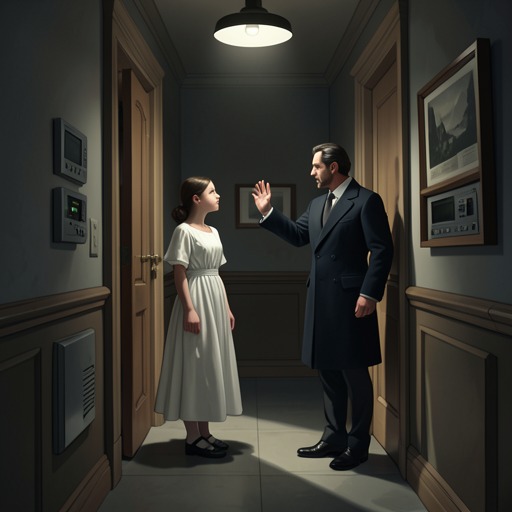
Small Park by the Apartment Building
The Bad SeedThe Small Park by the Apartment Building is a familiar neighborhood space that becomes a recurring stage for the novel’s mounting conflict around Rhoda Penmark. Beneath its pomegranate tree, ordinary activities such as reading and crocheting unfold alongside Leroy Jessup’s accusations and Rhoda’s efforts to manage what others know. The park’s paths, nearby bushes, and view from Christine Penmark’s window give these encounters a practical geography: people can approach, watch, hide from view, or leave, while suspicion grows in plain sight.
Setting and Everyday Use
After lunch, Rhoda asks Mrs. Forsythe for permission to sit in the park. She takes a book to her usual place beneath the pomegranate tree, but has barely found the right page when Leroy arrives, pretending to sweep the path behind her. He repeatedly sweeps the same spot before addressing her. The scene establishes the park as part of Rhoda’s routine, but also as a place where that routine can be interrupted by Leroy’s persistent attention.
The park’s recognizable landmarks recur as the characters use the space differently. The pomegranate tree marks Rhoda’s chosen place; a dead branch from it becomes an object Leroy uses to press his accusation. Elsewhere, the bridal-wreath bush offers a position outside Christine’s view from the window. The lily pond and the path toward the building also appear in Leroy’s movements. These details make the park more than a general outdoor backdrop: its familiar features shape who can observe a conversation and who can evade observation.
Leroy’s Accusations
Leroy uses the park to taunt Rhoda about Claude Daigle. While she sits reading, he suggests that her contentment comes from remembering the boy she struck. Rhoda answers in a dismissive, adult-sounding manner, telling him to finish sweeping and leave her alone. Leroy then picks up the dead branch, weighs it in his palm, and asks whether it is the size of the stick used against Claude. The branch turns an ordinary piece of the setting into a prop in his attempt to make Rhoda react.
Leroy goes on to describe his version of Claude’s death and to claim that traces of blood could remain on the stick despite washing. His threats depend on a supposed investigation: he imagines police finding the object and presenting it as evidence. When Christine enters the park looking for her daughter, she senses the tension and asks Leroy what he has said to Rhoda. He minimizes the exchange, and Christine asks Rhoda directly what happened. The interruption makes the park a meeting point between Leroy’s private harassment and Christine’s attempts to monitor and protect her daughter.
As Rhoda leaves the park, Leroy continues from the basement doorway, threatening that the police will find the stick and that she will face punishment. Rhoda replies that the electric chair is too large for her. His answer invents a smaller chair for children. The exchange carries their conflict from the park into the building’s threshold, showing how the park’s proximity to the apartment makes it difficult for Rhoda to leave Leroy’s provocations behind simply by going indoors.
Concealment and Escalating Suspicion
After Rhoda and Christine return from their stay at the inn, Rhoda again goes to the park, this time to crochet beneath the pomegranate tree. Leroy approaches and accuses her of having persuaded Christine to take her to the bay in order to look for the stick. Rhoda does not look up or openly acknowledge him. Instead, she tells him to stand by the bridal-wreath bush, where Christine at the window cannot see him. The park thus becomes a space Rhoda actively manages: she directs Leroy to a concealed position while maintaining the appearance of an ordinary afternoon activity.
From there, Leroy shifts his attention to the heavy shoes Rhoda wore to the picnic and has not worn since. Rhoda denies ever having had such shoes. When he later says he was only teasing her, she follows him insistently, asking for the shoes to be returned. His earlier joking gives way to a growing belief that she killed Claude with a shoe. He becomes frightened and resolves not to discuss the matter with Thelma Jessup or anyone else. The park encounter therefore marks a change in Leroy’s conduct: his teasing has become a suspicion he fears to voice, while Rhoda’s insistence makes him feel pursued in turn.
The park remains part of the sequence leading to Leroy’s death, though the killing takes place in the basement, not in the park. The next day Leroy tries to avoid Rhoda, while she watches his movements from her window. Later, an ice-cream seller draws the neighborhood children away from the park and courtyard, leaving the area deserted for a time. Rhoda asks Christine for money, takes two kitchen matches, and goes downstairs with her ice cream. Christine watches her movements from the kitchen window, but the fire Rhoda sets is in Leroy’s basement room. The emptied park and courtyard form part of the opportunity surrounding the act, rather than its location.
Narrative Significance
The park’s repeated appearances connect ordinary childhood routine with the adult world of accusation and surveillance. Rhoda reads, crochets, and sits among neighborhood children; Leroy sweeps, watches, and tries to draw from her a response about Claude. That contrast makes the setting’s familiarity consequential: the danger develops not in a distant or exceptional place, but alongside everyday use of the apartment grounds.
The park also stages a shifting balance of knowledge. Leroy first uses it to announce his suspicions to Rhoda, while Christine’s arrival briefly exposes their exchange to parental scrutiny. Later Rhoda exploits the view from Christine’s window by directing Leroy behind the bridal-wreath bush. Christine, in turn, watches Rhoda from the kitchen window during the final sequence. The window and the bush create opposing conditions of visibility: one allows Christine to observe, the other lets Rhoda control what her mother can see. Across these scenes, the park’s landmarks help make concealment and observation part of the action, as suspicion moves from Leroy’s taunts toward the fatal act that follows.