Aeron Fowler
The Ballad of the Last DragonAeron Fowler is the expedition leader whose dragon quest gives the novel its central direction and whose death changes the meaning of that quest. He begins as an exuberant, conspicuously theatrical nobleman seeking not wealth but a name that will survive him. By the time he falls in a mercenary ambush, his desire for legend has become a burden and an inheritance for the companions who remain. Sylvaine Abelan’s later decision to continue his journey, complete his mission, and turn him into a ballad hero makes Aeron both the architect of the adventure and the absent figure around whom its second life is organized.
Identity and Introduction
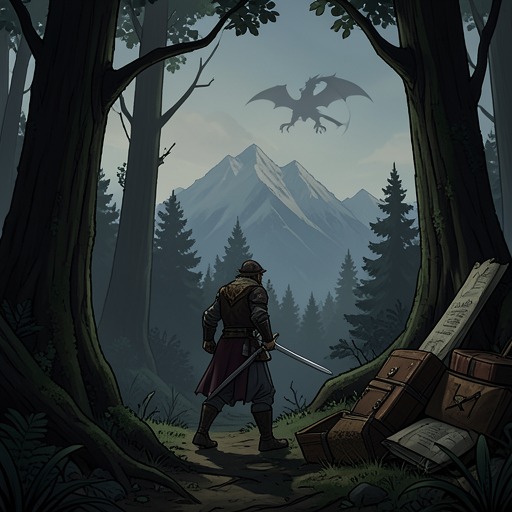
Aeron first appears at the tavern as a tall man whose excitement seems to propel his movement: he skips through the door, wears his long red hair loose over custom-made shiny armor, and displays a broad grin with straight white teeth. His eagerness is so unguarded that Sylvaine finds him handsome and immediately adorable. He orders a bottle of the tavern’s finest brew loudly enough to startle Petey from a snore, while Kingsley responds by opening his most expensive Bjovian wine. The entrance establishes Aeron’s defining mixture of spectacle, confidence, and youthful delight; he does not merely arrive in a room, but performs his arrival.
His performance quickly reveals a serious purpose. When Jaromir impatiently invokes the dragon, Aeron tells him to be patient because the dragon will wait, then leads Sylvaine to the table where Neith and Cadoc are seated. He describes whispers of fathomless wealth hidden in an unnamed mountain, guarded by the last dragon of the age, with every previous seeker lost to flame. The person who defeats the dragon and claims the treasure, he explains, will be immortalized as a legend long after death. Aeron’s account supplies the expedition’s promise, but Sylvaine notices that he gives more grand declaration than immediate dramatic detail. His quest is therefore introduced in the same register as his entrance: vivid, attractive, and deliberately larger than ordinary life.
Aeron then turns that rhetoric toward recruitment. After learning Sylvaine’s name, he beckons her closer and asks whether she would like to go on an adventure. The question is not simply logistical. It recognizes that her identity as a performer might be joined to his need for a story, even before either of them understands how closely their fates will become linked. His invitation makes the tavern a threshold between ordinary performance and dangerous travel, with Aeron acting as the herald who opens that passage.
Background and Motivation
Aeron hails from House Fowler, a noble family that owns much of the countryside beyond Lindale. He is the youngest of five brothers and has no interest in inheriting the family legacy. Although the expedition is associated with wealth, Aeron insists that the hoard itself does not matter to him, nor does his own share of family fortune. What he wants is a name that will last through the ages, a form of immortality valuable enough to outweigh everything he owns down to the last copper. His ambition is thus not primarily economic. Treasure is the material instrument of a story, while fame is the true prize.
His position within the family has shaped that hunger. Aeron explains that his father regarded pleasure as listlessness or indulgence and that they rarely agreed. As the youngest of five brothers, Aeron understands himself as the spare: an unnecessary addition to a long line of heirs. For a time, that status granted him freedom. Family money allowed him to pursue whatever venture, passion, or leisure attracted him. He once announced that painting was his life’s calling, boarded the next ship to Lindale, and spent the spring proving that he possessed neither the focus nor the talent to become a great painter. His laughter at the memory is self-mocking, but the failure has a darker consequence: he believes that by playing the fool too convincingly, he destroyed whatever trust or good opinion his family might once have held.
The dragon quest emerges from this history as a bid to escape disposability. Aeron has wealth, birth, and mobility, yet none of them guarantees significance. His brothers represent continuity within House Fowler; Aeron seeks a different inheritance, one made from deeds and retold language. That distinction explains why Sylvaine responds to him. She understands the wish to carve out a place in a vast world rather than disappear as if one had never been born, even though Aeron’s method is adventure and hers is art. Their alliance begins at the point where heroic action and artistic remembrance meet.
Leadership, Recruitment, and the Quest’s Public Face
Aeron’s leadership depends as much on presentation as on authority. He announces the expedition in a heroic register, thumping his fist against his spotless chest plate while beginning to describe the group’s “noble quest”; Cadoc immediately redirects the claim toward a search for fine drinks, exposing the gap between Aeron’s grand self-image and the companions’ practical awareness. Aeron’s public notice makes that gap more consequential. Under the name Sir Aeron Fowler, he promises adventure, travel, unimaginable wealth, fair compensation, and a “chance of a lifetime,” listing courage, loyalty, fighting and survival skills, willingness to share, and leadership potential among the requirements. The notice also reveals his carelessness: it states the intended route as far as Gilbrock and the plan to enter uncharted territory, information that Danion’s company later uses to locate and ambush the expedition. Aeron’s theatrical confidence can attract allies, but it also turns the quest into a visible target.
His relationships with Neith, Cadoc, Jaromir, and Sylvaine complicate the image of a self-involved noble adventurer. He presents the quest as his own undertaking, yet its execution depends on the distinct abilities of the people around him, and the group’s survival requires them to correct or restrain his impulses. The expedition is therefore not a solitary hero’s march toward glory but a fragile collective enterprise assembled through Aeron’s persuasive language. That collective quality becomes clearest after his death, when Sylvaine identifies the remaining companions’ skills—Cadoc’s wound care, Neith’s blades and judgment, and Jaromir’s fighting ability and knowledge of the land—as reasons to continue. Aeron’s leadership persists less as command than as a structure his companions inherit and reconstruct.
The ambush exposes the mortal cost of Aeron’s legendary self-fashioning. After the company encounters Danion and his men, Aeron is found lying in the road with an arrow jutting from his chest, blood and dirt spreading across his tunic. He survives that injury long enough to face a second, decisive attack: when Sylvaine is pushed aside, Aeron takes her place, and Danion’s sword passes through his back so that its bloody tip emerges from his chest. Aeron pulls himself free of the blade, sways, and sinks to his knees while the battle continues around him. The scene reverses the posture of his earlier entrances. The man who once arrived skipping through a tavern in gleaming armor is reduced to a body in the dirt, while the quest he made visible survives beyond his control.
Death, Final Words, and Inherited Mission
Aeron’s death is not only the physical end of the expedition’s leader but the moment when his stated desire for immortality is tested against the irreducible fact of mortality. After the sword is withdrawn, he falls into Sylvaine’s arms with blood already staining his lips. His blue eyes lose their focus as she holds his hand, and the battle recedes from her attention while she tries to keep him present. Aeron calls for Neith, then speaks of home, revealing that beneath the public language of treasure, courage, and legendary renown lies a final longing for return. His last word is Neith’s name, and his last breath transforms their shared past into an unresolved emotional truth. Neith’s reaction—clutching her hair and backing away when Sylvaine tells her what he said—confirms the force of that loss without reducing it to a simple explanation. Aeron dies still attached to the people who made the quest possible, not merely to the fame he once imagined waiting at its end.
The companions refuse to let his death terminate the journey. In the immediate aftermath, Sylvaine tells Jaromir that they should complete Aeron’s quest, secure the promised payment, and preserve the support he had intended for Jaromir’s sister-in-law and nieces. She also frames continuation as a way to bring eternal glory to Aeron’s name and fulfill his greatest wish. The proposal makes the surviving party both beneficiary and custodian: Aeron’s supplies, destination, and funding remain, but the purpose of those resources has changed from his personal ascent to a collective act of loyalty. Sylvaine’s determination crystallizes in her promise to bring Aeron honor and fight his dragon. His adventure therefore becomes a relay rather than a failed solo quest, passing from the man who sought the legend to the companions who must make the legend possible.
Aeron’s absence later becomes a deliberate public performance. Sylvaine sings of him as possessing a warrior’s heart and a saint’s mercy, while Cadoc enters wearing Aeron’s armor, polished until it shines and made to resemble a guardian descended from the Welkin. The disguise is knowingly imperfect: Cadoc and Jaromir will show their faces, and the party relies on confused or drunken eyewitnesses rather than a flawless imitation. Yet the scheme captures Aeron’s lasting narrative function. His body is gone, but his armor, name, deeds, and companions can still produce the heroic figure he wanted the world to remember. The man who once performed his own arrival is finally remade by others into a story capable of traveling without him.
Relationships and Narrative Role
Aeron Fowler’s relationships reveal the limits of his heroic persona and the human attachments beneath it. His bond with Neith is especially important because his final consciousness turns toward her: after Danion’s sword has pierced him, he calls her name and speaks of wanting to go home before dying with her name as his last word. Sylvaine later tells Neith that Aeron seemed to regard her as his last hope, the person he trusted to take him home even as death approached. Neith answers only that Aeron was an old friend, leaving the history between them partly unstated while making its emotional weight unmistakable. The restraint surrounding their connection contrasts with Aeron’s usual expansiveness; the most intimate truth about him is carried through broken words, another person’s testimony, and Neith’s stunned silence.
With Sylvaine, Aeron forms an alliance between heroic action and artistic memory. He recruits her by asking whether she would join an adventure, while she immediately recognizes that his story requires sharper detail and stronger dramatic shaping. Their difference is productive: Aeron supplies the dangerous deed and the theatrical ambition, whereas Sylvaine supplies interpretation, skepticism, and eventually the means of preserving his reputation. After his death, she does not merely mourn him. She converts his quest into material for a ballad and treats the completion of the dragon hunt as both practical responsibility and artistic commemoration. Aeron’s desire for immortality thus becomes dependent on the performer whose judgment had initially exposed the weakness of his storytelling.
Cadoc and Jaromir function as corrective forces within Aeron’s circle. Cadoc interrupts Aeron’s grand announcement of a noble quest by reducing it to a search for fine drinks, and later condemns the public recruitment notice that exposed the party’s route. These interventions puncture Aeron’s inflated presentation without making the quest meaningless. Jaromir, meanwhile, embodies the practical danger that Aeron’s rhetoric tends to overlook; he is impatient for progress, protective during encounters with strangers, and essential to the group’s fighting and survival. Aeron’s authority therefore depends on companions willing to challenge the performance while still carrying its purpose forward.
This tension makes Aeron a rounded rather than merely emblematic figure. He is at once a wealthy nobleman, a self-conscious failure, an exuberant adventurer, a careless recruiter, and a dying man who longs for home. His spectacular armor and heroic voice promise one kind of identity, while his admission that he was the unwanted spare of House Fowler exposes another. The plot does not resolve these versions by proving one false. Instead, it allows the public persona to collapse at death and then lets the surviving companions decide what parts of it deserve preservation. Aeron’s narrative importance lies precisely in that unfinished transformation: he begins by trying to author his own legend, but the legend ultimately belongs to those who loved, followed, corrected, and remembered him.
Narrative Role and Legacy
Aeron Fowler’s significance ultimately lies in the tension between self-authorship and communal remembrance. He begins by trying to design the conditions of his own immortality: he chooses the dragon, frames the expedition as a noble quest, publicizes his name as Sir Aeron Fowler, and imagines that a spectacular deed will rescue him from obscurity and from his family’s judgment. Yet his death prevents him from controlling the meaning of that deed. The surviving companions must decide whether the quest was merely a failed pursuit of wealth or a promise worth inheriting, and Sylvaine Abelan answers by transforming it into both an ongoing mission and a public story. Aeron’s legend is therefore not the simple reward he expected at the end of an adventure. It is an unstable construction assembled from his ambitions, his failures, his relationships, and the labor of those who remain.