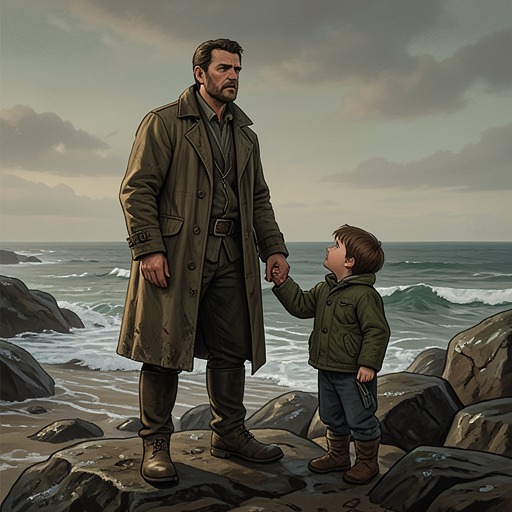
Aeron Fowler–Cadoc
The Ballad of the Last DragonAeron Fowler–Cadoc is a protective but volatile companionship at the center of Aeron Fowler’s adventuring party. Cadoc enters Aeron’s life by saving him from the consequences of an arrogant recruitment attempt, and thereafter becomes both companion and corrective force: he protects the party’s vulnerable members, challenges Aeron’s carelessness, and remains invested in the expedition even when Aeron’s leadership endangers everyone. Their relationship is therefore built less on ease than on an unstable mixture of obligation, irritation, practical loyalty, and reluctant familial fondness.
Chance, Recruitment, and the First Debt
Cadoc’s account of their meeting places the relationship in the Rutting Goose, a dangerous tavern on the far side of the Jürden Sea known for black-market dealings and unsavory ventures. Cadoc had gone there after hearing of a job that suited his interests, only to find himself at the bottom of several bottles. Aeron Fowler then arrived announcing that he needed skilled fighters and was willing to pay generously. In a place where survival depends either on being dangerous enough to intimidate others or invisible enough to avoid notice, Aeron was neither. His open recruitment pitch and conspicuously full purse made him an easy target.
Cadoc says that he saved Aeron from being killed when Aeron entered the tavern seeking experienced fighters. He emphasizes that the rescue depended partly on circumstance: had he not been nursing a massive hangover, he would have been at the docks preparing The Jaunty Loon for its voyage, and Aeron would have been left to face men who might have gutted him and displayed his body in the market square. The relationship consequently begins with a debt that is both literal and comic. Cadoc’s intervention gives Aeron a future, but Cadoc refuses to romanticize it as destiny; he treats it as a lucky interruption in his own plans.
Aeron’s response reveals the imbalance between their initial roles. He defends his recruitment method by asking how else he could have found the seasoned fighters he wanted, while Cadoc reduces the explanation to Aeron’s public display of naivety and wealth. Their exchange establishes the pattern that will govern them: Aeron supplies the ambition and the money, while Cadoc supplies the worldly judgment Aeron lacks. The mockery is sharp, but it also marks familiarity. Cadoc can ridicule Aeron because he has already chosen to remain close enough to keep him alive.
The Protector Against Recklessness
Cadoc’s protective role becomes clearest when Neith is wounded after compensating for Aeron’s poor judgment. As Cadoc dresses her injury, he wraps an arm around her shoulder and directly condemns Aeron, telling him that his incompetence could have gotten her killed. The accusation is not abstract. Aeron can barely manage his sword, yet he wears heavy plate armor in the middle of summer and continues trying to play the hero. Neith has been forced to cover for him, turning Aeron’s performance of martial leadership into a danger borne by someone else.
Cadoc’s anger is intensified by the fact that Neith minimizes the injury, insisting that it is only a scratch. To Cadoc, her refusal to acknowledge the danger does not excuse Aeron; it confirms how close the party has come to disaster. His statement that it is a miracle Aeron has not already been killed for his witlessness presents protection as a form of discipline. Cadoc does not merely shield companions from immediate harm. He tries to force Aeron to recognize the difference between courage and theatrical irresponsibility.
This scene gives the relationship a familial quality without making it gentle. Cadoc’s care appears through physical attention to Neith’s wound and through furious confrontation with Aeron. His protectiveness is distributed across the group, but Aeron receives the harshest treatment because Aeron’s decisions create the risks Cadoc must manage. Cadoc acts as the practical guardian of a leader who wants the authority of a hero before acquiring the competence required to protect others.
Command, Money, and the Line of Conflict
Aeron does not simply accept Cadoc’s correction. After an awkward silence, with his cheeks flushed and his eyes glassy, he marches toward Cadoc in clanking armor and insists that the risks were clear when the others joined the job. He argues that no one is forcing Cadoc to follow him and that the party is being paid handsomely. If the money is not enough to command respect, Aeron leaves the challenge hanging while spreading his arms wide. The gesture draws a line between employer and employee, leader and subordinate.
The confrontation exposes the structural weakness beneath their companionship. Aeron’s authority rests partly on payment and on the promise of the quest, whereas Cadoc’s authority within the group rests on experience and the ability to respond when plans fail. By invoking compensation, Aeron attempts to convert loyalty into a contractual obligation. Cadoc’s clenched jaw and tightened lips show that the answer he wants to give is being restrained, not erased. The silence is a temporary ceasefire rather than a resolution.
Yet the conflict also demonstrates why the pair cannot be reduced to a simple commander-and-mercenary arrangement. Cadoc’s criticism is motivated by the safety of the party, not by a refusal to work. Aeron’s anger comes from humiliation and wounded authority, but he continues to depend on the very people whose judgment he resents. Their relationship is held together by a contradiction: Aeron needs Cadoc’s competence, while Cadoc objects to the conditions under which Aeron exercises command.
Loyalty Under the Threat of Exposure
The relationship is tested again when Danion confronts the party with Aeron Fowler’s recruitment notice. The notice promises adventure, travel, unimaginable wealth, fair compensation, team-building exercises, and a journey along the merchant roads toward Gilbrock before the party enters uncharted territory in search of a secret cache. It lists courage, loyalty, fighting ability, survival skills, willingness to share, and leadership potential among the requirements for joining. Danion’s sneering recitation turns Aeron’s optimistic advertisement into evidence that the party has been exposed and can be tracked.
Cadoc reacts immediately, cursing while working to keep the horse calm. He says that he thought he had torn down all the notices and reminds Aeron that he had warned him not to state the travel route. The response combines damage control with reproach. Cadoc is still performing the practical labor needed to prevent the situation from worsening, but he also makes clear that the danger was foreseeable and that Aeron’s public promises created it.
Aeron answers with the subdued admission that hindsight is the greatest teacher. Unlike the earlier confrontation, he does not try to assert dominance through payment or challenge Cadoc’s right to criticize him. The exchange suggests a limited but meaningful adjustment: Aeron remains capable of disastrous judgment, yet Cadoc’s warnings have become part of the way he understands his own failures. Their bond survives because Cadoc’s anger is paired with continued action and Aeron, however reluctantly, can recognize the truth in it.
A Bond Made of Friction and Dependence
Aeron Fowler–Cadoc is defined by an exchange of opposing functions. Aeron is the ambitious initiator who gathers people for a dangerous quest, advertises the mission too openly, and presents himself as a heroic leader despite limited practical skill. Cadoc is the experienced companion who saves him at the Rutting Goose, manages immediate physical danger, tends the wounded, controls frightened animals, and identifies the consequences Aeron prefers not to see. The protector is not outside the adventure; he is the person who keeps the adventure from collapsing under its leader’s mistakes.
The relationship also complicates the conventional quest pattern in which a hero receives unquestioning support from an ally. Cadoc is an ally who refuses to flatter the hero. He can rescue Aeron and still call him incompetent; he can remain with the expedition and still challenge the authority Aeron claims; he can value the group and still resent the recklessness that repeatedly places it in danger. This makes Cadoc’s loyalty more substantial than obedience. It is a continuing decision to protect people while contesting the methods of the person who recruited them.
Their repeated clashes therefore carry the force of a rough family dynamic: affection is expressed through irritation, responsibility through intervention, and trust through the freedom to speak angrily without immediately abandoning the group. Aeron Fowler and Cadoc do not form a calm partnership. They form a necessary one, in which Aeron’s quest depends on the very judgment his pride most resists and Cadoc’s protectiveness keeps returning him to the work of safeguarding an imperfect leader.