Aeron Fowler’s crew
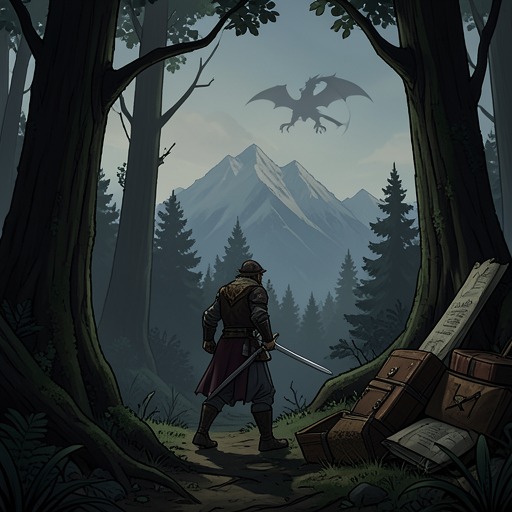
The Ballad of the Last DragonAeron Fowler’s crew is the adventuring company formed around Aeron Fowler’s quest for the fabled hoard of the last dragon. Its decisive importance lies in its mixed composition: Cadoc, Neith, and Jaromir provide hired martial strength, while Sylvaine Abelan joins as the bard whose songs can turn the expedition’s deeds into a public legend. The crew therefore operates as both a paid venture and a story-making enterprise, binding protection, money, travel, and reputation into one improbable expedition.
Formation and Purpose
The company takes shape when Aeron Fowler recruits armed companions for his dragon quest and brings Sylvaine Abelan into the arrangement. Cadoc, Neith, and Jaromir are explicitly blades for hire, retained on Aeron’s payroll for the venture; after agreeing to accompany the group, Sylvaine is also paid. Her reason for accepting is practical as well as artistic: the journey promises coin, protection, and the chance to make a name for herself by traveling from tavern to tavern. The expedition thus answers two needs at once. Aeron requires people capable of surviving danger, while Sylvaine needs material for a career and a public audience for the stories she can create from it.
The quest itself remains uncertain even to one of its participants. Sylvaine regards Aeron’s claim about the last dragon’s hoard as far-fetched and wonders whether he has truly found it. That doubt does not prevent her from joining. The crew is founded not on shared certainty but on overlapping incentives: Aeron pursues the treasure, the hired fighters pursue payment, and Sylvaine pursues opportunity. Its cohesion begins as a contract before it develops into fellowship.
Members and Internal Structure
Aeron functions as the crew’s leader, employer, and organizer. His authority is expressed through recruitment, payment, logistical decisions, and the expectation that those who accept the work will face the risks attached to it. When the party prepares to depart, Aeron oversees the division of supplies among the horses and then turns to Sylvaine with a direct question about her readiness. The gesture places her within the operational body of the expedition rather than treating her merely as an observer or entertainer.
Cadoc, Neith, and Jaromir form the company’s armed core. Their professional status gives the group a clear economic structure: Aeron pays, and the others undertake the dangers of the job. Yet the arrangement is not frictionless. Jaromir objects to carrying Sylvaine’s additional weight and tells her that she must either go without supplies or find a way to manage them herself. Sylvaine interprets his hostility as a threat to the protection she was promised and confronts him before departure, insisting that any grievance be spoken openly rather than allowed to endanger her at the hands of a supposed ally.
The crew’s structure is therefore practical but unstable. Aeron commands, the fighters protect and carry out the dangerous work, and Sylvaine contributes artistic labor while depending on the others for safety. The argument over supplies exposes the unequal burdens hidden inside the contract: a bard may be central to the expedition’s future reputation while still being viewed by a soldier as extra weight in the present.
Recruitment and the Traveling Bard
Jaromir’s presence results from a separate opportunity before it becomes part of the larger dragon venture. Aeron explains that Jaromir had already been hired for another venture after seeing one of Aeron’s advertisements on a noticeboard and finding the group on the morning they embarked. The advertisement was meant to gather help, although Cadoc had warned Aeron against posting it. Aeron defends the decision because, without it, Jaromir might have left for Kalinia before discovering the opportunity.
This recruitment story gives the crew an accidental quality. It is not presented as a perfectly designed fellowship assembled according to a grand plan. Instead, it grows through notices, timing, available labor, and individual decisions. Aeron’s advertisement opens a path that might otherwise have closed, and Jaromir’s arrival turns a separate employment arrangement into part of the dragon quest.
Aeron sees Sylvaine’s addition as the final element that transforms a group of workers into a recognizable band. He calls them a merry band of adventurers and identifies Sylvaine as a real bard who can sing of their exploits. His enthusiasm reveals that he understands the quest’s success as partly reputational: the crew must not only undertake extraordinary deeds but also have those deeds carried into public memory. Sylvaine is consequently not decorative. Her art is one of the expedition’s instruments.
Conflict, Risk, and Authority
The company’s first tensions arise from the collision between professional obligation and personal respect. Sylvaine insists that her artistic integrity comes before false praise after Aeron insults her work during a song. Her refusal to flatter him establishes that the bard is not a compliant employee whose role is simply to glorify the leader. She accepts the job, but she does not surrender judgment or dignity along with it.
The crew’s more serious dispute follows an injury caused by the expedition’s dangers. After Cadoc finishes dressing Neith’s wound, he condemns Aeron’s recklessness and treats her survival as nearly miraculous. The exchange makes clear that the company’s work is not an abstract adventure but a job in which members can be maimed or killed. Aeron responds that the risks were made clear, that everyone signed up for the work, and that no one is being forced to follow him. He also emphasizes that the crew is being paid handsomely, making compensation the formal basis of his authority.
Aeron’s response draws a line within the company. His words defend contractual consent, but his anger and clanking armor show how quickly the employer’s logic becomes a personal confrontation. Cadoc clenches his jaw and restrains the words he wants to say, leaving the conflict unresolved rather than reconciled. The crew survives this moment because its members remain bound by the job, yet the scene exposes the cost of treating danger as a condition that money alone can settle.
Narrative Function and Significance
Aeron Fowler’s crew joins the quest structure to an episodic traveling world of roads, taverns, advertisements, and chance encounters. Its members move between places as a compact social unit, carrying the expedition from private intention toward public legend. The crew’s mobility also gives Sylvaine the route she wants: a chance to earn coin, perform before new audiences, and build a name through the exploits of others without abandoning her own standards.
The group embodies a tension between myth and material reality. Aeron speaks in the language of a legendary discovery, but the expedition depends on payroll, supplies, horses, wounds, and arguments over carrying weight. The phrase “merry band of adventurers” captures Aeron’s preferred heroic framing, while the hired status of Cadoc, Neith, and Jaromir keeps the practical economics visible beneath it. The crew becomes meaningful precisely because it holds those modes together: a commercial undertaking that wants to look like an epic fellowship, and a fellowship whose future depends on whether anyone can make its dangerous work into a compelling story.