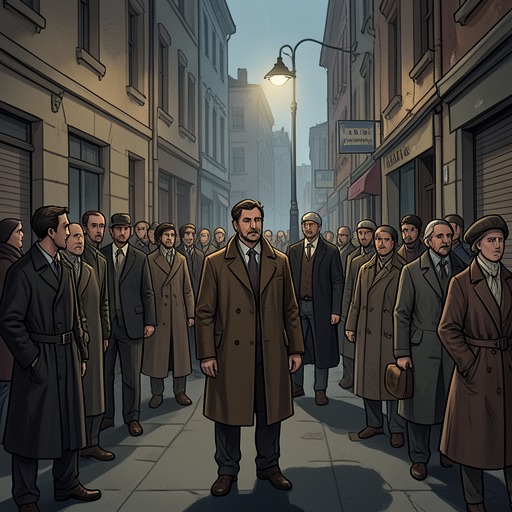
Aeron identity deception plan
The Ballad of the Last DragonThe Aeron identity deception plan is a deliberate scheme to keep Aeron Fowler’s name alive after his death by presenting an invented continuation of his life. Conceived by Sylvaine Abelan and carried out with Jaromir, Cadoc, and Neith, it uses performance, costume, tavern gossip, and controlled deception to restore Aeron’s honor and secure the heroic ending he was denied in life. Its decisive act is not merely impersonation: it converts absence into evidence of greatness and turns a dead adventurer into a public legend.
Purpose and Design
The plan begins as a response to the shame surrounding Aeron’s death and the desire to welcome him home as a hero rather than allow his memory to be diminished. Sylvaine argues that continuing the quest in his apparent presence would honor his wishes. She proposes writing and singing ballads in his name, exaggerating his exploits, visiting as many inns and taverns as possible, and taking contracts that could be completed under his name. Each performance would enlarge Aeron’s reputation until his brother was forced to restore Aeron’s honor.
The intended final movement is both theatrical and strategic. At the end of the journey, Aeron will be said to die bravely while taking the dragon down with him. The story therefore supplies the public with a complete heroic arc: a living adventurer who travels, performs great deeds, confronts the dragon, and sacrifices himself in victory. The plan replaces the humiliating fact of an uncelebrated death with a narrative of courage, while also making Aeron’s posthumous reputation difficult for his family to ignore.
The Impersonation Scheme
The group decides that someone must pose as Aeron, but Sylvaine rejects the idea of bringing an outsider into the secret. A hired impersonator could expose the scheme or use it for blackmail. Instead, the companions already possess the people and materials needed to make the deception work. Jaromir and Cadoc are assigned to take turns wearing Aeron’s armor, allowing the supposed Aeron to appear in different places without requiring a stranger to learn the group’s purpose.
The armor is central to the scheme because it provides a recognizable public identity while leaving room for uncertainty. Cadoc’s first appearance is prepared with painstaking care: the armor is polished to a high sheen, and in the candlelight he resembles a fierce guardian descended from the Welkin. The group understands that a tavern appearance cannot be perfectly controlled. Aeron’s face cannot remain hidden behind a helm if the figure is expected to mingle with patrons, so both Cadoc and Jaromir will sometimes be seen openly. Rather than treating this inconsistency as a weakness, Sylvaine turns it into protection. Conflicting eyewitness accounts will make it harder for anyone to establish who was actually inside the armor, especially when the witnesses are drunk.
Tavern Performances and Public Manufacture
The deception becomes a traveling publicity campaign. Sylvaine performs Aeron’s ballads while the disguised companion enters at the arranged moment, giving the audience a tangible spectacle to accompany the songs. On the night Cadoc dons Aeron’s armor, Sylvaine returns to the stage for an encore that no one requested, creating the musical cover for his grand entrance. Her performance is itself part of the machinery: the song prepares the room to interpret the armored figure as the hero it has just heard praised.
Cadoc favors theatrical flair. He enters decked out in Aeron’s armor and addresses Sylvaine as though the famous man has arrived to interrupt her song. He surveys the room with a proud smile, making the entrance feel spontaneous even though it has been carefully rehearsed. The visible face is a calculated compromise, and the group relies on the atmosphere of the tavern to blur memory into rumor. The more excited and intoxicated the witnesses become, the more readily a staged encounter can pass into local legend.
Jaromir offers a contrasting version of the same role. At the Golden Selkie in Greenfell, he wears only the chest plate because Aeron’s greaves are too short; attempts to walk in the ill-fitting armor had produced laughter among the companions, though not from Jaromir. Even so, Jaromir’s presence gives the performance a different authority. During Sylvaine’s extravagant introduction, he pauses at a table of men playing Sinners and Saints and murmurs something that makes them erupt in laughter. He then goes to the bar and quietly offers to pay for everyone’s drinks. When the barkeep announces the offer publicly, the patrons cheer Aeron’s name while directing their affection toward Jaromir.
This scene reveals how the plan works beyond simple disguise. Jaromir does not merely look like Aeron; he stages the social behavior expected of a beloved hero. Cadoc supplies spectacle and attention, while Jaromir performs modesty, charm, generosity, and controlled accessibility. The public is encouraged to see Aeron as the man other men want to become and the man women dream of, even though the qualities producing that response belong to the companions acting in his place.
Myth, Evidence, and Control
The plan depends on the idea that stories need physical confirmation. Sylvaine recognizes that audiences want to believe in the extraordinary but also want something tangible to sustain that belief. The armored appearances provide that tangible element. The ballads give the encounters a ready-made interpretation, while the staged entrances, jokes, generosity, and visible armor produce memories that patrons can repeat afterward.
At the same time, the group never attempts to create a single perfectly consistent account. Cadoc and Jaromir show their faces, their bodies do not fit the armor in exactly the same way, and their manners differ. These discrepancies are not accidental failures but deliberate safeguards. If eyewitnesses disagree, no one can confidently identify the impersonator, and uncertainty allows the public version of Aeron to survive. The plan thus treats inconsistency as a resource: a myth becomes stronger when ordinary people possess several imperfect versions of the same extraordinary figure.
Consequences and Narrative Significance
The Aeron identity deception plan gives the companions a way to act after death has removed their leader from the ordinary course of the quest. Instead of allowing the narrative to end with Aeron’s absence, they manufacture a return in symbolic form. The armored figure enters taverns, the songs announce his exploits, patrons cheer his name, and the journey acquires the shape of an ongoing heroic adventure. In this sense, the scheme reverses the usual direction of a hero’s legend. Aeron cannot return to the world, so the world is taught to receive substitutes as manifestations of him.
The plan also exposes the power and danger of public storytelling. Sylvaine is not simply preserving memory; she is selecting facts, magnifying virtues, managing witnesses, and arranging a final death that never occurred in the form being reported. The performance can restore honor because it makes honor visible, repeatable, and socially undeniable. Yet the deception remains morally charged: the companions must make private grief serve a public fiction, and every successful tavern appearance deepens the distance between Aeron the dead man and Aeron the heroic image.
Its deepest achievement is the conversion of companionship into authorship. Sylvaine writes the songs, Cadoc and Jaromir embody the hero, Neith and the others protect the secret, and audiences complete the process by cheering, laughing, drinking, and carrying the story onward. Aeron’s legend is therefore neither an individual achievement nor a simple lie told by one narrator. It is a collaborative construction in which costume, voice, gesture, rumor, and desire cooperate. The plan ensures that Aeron’s story does not end at death; it begins again each time an audience recognizes the armor, hears the ballad, and calls the absent man a hero.