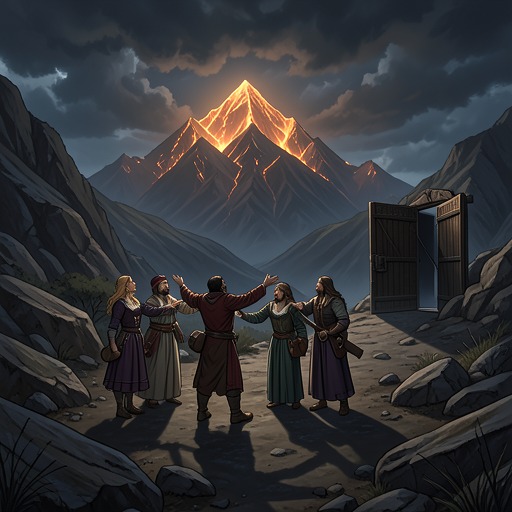
Aeron's dragon quest
The Ballad of the Last DragonAeron's dragon quest is the expedition to find the last dragon of the age, reach its hidden mountain lair, and claim the wealth said to lie beyond the entrance. Its importance is established before the journey begins: in a world where Dragons have supposedly been hunted to extinction, the quest offers not only treasure but the possibility of a legend, while giving Sylvaine Abelan a professional and personal reason to leave Hollowden and make a name through song.
Rumor, Extinction, and the Promise of Immortality
The quest grows out of an apparently impossible premise. Sylvaine has heard that no dragon has been sighted for more than a century, and she knows the surviving accounts as tales of the dark times, when Dragons prowled the land and flew through the skies. One of her favorite stories concerns a bard and his wayward brother who slew a dragon, linking dragon-slaying to performance and remembrance before Aeron Fowler ever explains his plan. Travelers have also circulated rumors of a lost hoard, but no one has found it, and forged maps are common enough to make any claimed discovery suspect.
Aeron gives the rumor a more definite shape. He describes fathomless wealth buried deep in an unnamed mountain, with all previous seekers lost to flame because the last dragon of the age guards the entrance. The person who defeats the dragon and takes the treasure, he says, will be immortalized as a legend long after death. The quest therefore joins material reward to artistic and historical survival: the hoard promises wealth, while the act of reaching it promises a story that can outlast the adventurer.
Recruitment and the Threshold of Adventure
Sylvaine's curiosity is the first force that turns the rumor into action. Jaromir's mention of a dragon interrupts her preparation for another song, and Aeron's manner suggests that he possesses knowledge she lacks. She remains uncertain whether the dragon is literal or merely a moniker or code, but the possibility of a story she could preserve is enough to make her pursue the truth. Her desire to remember and shape events is not separate from the expedition; it is one of the reasons the expedition can become meaningful at all.
Aeron eventually asks Sylvaine whether she would like to go on an adventure. Her acceptance creates the quest's first practical arrangement. Cadoc, Neith, and Jaromir are blades for hire on Aeron's payroll, and Sylvaine is now paid as part of the venture as well. The expedition thus begins as a mixed company: armed professionals provide protection, while Sylvaine provides the interpretive and musical labor through which Aeron's deeds may acquire a public life.
Sylvaine does not accept because the quest has become fully credible. She considers Aeron's claim far-fetched, yet the chance to travel from tavern to tavern with coin and protection is too valuable to refuse. The journey offers a way to make her own name and, if her songs succeed, to make Aeron's name alongside it. Her participation is consequently both practical and artistic: she joins a dangerous search while already imagining its transformation into a ballad.
The Map and the Languages of the Route
The quest gains its first substantial evidence when Aeron reveals that the notes on an old parchment are not incidental annotations but directions. He initially does not understand them and carefully avoids Sylvaine's gaze when he hands her the map. Its drawn outline of Targgein resembles maps she has seen in Hollowden, although the mountains and valleys carry unfamiliar names and the landmarks are described archaically. The document is therefore neither immediately trustworthy nor obviously fraudulent; its recognizable geography gives the legend a material foundation.
The directions are written in a combination of old Common Tongue, dwarven runes, and Ancient Elvish, a language Sylvaine has never encountered in Targgein and understands to have been dead even in Smarighad. That linguistic mixture makes the route a layered historical object. The quest is not simply a matter of following a modern road: it requires recovering meaning from languages altered, forgotten, or preserved outside ordinary use.
Sylvaine's ability to translate the map comes from her childhood education. Her father required her to practice alphabets in the dirt before allowing her to play in the forest, and she was expected to master Ancient Elvish, Dwarvish, Common Tongue, and forgotten human languages. What may have seemed like an unusual household discipline becomes the practical skill that allows the expedition to proceed. Her access to languages also gives her access to stories, making the map's decipherment an extension of the same impulse that draws her toward the quest.
The Route Through the Wilds
The translated directions identify a precise, difficult route that Aeron could not have followed unaided. The company is instructed to travel through Glas Fían, now known as The Veridian Wilds, keeping the sun on the left shoulder until midday for three days. From there, the travelers must leave the road, cross the river, and reach the base of a mountain pass. The old valley name Bealucwelm no longer matches current usage, adding another navigational problem to the already archaic map.
The route then reverses the obvious expectation. Rather than taking the mountain pass, the expedition must climb the western peak to reach a cave where the dragon awaits. This detail turns the quest from a conventional journey toward a landmark into an act of historical and geographical reconstruction. The party must reconcile old names with modern terrain, move away from established roads, and trust instructions whose authority rests on languages and places that ordinary travelers no longer recognize.
The physical cost appears immediately. After staying awake too late to translate the map, Sylvaine finds morning arriving too quickly and begins the journey exhausted. She is unused to riding, and the prolonged travel leaves every muscle aching; the prospect of another day on horseback is painful enough to make her want to cry. Her discomfort counters the romance of the dragon legend with the bodily realities of expedition travel, while also confirming that her contribution is not ornamental: the company depends on the work that has kept her awake.
Narrative Function and Unresolved Stakes
At this stage, Aeron's dragon quest remains suspended between legend and verifiable undertaking. Sylvaine's doubts never disappear simply because Aeron speaks confidently. The absence of a sighting for over a century, the history of forged maps, the lack of ordinary details in Aeron's initial account, and the mixed ancient languages all preserve uncertainty. Yet each successive disclosure narrows the distance between rumor and route: Aeron's party exists, the recruitment is complete, the map corresponds to recognizable geography, and the translation supplies a sequence of directions.
The quest also makes storytelling part of its mechanism rather than a retrospective decoration. Aeron seeks the dragon and hoard, but Sylvaine seeks the story that may be hidden inside his knowledge. His promise of immortalization answers her ambition as directly as the prospect of treasure answers the hired blades' practical needs. The expedition's earliest structure is therefore a convergence of motives: Aeron's pursuit of the legendary destination, the mercenaries' paid protection, and Sylvaine's attempt to convert danger into artistic memory.
Because the evidence at this point stops with the party beginning to follow the translated route, the dragon's existence and the hoard's reality remain open questions. What is already certain is that Aeron's quest has crossed the threshold from tavern rumor into organized movement through The Veridian Wilds and toward the western peak. Its decisive transformation has occurred before the cave is reached: a nearly impossible story has acquired companions, wages, a multilingual map, and a direction.