Aeron's map
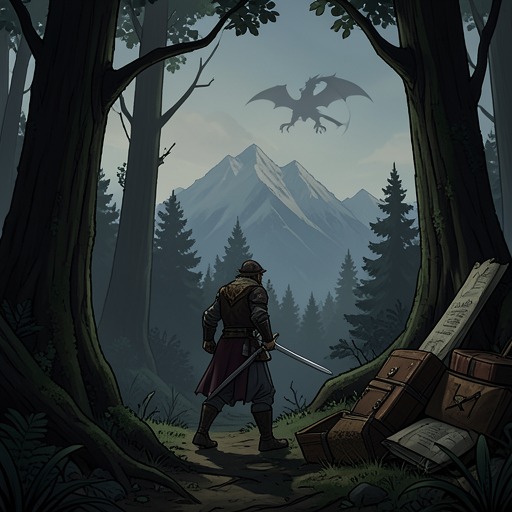
The Ballad of the Last DragonAeron's map is the expedition's essential guide and its most consequential deception. Found by Aeron Fowler and followed by the company into the mountains, it appears to lead toward The Dragon and the hidden hoard, but ultimately proves to be a false trail created within a much older scheme. Its decisive significance lies in the way it converts uncertainty into belief: the map does not merely locate a cave, but gives a surviving legend the physical direction needed to claim new lives.
Appearance and Function
Aeron's map functions as a navigational object whose authority comes from its apparent connection to Aeron Fowler. The company treats it as a route into the dragon's domain, using its directions to reach the hidden cave and to interpret the dangers encountered along the way. Because the map supplies a concrete path toward an otherwise improbable destination, it allows the expedition to act on the dragon story rather than dismiss it as rumor.
The map's importance is therefore partly practical and partly psychological. In the cave, the discovery of a date more than a century and a half old reveals that The Dragon was not a living dragon in the expected sense, but a dying man who constructed a legacy through deception. Aeron Fowler's map had led the company into that deception, yet the map itself was not necessarily a unique or reliable record: it is described as a false trail and later understood as part of a tradition of forged copies that could preserve the hunt while severing it from the original directions.
Role in the Dragon Quest
The map sets the expedition on the chain of actions that brings it to the cave. It helps make the legend credible because the company can follow a route and arrive at a real place containing mechanisms, furnishings, treasure, and a corpse-eaters' nest. The physical reality of the destination disguises the unreality of the dragon. What the map appears to confirm is not the existence of a dragon, but the existence of a carefully staged environment capable of sustaining that belief.
Its route also exposes the cost of inherited stories. The corpse-eaters surrounding the cave have served as a deterrent to investigators, while the traps, fire, and death hidden inside have continued the same work. The map's promise of discovery thus conceals a history of repeated fatalities. By leading the company to the source of the legend, it connects Aeron Fowler's quest to the many lives claimed by the dying man's attempt to leave behind an immortal name.
Discovery and Reinterpretation
Once the company reads the old letter and understands the mechanism behind the legend, Aeron Fowler's map changes meaning. It is no longer evidence that a dragon has survived in the mountains. It becomes one component in a story spun by a dying man roughly one hundred and fifty years earlier, a story that outlived its maker because later seekers supplied it with faith. The map's apparent certainty is exposed as an instrument of uncertainty: it points somewhere real while encouraging a false conclusion about what waits there.
This reversal also explains why the company survived when earlier visitors did not. The formula protecting the cave has apparently degraded with time, leaving some part of the defense inactive. The map brought the company through a danger that had once been more lethal, but it could not tell them whether survival represented destiny, skill, or mere historical accident. Its directions therefore support the expedition while offering no trustworthy interpretation of the evidence encountered along the way.
Destruction and Concealment
After taking the hoard, the company decides to collapse the cave entrance with blackpowder. Aeron Fowler's map is to be burned along with the narrator's translations, so that the route cannot continue directing adventurers toward the hidden chamber. If future searchers come to the mountain, they are meant to find only a corpse-eaters' nest and a destroyed cave.
The decision gives the map a final function as dangerous evidence. The company confiscates the surviving proof of The Dragon's existence, including knowledge of the deep room where the old furnishings and mechanisms remain buried behind rubble. Destroying the map is an attempt to end the circulation of the legend at its material source, even though the company recognizes that stories are difficult to kill once they have acquired cultural force.
Legacy and Narrative Significance
The map's destruction is bound to the fabrication of Aeron Fowler's heroic ending. The company invents a story in which Aeron Fowler kills the dragon with his blade, receives the killing blow himself, and is carried outside to see the sky before dying. The map is part of what must disappear for that version of events to stand: its true route and the translations would reveal the false dragon, while the public account requires the quest to retain its conventional shape of dragon, treasure, sacrifice, and victory.
That contradiction makes Aeron Fowler's map both a relic of deception and a witness to the truth. It led the expedition to a treasure that genuinely existed, but it misidentified the source of the danger and encouraged the belief that made the journey meaningful. Burning it protects others from repeating the quest, yet it also helps preserve Aeron Fowler's posthumous heroic legend by removing the object most capable of disputing it. The map therefore ends not as a guide, but as a condemned archive: its destruction closes the physical route while leaving the story it helped create available for remembrance.