Aeron’s Heroic Memorialization and Final Ballad Performance
The Ballad of the Last DragonAeron’s Heroic Memorialization and Final Ballad Performance is the culminating public act through which Sylvaine Abelan and Aeron Fowler’s surviving companions turn his death into a shared legend. The performance does not restore Aeron to life or erase the grief surrounding him. Instead, it gives that grief a shape that can be repeated: a song, a set of relics, a gathering of witnesses, and a promise that his story continues beyond its apparent ending.
A Memorial Built from Memory
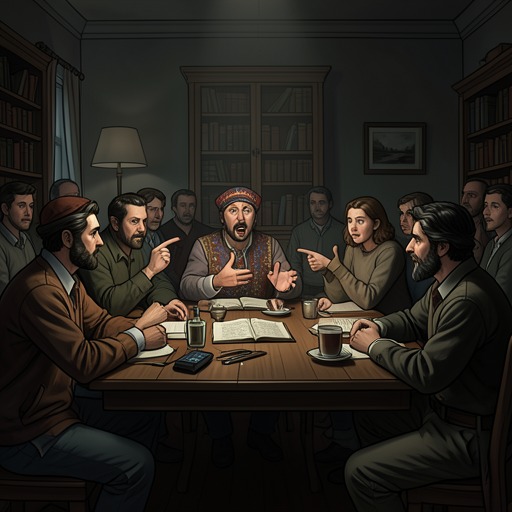
The performance takes place after First Fruits Day and the summer season have passed, when the tavern has changed its decorations for the approaching Harvest Day. Burgundy fabrics replace the earlier red banners, while pumpkins and gourds mark the seasonal transition. This setting makes the memorial part of a larger movement from one season into another. The gathering is not presented as a simple farewell to summer, but as a welcoming of change, and Aeron’s remembrance follows the same pattern: his life has ended, yet his meaning is entering a new phase.
Sylvaine has already made the ballad part of the company’s daily life. She plays the familiar tune in every tavern where the group stays, in the privacy of the inns where she and Jaromir sleep, and beside the campfire each night. Its repetition carries Aeron through places he will never visit himself. The song is therefore both performance and ritual. Each playing renews his presence, allowing the companions to carry him forward even though they did not lose him directly to the dragon whose legend surrounds him.
The memorial’s emotional force comes from this tension between absence and continuation. Words and memories have kept Aeron alive enough that the final public performance feels like the true goodbye. The song does not merely describe a dead companion; it marks the moment when private remembrance becomes communal history.
The Final Performance
The central artifact of the event is Aeron’s Ballad, whose opening identifies its subject as a man named Aeron. The song presents Aeron in heroic terms, and its structure combines plucked melody with spoken narration. The spoken sections recount episodes from Sir Aeron’s adventures, with regional differences in both the stories and their styles, before the final verses return to the established tune and song pattern. This form allows the ballad to preserve not only one fixed account but also the variation that naturally develops as stories travel.
The performance’s decisive image is Aeron facing the dragon with sword in hand. Sylvaine recalls seeing the glimmer in his eye and understanding his intent, then incorporates his wink and passing words into the song’s account of the encounter. The scene presents courage as something witnessed by another person rather than as an abstract quality announced from nowhere. Sylvaine’s presence gives the heroic image an intimate source: she was close enough to recognize the decision in Aeron’s expression, and she now becomes the person who carries that recognition into public memory.
The song’s ending refuses to close Aeron’s story absolutely. Its final movement says that the companions are not finished and that further adventures lie beyond, concluding not with a definitive farewell but with the promise, “Until we meet again.” In narrative terms, the ending shifts the value of the event from loss toward continuation. Aeron cannot return, but the story associated with him remains open, available for retelling and new adventures shaped by what he left behind.
Relics and Witnesses
The performance is supported by a carefully arranged display of physical remains. Cadoc places Aeron’s scorched armor, specifically the chest plate that the companions held over their own campfire, on the table. The object bears the marks of both violence and preservation: it is associated with the journey, damaged by fire, and still capable of serving as evidence of the person being remembered. Neith raises her tankard while wearing the dragon tooth around her neck, making another remnant of the quest visible within the gathering.
The relics distribute Aeron’s memory among the people who survived him. Cadoc’s hand rests on the chest plate and traces the grooves around its design, while Neith carries the dragon tooth on her body. The objects do not remain abstract symbols separated from the companions; they are handled, worn, and placed among food, drink, and conversation. The memorial therefore joins heroic legend to ordinary fellowship, showing that Aeron’s significance persists through the habits and possessions of the people who knew him.
After the song, Neith announces that the chest plate is being mounted on the tavern wall. The barkeep hammers in a large nail, hangs the armor, and steps back to inspect it. The group falls silent before the final piece of Aeron adorning the wall. Its brightness remains visible despite scorch marks and the tarnish of the road, so the displayed object preserves both the heroic ideal and the material damage of the journey. Cadoc’s uncertainty about whether the armor should have been polished emphasizes that the marks are not defects to be concealed. They are part of what makes the memorial truthful.
Communal Recognition and Private Grief
The audience confirms that the memorial has achieved its purpose. Some listeners become tearful, while others sing along with familiar portions of the ballad. Aeron’s story has crossed the boundary between the company’s private memory and the public’s shared knowledge. The crowd does not merely hear the song; it participates in its recurrence, helping transform an individual death into a communal tradition.
Sylvaine experiences the conclusion as a mixture of release and sorrow. A weightlessness rises in her chest even as grief remains in her stomach. The contrast records the event’s value shift with unusual precision: the burden of keeping Aeron’s story alive has reached its public fulfillment, but success cannot remove the pain that made the act necessary. Jaromir’s response joins affection to recognition when he places an arm around Sylvaine’s shoulder, kisses her forehead, and tells her, “You were wonderful.” His gesture confirms that the performance has been witnessed not only by the crowd but also by the person closest to her in the moment.
The memorial also repairs, as far as the living can repair it, the honor Aeron was denied during his lifetime. Sylvaine regrets that he never had the chance to reunite with his family and restore his standing himself. Yet the companions can give him that restoration after death by ensuring that his name carries the meaning he wanted it to carry. The performance thus answers a private wound through a public act: Aeron’s family blessing is no longer the sole measure of his worth, because the people who traveled with him now testify to what he was.
From Death to an Ongoing Legend
Neith plans to write to Arnorr about Aeron’s tale and ask that a memorial be placed for him in the family crypt. She may even travel there to see the request completed. This proposed memorial extends the tavern ceremony into Aeron’s family space, connecting the companions’ chosen remembrance with the lineage that had failed to honor him while he lived. The wall-mounted armor and the possible crypt memorial create two linked sites of memory: one belonging to the road and the community formed upon it, the other belonging to the family from which Aeron had been separated.
The event’s deepest significance lies in how it reverses the apparent meaning of Aeron’s death. The dragon quest has not ended in the recovery of a living hero who can claim his reward. Instead, the survivors become the agents of his return. They bring his armor into public view, preserve the dragon tooth, repeat the music, recount the adventure, and place his name within a story that can outlast the original witnesses. The hero’s journey is therefore completed through an inversion of the usual return: Aeron does not come back with an elixir; his companions return with his story and offer it to the world.
The final ballad performance consequently serves as both ending and beginning. It closes the period in which Aeron’s friends carried an unspoken private loss, but it begins the larger life of Aeron’s heroic legend. The song’s promise that adventures remain beyond the final verse expresses the memorial’s governing conviction: where Aeron’s life ends, the story carried by Sylvaine Abelan and the others begins anew.