Battle of Death Valley Flesh-Eater
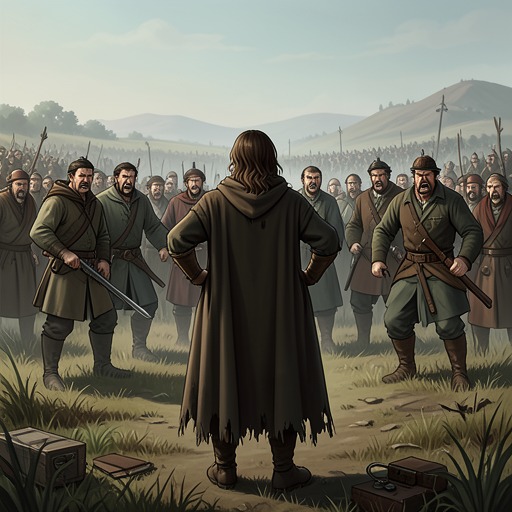
The Ballad of the Last DragonThe Death Valley corpse-eater battle marks the expedition’s transition from fearful observation to open survival combat. At the edge of the forest, Sylvaine Abelan and her companions discover a nest of mottled gray, almost humanoid beasts prowling on all fours and tearing at a deer carcass. Neith identifies them as corpse-eaters, creatures drawn to the dead when bodies are neither properly buried nor burned. The discovery turns Death Valley from a desolate landscape into an active ecological threat: every corpse left behind can become an invitation, and the group’s own history of disposing of bodies suddenly acquires a more ominous explanation.
Causes and Background
The battle is rooted in the valley’s condition and in the group’s approach to the mountain entrance. Death Valley is already marked by decay; the surrounding vegetation has begun to fail, and the air carries the smell of rotting flesh. The corpse-eaters are not merely encountered by chance. Their presence is connected to the remains scattered through the landscape, while their behavior makes them especially dangerous to travelers who might assume that a dead body is only evidence of an earlier tragedy. Neith explains that they consume whatever they can reach once they realize someone is nearby, but that improperly buried or unburned dead exert an especially strong attraction.
That knowledge also reframes earlier burial practices across the journey. In Hollowden, bodies were buried or placed on funeral pyres as soon as a medic confirmed death, whether or not next of kin were present. In Bridgebarrow, guards removed people who had died from disease or starvation before the same body could be encountered again. These customs had seemed to be measures against disease; the corpse-eaters suggest that they may also have protected settlements from a predatory infestation. The battle therefore links immediate danger to a broader system of communal rites, showing how the treatment of the dead can determine whether the living remain safe.
The First Engagement
Jaromir initially proposes that Sylvaine Abelan remain beneath the trees while he, Neith, and Cadoc draw the creatures toward the mountain entrance and kill them individually. The plan is protective but excludes Sylvaine from the danger, and she resents being told to hide while the others advance. Cadoc converts the impending fight into a wager, offering an additional ten percent of the share from the two losers to whoever kills the most corpse-eaters. The wager gives the group a familiar competitive structure even as the scene moves toward a genuine threat, preserving their camaraderie without making the danger less real.
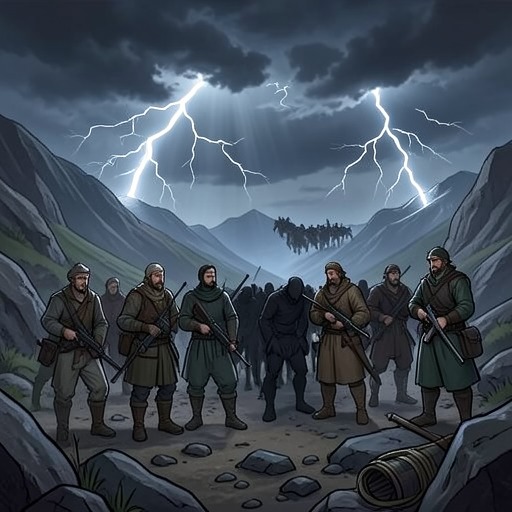
The controlled plan collapses when Neith skewers one corpse-eater through the belly with her sword and cuts its throat with her dagger. The creature’s warning screech carries across the entire valley. Its cry summons dozens of others, which rush toward Jaromir, Neith, and Cadoc as they form a triangular defensive position with no one’s back exposed. Sylvaine joins the fight from the edge of the formation, using her sling to strike a nearby beast in the back of the head and stun it. The battle’s scale changes in a single beat: an attempt to pick off isolated predators becomes a concentrated assault.
Combat and Immediate Outcome
The horde presses the companions into close combat. Sylvaine is knocked beneath one of the beasts and, convinced that she is about to be eaten alive, reaches the edge of panic. Jaromir’s shout draws her back into action. She thrusts her sword upward into the corpse-eater’s belly, twisting the blade through flesh, bone, and sinew before pushing the heavy body aside and scrambling free. The kill is both physical and psychological: the creature’s black blood and rotten smell provoke nausea, but Sylvaine survives by acting within the terror rather than remaining paralyzed by it.
Jaromir immediately pulls Sylvaine to her feet, his own face marked by panic and blood. Their brief moment of closeness is interrupted when Sylvaine remembers that the battle is still underway. Jaromir tells her that the group has broken down the horde and that most of the stragglers have fled; if one or two return, the companions can handle them. The exchange establishes the fight’s decisive reversal. The corpse-eaters’ numbers initially threaten to overwhelm the party, but coordinated resistance reduces the horde to scattered survivors and leaves the route to the mountain entrance open.
The victory is measured through the wager. Sylvaine does not win, and Cadoc does not either. Neith claims the prize with eleven kills, Jaromir follows with nine, and Cadoc records eight felled by his arrows. Sylvaine’s single confirmed kill does not erase her lesser tally, but her sling strikes and other assistance earn recognition: Jaromir allows her to claim any of his kills made with her aid. The accounting turns a brutal encounter into a shared record of competence, while Neith’s eleven deaths establish her as the battle’s dominant fighter. Sylvaine also resolves to place the episode into the ballad, intending to give Neith the glory her bloodied arms, face, and hidden limp have earned.
Historical and Ecological Significance
The encounter also exposes the political history beneath Death Valley’s physical decay. Anti-elf hostility is not presented as an isolated prejudice among drunken travelers, but as the inheritance of a much older historical narrative. During The Unification, Hawthok allied with humans, while dwarves who fought alongside them received land and minor titles in Targgein. Human and dwarven histories subsequently preserved those allies as heroes opposing ancient elves, represented as beings of power and malice. That account helped turn fear into policy: after dissent and land disputes destroyed the appearance of peace, elves were barred from holding titles, including land, and those who refused relocation were branded fugitives. Humans could even purchase licenses to hunt them for sport, with some hunters displaying severed elven ears as trophies. The corpse-eater battle therefore occurs within a landscape already shaped by violence, displacement, and the careless handling of death; the valley’s monsters literalize a world in which neglected remains, buried history, and institutional cruelty continue to feed one another.
The Battle’s Wider Historical Context
The corpse-eater battle also acquires meaning from the history that has made Death Valley a place of accumulated violence. Anti-elf hostility is not an isolated prejudice among individual drunkards; it is the inheritance of a political narrative shaped during The Unification, when Hawthok allied with humans and dwarves who took up arms were rewarded with land and minor titles in Targgein. Human and dwarven histories then preserved those allies as heroes opposing ancient elves, who were represented as beings of power and malice. The resulting fear endured even after more than a century of tenuous peace. During the later raids, elven texts and sacred structures were destroyed, leaving spoken tradition as the principal means by which elven history survived. The same distrust hardened into law: elves were forbidden to speak in official councils, lost the right to hold titles and land, and were branded fugitives if they refused to surrender property and move into cities subject to searches and curfews. Humans could purchase licenses to hunt fugitive elves for sport, while some hunters wore elven ears on chains as trophies. Against this background, the valley’s monsters become more than a local hazard. The battle unfolds in a landscape where bodies, histories, and entire communities have been treated as disposable, so that the corpse-eaters’ attraction to neglected remains gives physical form to a culture of violence that has never been fully buried.
Historical and Material Legacies
The battle’s setting is also connected to the legacy of weaponry and war. In the mountain cave, the companions find four barrels of black powder among stores of aged dwarven whiskey and wine from the Western Isles. Saltpeter had been outlawed after the dwarven alliance with humans during The Great Loss because the explosive material was judged inhumane after helping win the war against the elves. This discovery places the corpse-eater encounter beside another abandoned consequence of historical violence: the valley contains not only creatures feeding on the dead, but also dangerous technology preserved from a conflict whose moral damage was never erased. The group’s passage from the corpse-strewn forest into a chamber of concealed mechanisms and forbidden powder suggests that Death Valley’s threats are layered rather than singular. Ecological danger, political persecution, and militarized history occupy the same expedition route, each revealing how past violence continues to shape the living world.
Narrative Function and Significance
The Death Valley corpse-eater battle concentrates the expedition’s central anxieties into a single physical crisis: the party must cross a landscape where death is not passive, history is not finished, and survival depends on collective action. The creatures transform neglected remains into an immediate threat, while the battle’s progression turns fear into competence. Jaromir’s protective attempt to keep Sylvaine Abelan behind the others fails because she refuses to remain a bystander; Neith’s killing blow accidentally summons the horde; and Sylvaine’s desperate sword thrust converts her own near-death into proof that she can fight within the group rather than merely be guarded by it. The aftermath preserves both danger and fellowship. The companions tally their kills, Neith leads with eleven, Jaromir follows with nine, and Cadoc has eight, while Sylvaine’s assistance earns her a share of Jaromir’s credited victories. Her decision to place the encounter in the ballad also changes what the battle means: the dead are not left to vanish into the valley, and the violence becomes a story capable of remembering courage, especially Neith’s bloodied triumph. The expedition can therefore proceed toward the mountain entrance not because Death Valley has become safe, but because terror has been answered by solidarity, skill, and the deliberate preservation of memory.