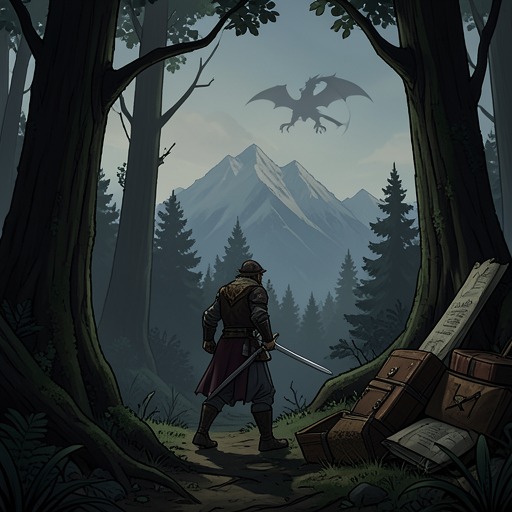
Bealucwelm
The Ballad of the Last DragonBealucwelm is the valley named on the translated map of the dragon’s route, and it marks the expedition’s transition from ordinary travel into the difficult approach to the mountain cave where the dragon awaits. Its decisive significance lies in the way geography, lost language, and the quest’s hidden past converge there: the travelers must pass through a place whose ancient name survives even though its present human identity has been forgotten.
Name and Historical Displacement
Bealucwelm appears in directions whose meaning has only recently been recovered through translation. The valley’s name is preserved in the older map, but it is no longer current; the narrator cannot remember what humans call it now. That gap between the map’s terminology and contemporary usage gives the location a distinctly historical character. Bealucwelm is not simply an unmarked stretch of countryside but a remnant of an earlier world, one in which the map’s language still organized the landscape.
The forgotten modern name also reflects the limits of the expedition’s knowledge. The route can be read well enough to identify the valley, yet the travelers remain dependent on partial understanding and uncertain memory. This combination of precise instruction and cultural dislocation makes Bealucwelm a threshold location: the map offers a direction, but not complete mastery of the land through which the party must move.
Position on the Dragon Route
The translated directions require the travelers to pass through Bealucwelm after leaving the road, crossing the river, and reaching the base of a mountain pass. The valley therefore lies beyond the established route and forms part of a deliberate withdrawal from familiar travel. It is not approached as a destination served by ordinary roads; reaching it requires the expedition to follow instructions preserved in the old map rather than rely on current infrastructure or local naming.
The party is instructed to travel with the sun on the left shoulder until midday for three days. This unusual method of orientation makes the approach depend on sustained bodily observation rather than a simple written distance or landmark. Bealucwelm is consequently embedded in a route that tests endurance and attention: the map dictates a rhythm of movement across several days before the travelers can reach the valley and continue toward the mountains.
Gateway to the Mountain Cave
The directions distinguish Bealucwelm from the mountain pass itself. The travelers are to go through the valley but not take the pass; instead, they must climb the western peak to reach a cave where the dragon awaits. Bealucwelm is thus a gateway rather than the final objective. Its narrative function is to bring the expedition to the base of the decisive ascent while simultaneously directing it away from the most obvious route.
This choice of path gives the valley a strategic importance. The expedition must move from road to river, from river to valley, and from valley to the western peak. Each change in terrain narrows the route and increases its remoteness, with Bealucwelm serving as the intermediate space that connects the accessible world to the hidden cave. The location’s importance comes not from an event recorded within the valley itself, but from its role in the chain of instructions leading to the dragon.
Narrative Significance
Bealucwelm embodies the expedition’s broader encounter with a past that survives in fragments. The map preserves a name and a route, but the present world has changed enough that the valley’s human name has disappeared from immediate memory. The travelers therefore advance through a landscape that is simultaneously knowable and estranged: its position can be followed, while its cultural meaning has become uncertain.
As a stage in the quest, Bealucwelm belongs to the movement away from ordinary life and toward ordeal. Leaving the road and crossing the river begin the separation from familiar space; following the sun for three days and entering the valley deepen that separation; climbing the western peak toward the waiting dragon completes the approach to the dangerous threshold. Bealucwelm’s lasting importance is therefore structural as well as geographical. It is the forgotten valley through which the expedition must pass before the quest reaches its hidden destination.