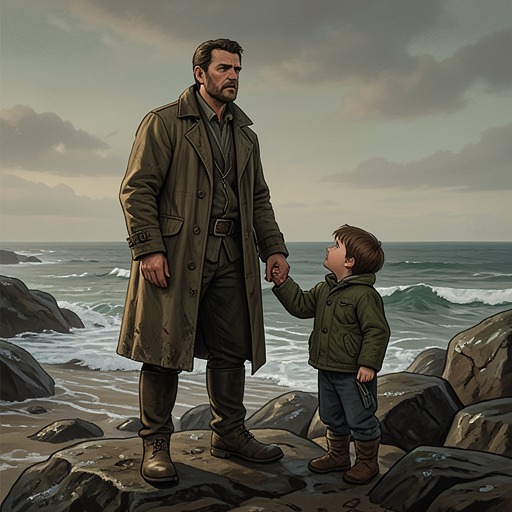
Cadoc and Tomas
The Ballad of the Last DragonCadoc and Tomas are a romantic pair whose relationship takes shape around the tavern life of the adventuring party. Tomas is introduced as the barkeep who draws Sylvaine Abelan into conversation, while Cadoc’s immediate attention to him, visible embarrassment, and later inability to conceal what he knows about Tomas establish a mutual attraction that the surrounding companions recognize before the men openly discuss it. The relationship remains partly offstage, but its scattered signs are unusually vivid: a flushed face, a private appraisal across a crowded room, a hand on the back, a cracked voice, and a song Sylvaine Abelan begins composing for them.
First Encounter and Immediate Attraction
Tomas first approaches Sylvaine Abelan at the bar and confirms her name before asking what she is doing with a group of hired swords. His curiosity is not merely professional. He leans across the bar, and Sylvaine Abelan notices herself leaning toward him as though they have entered a private confidence; at the same time, his gaze darts toward the adventurers, his eyes brighten with excitement, and his cheeks and the tips of his ears turn bright red. The scene therefore introduces Tomas through an atmosphere of social ease and visible nervousness, with his interest in the group providing the occasion for a more personal connection.
Cadoc’s attraction becomes clearest when the party performs at Tomas’s tavern. After Sylvaine Abelan completes the first part of Aeron Fowler’s ballad, Cadoc claps Tomas on the back with a broad grin. Two attractive women occupy the stools beside Cadoc, laughing and drinking, but he pays attention only to Tomas, who returns the smile with an unmistakably appreciative appraisal. The contrast is comic but decisive: the women offer an obvious distraction, yet Cadoc’s attention is fixed on the barkeep, and Tomas responds in kind.
Desire Revealed Through Embarrassment
The relationship’s early language is largely physical rather than declarative. When Sylvaine Abelan later jokes about singing a ballad about a handsome barkeep, Cadoc chokes, disguises the reaction as a cough, and asks why he would care to hear such a song in a voice that cracks mid-question. His discomfort does not conceal the attraction; it makes it legible. Neith and Sylvaine Abelan can read the reaction immediately, while Cadoc’s attempt to deny interest only confirms that Tomas matters to him.
Cadoc also reveals how closely he has been observing Tomas’s life. He explains that Tomas’s uncle owns the tavern, but Tomas handles most of its work and has been promised the deed when his uncle dies, perhaps even sooner. Cadoc knows that Tomas rises before sunrise to check supplies and accounts, and even knows the circumstances under which Tomas dismissed a serving girl for sneezing into a hunter’s pot. The detail is more intimate than casual gossip: Cadoc admires Tomas’s diligence and can describe the practical burdens of the man he desires. His knowledge also exposes him; he realizes that he has said too much and abruptly falls silent.
Companions as Witnesses and Interpreters
The party functions as an audience to Cadoc and Tomas’s romance. At the end of the performance, Cadoc’s broad grin and his exclusive attention to Tomas are so conspicuous that Sylvaine Abelan interprets the exchange as a promise that Cadoc will not be seen again until morning. Tomas returns the appraisal, giving the scene the shape of reciprocal interest rather than one-sided pursuit. Their attraction is thus communicated through a public moment that the men themselves do not explain, while their friends supply the interpretation.
Sylvaine Abelan turns that interpretation into art. She begins plucking a tune intended for a ballad about Tomas and Cadoc, treating their romance as new material to be developed and revised. When she starts to sing about a barkeep with hair of fire and gold, Cadoc’s pained objection makes her stop, but she continues playing the tune and keeps its working designation. The unfinished song mirrors the relationship’s narrative position: the attraction is already present and socially recognized, yet its full story has not been performed or spoken.
Neith and Sylvaine Abelan also deliberately collaborate in teasing Cadoc. When Sylvaine Abelan asks whether he would care to hear a song about a handsome barkeep, she gives Neith a conspiratorial look, and Neith answers with one of her own before asking whether Tomas owns the tavern. Their shared amusement places Cadoc under affectionate scrutiny. The teasing is not presented as hostile exposure; it is a way for the group to acknowledge his desire while allowing him to retain a measure of privacy.
Protective Concern and Emotional Intensity
Tomas’s concern for Sylvaine Abelan during her panic attack provides another point of contact between him and Cadoc. After Sylvaine Abelan fails to begin her performance and panic constricts her chest and throat, Tomas’s face flashes with alarm. He leaves the bar, comes to her, and takes hold of her arms while asking whether she is well. His attempt at harmless comfort cannot calm her, but it establishes him as attentive and responsive to distress rather than merely a tavern keeper concerned with business.
Cadoc’s later reaction to a threatening customer makes the emotional stakes around Tomas’s establishment more explicit. When an abusive patron grabs Sylvaine Abelan and calls her a “knife-ear,” demanding that she fetch drinks and threatening to show her what her kind deserves, Cadoc immediately orders the man to remove his hands from her. Although the moment is directed at Sylvaine Abelan’s safety, it occurs within Tomas’s tavern and reinforces the protective, communal atmosphere in which Cadoc and Tomas’s attraction develops. Tomas’s establishment becomes not only the place where their desire is displayed, but also a place where the party confronts the prejudice that forces Sylvaine Abelan to hide her elven ears and endure insults.
Narrative Function and Limits of the Romance
Cadoc and Tomas’s relationship supplies a counterpoint to the violence, loss, and prejudice surrounding the adventurers. Tomas’s blushes and Cadoc’s evasions transform a public bar into a space of flirtation, while the group’s jokes convert private attraction into shared knowledge without stripping it of tenderness. Their romance is also connected to work: Tomas’s responsibilities keep him behind the bar, Cadoc arrives as part of a hired-sword company, and Sylvaine Abelan’s performance turns their encounters into a story that can circulate among listeners.
The text presents the pair through implication rather than a fully narrated courtship. It confirms reciprocal looks, Cadoc’s detailed knowledge of Tomas, Tomas’s visible embarrassment, and the party’s expectation that Cadoc will spend the night with him, but it does not provide a formal declaration, a confrontation, or a stated long-term resolution. That incompleteness is part of the relationship’s charm and structure. Like Sylvaine Abelan’s unfinished tune, Cadoc and Tomas’s romance is an emerging narrative: its central feeling is already unmistakable, even while its future remains outside the scenes shown here.