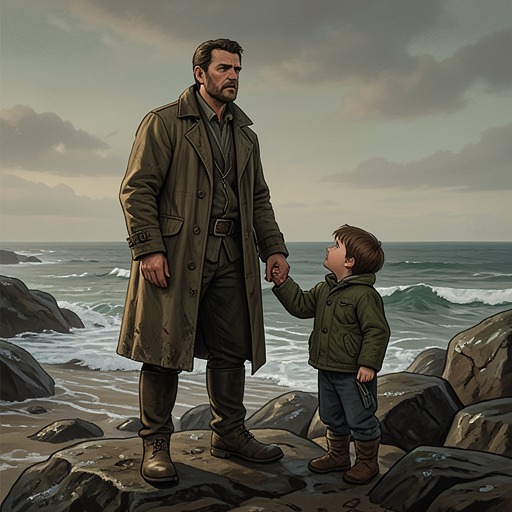
Cadoc–Tomas relationship
The Ballad of the Last DragonThe Cadoc–Tomas relationship is a developing love affair whose decisive force lies in the change it brings about in Cadoc. Tomas first appears through correspondence, but the letters quickly become more than a private exchange: they give Cadoc a new emotional center, inspire his return to The Laughing Goat Tavern, and make permanence seem desirable to a man once defined by motion and detachment.
The Relationship Emerges
The relationship is disclosed indirectly through Cadoc’s behavior before Tomas is even discussed openly. Cadoc becomes conspicuously cheerful, asks for writing materials, and hums constantly while composing a response. When Neith asks whether Tomas has finally written to him, Cadoc confirms it while continuing to scribble another line. His posture and distraction make the correspondence legible as romantic anticipation rather than ordinary news between acquaintances.
The scene also establishes the relationship through the group’s teasing intimacy. Cadoc is writing something personal enough to require careful phrasing, and he asks Sylvaine Abelan how to express missing Tomas’s body in a romantic way. Sylvaine Abelan redirects the blunt sexual sentiment toward language about emotional and physical compatibility, advising a formulation equivalent to missing how perfectly the two men fit. The exchange presents their intimacy as openly erotic but not reducible to sex: Cadoc wants to communicate longing while preserving tenderness and interpretive restraint.
Letters, Desire, and Creative Expression
Tomas’s importance is filtered through writing. Cadoc’s request for vellum and quill turns his affection into an ongoing composition, while Sylvaine Abelan’s own artistic habits provide a parallel. She recognizes that, if her lute had not been ruined, she would play the tune written to represent Cadoc and Tomas while drafting their ballad. The couple therefore becomes part of the traveling company’s artistic world before their full domestic future is visible; their relationship is translated into letters, melody, and story.
The correspondence also changes the emotional atmosphere around Cadoc. Sylvaine Abelan initially understands coin as his chief motivation, but his besotted longing whenever he mentions Tomas proves that money is no longer his only reason for acting. Cadoc’s earlier freedom from fixed attachments is not simply erased; it is redirected. Love softens what had been an untethered existence, giving his ambitions a person-shaped destination without making his practical concerns disappear.
From Longing to Attachment
The relationship’s most important development is Cadoc’s movement toward attachment. Tomas’s letters generate visible excitement, but the later evidence shows that the bond has become reciprocal and durable rather than remaining a one-sided fantasy. During the company’s visit to Bucklebrook, Cadoc and Tomas are inseparable, and their departure ends in a tearful goodbye. The scene confirms that the emotional intensity suggested by Cadoc’s writing has an embodied counterpart in shared time and separation.
Their bond also alters Cadoc’s relationship to place. He can return to Bucklebrook without fearing that a journey will mean leaving Tomas behind, a striking reversal for someone who had previously found staying anywhere uncomfortable. The relationship makes rootedness attractive. What once might have felt like confinement becomes the possibility of remaining beside Tomas, and travel gains a different meaning because it can now lead back home.
A Shared Future at The Laughing Goat Tavern
Cadoc’s invitation for Sylvaine Abelan to visit The Laughing Goat whenever she passes through Bucklebrook names Tomas as an equal participant in their welcome. He says that Tomas and he will be thrilled to see her, presenting their partnership as a shared household and social unit rather than a private attachment kept separate from the company. Their relationship is consequently woven into the wider network of friendship that survives the expedition.
The tavern itself becomes the material expression of their future. Sylvaine Abelan questions whether Cadoc is truly attached to the old name and suggests that the venue could be reinvigorated, but Cadoc answers that he and Tomas have big plans. The details of those plans remain undisclosed, yet the promise is concrete enough to establish a common project. Their love is not confined to longing across letters: it is attached to a place, a business, and a future they intend to shape together.
Narrative Significance
The Cadoc–Tomas relationship gives the novel one of its clearest movements from itinerancy to belonging. Cadoc’s emotional arc does not culminate in heroic conquest or wealth, but in the discovery that intimacy can make a fixed life feel expansive rather than restrictive. His return to The Laughing Goat Tavern is meaningful because Tomas will be there; the tavern becomes less an inn than a chosen home.
The relationship also contrasts with the losses surrounding the expedition. Aeron Fowler’s death leaves the surviving companions to preserve a friend’s honor after his lifetime, while Cadoc and Tomas’s bond offers a living continuation: letters become reunions, reunions become plans, and plans imply a shared tomorrow. The romance therefore embodies the book’s broader insistence that lives are sustained through connection and through the stories people continue to tell about one another.
Cadoc’s love for Tomas remains lightly sketched rather than exhaustively narrated, but the available signs form a coherent progression: eager correspondence, playful sexual longing, visible infatuation, physical inseparability, tearful parting, and an intention to build a life together at The Laughing Goat Tavern. The relationship’s emotional truth lies precisely in this accumulation of small proofs. A man once reluctant to stay has found a reason to remain, and that reason is Tomas.