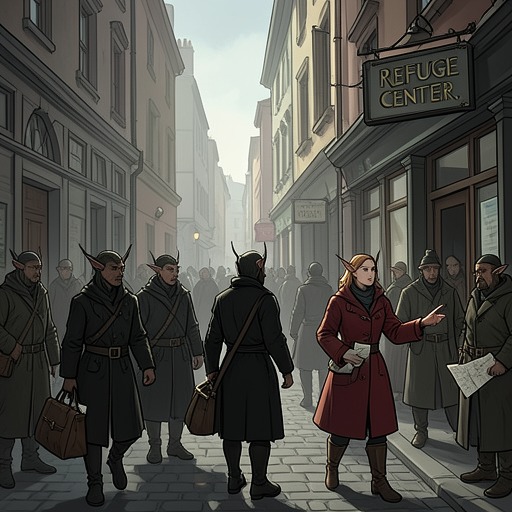
Cinna’s crew
The Ballad of the Last DragonCinna’s crew is an elite extraction organization aboard The Sea Harpy, created to carry out rescues from neighboring countries and most notably Smarighad. Its importance lies in turning maritime skill into direct aid for elves fleeing persecution: the crew does not treat escape as a commercial opportunity, but undertakes transport without charging those it rescues. At the same time, its stated limits make the organization’s work practical rather than idealized, since extraction and passage are within its responsibility while settlement and safety after disembarkation remain uncertain.
Formation and Command
Cinna’s crew is led by Cinna, who captains The Sea Harpy and recruits an elite crew for extraction work. Neith reports that she has joined the crew after Cinna offered her an opportunity suited to specialized rescue operations. The organization therefore appears not as an ordinary merchant crew but as a deliberately assembled maritime unit, defined by its ability to enter dangerous circumstances, remove people from them, and transport them elsewhere.
Neith’s recruitment also establishes the crew as part of the continuing movement of the adventurers after their separation. Her new allegiance gives her a distinct future beyond the group’s earlier travels, while Cinna’s offer suggests that the crew values capable individuals for a focused purpose rather than merely for routine shipboard labor.
Mission and Methods
The crew’s operations extend to several neighboring countries, with Smarighad identified as the principal destination. Its central task is the extraction and transport of elves. This places Cinna’s crew within the wider conditions of elven displacement and anti-elf persecution: the people being moved are not simply travelers seeking better prospects, but refugees attempting to escape death and dismemberment.
The crew’s method is marked by an explicit refusal to profit from that vulnerability. When Neith is asked what it charges for transport, she answers that the price is nothing. The decision distinguishes Cinna’s crew from exploitative rescuers who might demand payment from people with no safe alternative. Its service is consequently both logistical and ethical, offering passage as assistance rather than as a transaction.
Limits and Responsibilities
Cinna’s crew takes responsibility for the dangerous first stage of escape: reaching endangered elves, extracting them, and carrying them to a place where they can begin again. It does not, however, claim control over the whole of their future. Neith explains that the crew’s goal is extraction and transport, while what happens to those who disembark and begin new lives is left to the refugees themselves.
That boundary reveals both the organization’s reach and its limits. Free passage removes one immediate barrier, but it cannot by itself provide permanent security, community, or legal protection. The crew’s work interrupts persecution without pretending to have solved the political order that produced it. Its rescue mission is therefore compassionate but incomplete by necessity: it can open a route out, not guarantee the shape of life on the other side.
Members and Narrative Significance
Neith is the only named member identified in the available account, and her decision to join makes Cinna’s crew personally significant to Sylvaine Abelan. Sylvaine reacts with relief when she learns that the rescued elves will not be charged, recognizing that the crew is helping people rather than taking advantage of those fleeing violence. Neith’s choice thus becomes an extension of the moral commitments that bind the traveling companions even after their paths diverge.
The organization also provides a strong contrast with the hostility elves encounter elsewhere. In a tavern, Sylvaine Abelan is addressed as “knife-ear” and told that she is lucky to be allowed inside; later, Magistrate Ridion dismisses her as an elf who is “more than gutter refuse.” Against these scenes of exclusion, Cinna’s crew offers movement, practical solidarity, and a refusal to reduce elven lives to a source of revenue. The contrast gives the organization significance beyond its maritime function: it embodies an active answer to anti-elf prejudice.
Cinna’s crew also develops the book’s recurring opposition between abandonment and chosen belonging. Those it rescues may have lost homes or been driven from them, yet the crew creates a passage toward the possibility of another life. Because it does not promise to determine that life afterward, its role is not to replace home but to make survival and self-determination possible. Its most decisive contribution is the opening of an escape route where the surrounding society has made ordinary belonging dangerous.