Danion
The Ballad of the Last DragonDanion is the leader of a heavily armed band whose encounter with Aeron Fowler’s expedition turns a purported recruitment effort into a lethal ambush. He first presents himself as an adventurer seeking the same wealth and danger as Aeron, but his conduct reveals a more coercive purpose: he uses a staged show of force, sexualized threats, and finally murder to test and dominate the people before him.
Identity and First Appearance
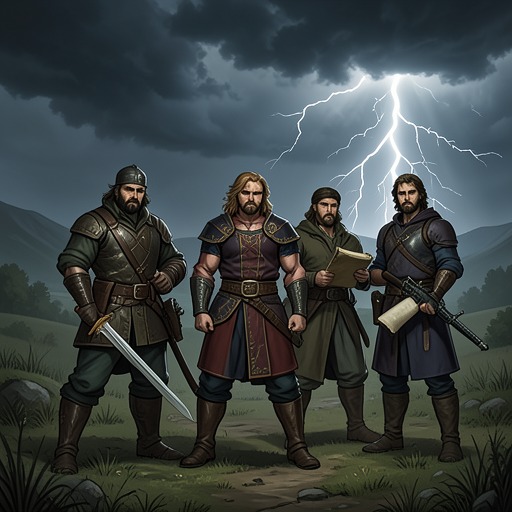
Danion appears on a narrow, tree-enclosed road at the head of seven unfamiliar warriors. Three of his men have dismounted, swords are drawn, and the group blocks the road while Aeron Fowler’s horse stands wounded by an arrow. The arrangement makes the encounter a standoff rather than an ordinary roadside conversation. Danion’s own physical presentation is deliberately contradictory. He is a full head taller than Aeron, with closely cropped brown hair when first seen from a distance, yet up close he has freckles across the bridge of his slender nose, pale green eyes, and the almost romantic face of a lovelorn farmhand. Against that approachable appearance, his gaze carries a discernible sharpness associated with cruelty and malice.
Danion frames the shooting as an accident. He claims that Bollen, the least experienced member of the group, meant only to attract attention and had poor aim, though the arrow remains lodged in the horse’s side. His explanation is accompanied by a grin and an insinuation that the expedition’s performance distracted the shooter, turning an act of violence into a joke at the travelers’ expense. The contrast establishes Danion’s method: he minimizes the harm his group has caused while watching for the emotional and tactical weakness it creates.
The Recruitment Ruse
When Jaromir demands his purpose, Danion identifies himself and produces a recruitment notice taken from one of his men’s packs. He reads aloud the announcement written in Aeron’s name, advertising adventure, travel, unimaginable wealth, fair compensation, team-building exercises, and a journey along the merchant roads toward Gilbrock before entering uncharted territory in search of a secret cache. The notice lists courage, loyalty, fighting and survival skills, willingness to share, and leadership potential among its requirements. Danion’s possession of the document shows that he has deliberately tracked Aeron’s advertised quest and knows its route.
The reading humiliates Aeron, who looks sickened by the public reuse of his own words. Cadoc reveals that he had tried to tear down the notices and had warned Aeron not to state the party’s route. Danion therefore exploits information that the expedition had made public, converting an invitation meant to gather allies into a means of locating and confronting the existing crew. His sneering question about whether the travelers satisfy Aeron’s own criteria turns the announcement into a taunt: the language of fellowship is now being wielded by an armed stranger who has arrived without trust or consent.
Danion’s alleged interest in joining is exposed as insincere when he asks whether Sylvaine Abelan is part of the compensation and suggests that the group might share her when bored. The remark changes the encounter’s stakes immediately. It treats Sylvaine not as a performer or prospective companion but as property, while also testing whether the others will permit her to be isolated and objectified. Jaromir responds by drawing his sword, and Danion eagerly draws his own, confirming that the recruitment language has only been a pretext for provocation.
Sylvaine refuses to remain hidden behind Jaromir. She proposes that Danion’s party give them one of its horses as a gesture of good faith and leave, perhaps meeting later for a drink. Danion answers by circling his sword so close that its metallic rush blows back her hair, then suggests that his own group should join Aeron’s crew and take over the venture themselves. His open leer and penetrating inspection make clear that the proposed alliance is another form of possession. When Sylvaine rejects him with a deliberately crude insult, Danion answers that the sexualized threat can be arranged. The exchange strips away the last appearance of negotiation: his interest is domination, not cooperation.
Aeron attempts to prevent escalation through courtesy and deception. He claims responsibility for the misunderstanding, explains that the notice was written before he had a crew, and says that the existing party has become a tight unit whose positions are filled. His heroic smile and formal manners briefly hold the scene in suspension, offering civility as an alternative weapon to steel. Danion’s final response is that it is a shame, a deceptively mild phrase that immediately precedes the attack. The gap between his words and his action defines his menace: he speaks in the language of disappointment and recruitment while acting with calculated violence.
The Ambush and Its Immediate Violence
Danion’s mild expression of regret becomes the signal for an attack. Without warning, he swings his sword, and Sylvaine Abelan is knocked aside before she can understand what has happened. She strikes her head against a large stone, but the blow is not an accident: she realizes that someone has pushed her out of the sword’s path. Aeron Fowler is standing in the place she occupied moments earlier, and Danion’s blade has passed through Aeron’s back, its bloody point projecting from his chest. Aeron pulls the sword free, sways, and collapses to his knees, his lips already red and his expression marked by stunned disbelief. Danion’s violence thus produces its decisive result through a substitution: Aeron takes the wound meant for Sylvaine, turning the attempted assault on her into the death of the expedition’s leader.
The attack continues around them as swords clash and arrows pass through the trees, but Danion’s personal act remains the scene’s central revelation. He has not merely threatened the party or engineered a confrontation; he has violated the possibility of negotiation by killing the person whose public notice he had appropriated. Sylvaine crawls to Aeron and turns him toward the sky, concentrating on the fading light in his blue eyes while refusing to look at the battle. Danion’s strategy has therefore achieved more than a tactical advantage. It fractures the group’s purpose at the instant of contact, replacing the promised quest for a secret cache with shock, grief, and an immediate struggle to survive.
Danion’s Pattern of Coercion
Danion’s conduct on the road establishes a pattern that extends beyond the ambush itself. He relies on armed superiority, but he also uses language to make domination appear reasonable, playful, or even contractual. The wounded horse is treated as the consequence of an “honest mistake”; Aeron Fowler’s recruitment notice becomes a pretext for claiming familiarity; and Sylvaine Abelan is reduced to an object supposedly included in the expedition’s compensation. Each move tests whether the people before him can be made to accept an insult before they resist it. His joking tone does not soften the threat. It is the mechanism by which he disguises threat as banter and violence as an answer to wounded pride.
The same contempt for vulnerable bodies appears elsewhere in the novel’s social world. In the tavern, a man seizes Sylvaine Abelan and calls her a “knife-ear,” claiming that she is lucky to have been admitted at all and ordering her to fetch drinks before showing her what her kind deserves. Danion is not identified as one of those patrons, so the scene cannot be treated as a direct action by him; nevertheless, it clarifies the culture of intimidation in which his behavior operates. Sylvaine’s elven identity, her status as a woman, and her dependence on precarious public spaces repeatedly expose her to people who believe access, safety, and dignity can be withdrawn by force. Danion’s threat is distinctive because it fuses that broader anti-elf and misogynistic violence with the organized power of an armed company.
His predatory logic is also visible in the later assault in the field, where three men approach Sylvaine while she is alone. She climbs into a concealed branch rather than risk being seen, carries the short sword Neith insisted she keep, and has a shepherd’s sling in her pocket. When the men seize her, she bites one attacker’s hand hard enough to draw blood, struggles against blows, and tries to brace herself for a reversal, but several assailants restrain her wrists, legs, and body. Danion is not named in that attack, and the evidence does not make him its perpetrator. Its relevance to Danion lies instead in the recurring structure of threat: groups of men convert numerical advantage into entitlement, while Sylvaine must use wit, concealment, and improvised weapons to preserve even the possibility of resistance. Danion’s road encounter is the most overtly strategic version of this pattern, because he first manufactures the appearance of an invitation and then turns refusal into a justification for bloodshed.
Danion’s violence therefore functions as a direct challenge to the relationships holding Aeron Fowler’s expedition together. Jaromir shields Sylvaine Abelan with his body and keeps a hand on his sword; Neith grips her own weapon; Cadoc attempts to calm the injured horse; and Aeron steps between Sylvaine and Danion when courtesy can no longer contain the confrontation. Danion interprets solidarity not as a boundary but as an opportunity to identify what the group values. The resulting attack exploits precisely that protective bond: Aeron pushes Sylvaine clear and receives the sword through his own body. Danion’s defining defeat is moral before it is tactical. He cannot recognize cooperation except as a weakness to penetrate, so the expedition’s loyalty becomes the weapon against which he strikes—and the reason his first act destroys the quest he pretended to join.
Narrative Function and Limits of the Evidence
Danion’s importance lies less in any confirmed biography than in the role his conduct performs within the expedition’s story. He is the false companion at the threshold: a figure who appears to answer Aeron Fowler’s call for adventurers but converts that call into an instrument of interception, humiliation, and attack. The recruitment notice promises shared courage, loyalty, survival, and leadership; Danion’s behavior supplies their grotesque inversion. He arrives with seven armed warriors, treats an injured horse as a punchline, reads Aeron’s own words as mockery, and turns the language of team building toward sexual possession and coercion. His presence exposes how easily an open invitation can become a vulnerability when a quest announces its destination and requirements to strangers.
The encounter also makes Danion a test of the expedition’s ethical structure. Jaromir’s instinct is to shield Sylvaine Abelan physically, Neith remains armed and ready, Cadoc tends the wounded horse, and Aeron attempts to preserve civility even after the threat has become unmistakable. Danion recognizes none of these responses as forms of responsibility. He reads restraint as an opening, protection as a weakness, and refusal as an insult demanding punishment. His attack consequently reveals the difference between a crew bound by mutual care and a band held together by force. Aeron’s death is the most devastating consequence of that difference, but the scene’s deeper reversal is that Danion’s supposed recruitment attempt destroys the very fellowship he pretended to seek.
The available evidence does not establish Danion’s later fate, his origins, the full composition of his company, or whether he personally participates in the later attacks on Sylvaine. The tavern assailant and the three men in the field are not identified as Danion, and their violence should not be attributed to him. What the evidence does establish is sufficient to define his narrative identity: he is an armed leader whose charm is inseparable from menace, whose jokes normalize harm, and whose final polite phrase conceals an immediate lethal act. By placing him beside the broader threats of anti-elf prejudice, sexual violence, and organized ambush, the novel distinguishes individual agency from social pattern while showing how both endanger Sylvaine Abelan. Danion remains memorable because he makes the danger legible in a single encounter: the road does not merely contain enemies; it contains people willing to disguise predation as an invitation.