Death Valley
The Ballad of the Last DragonDeath Valley, formerly known as Bealucwelm, is a devastated region whose environmental ruin turns the approach to the dragon’s cave into an ordeal of historical memory as well as physical danger. The valley’s deathly name proves grimly accurate: its air carries rot, its vegetation is failing, and its hidden threats emerge from the remains of earlier violence. For Sylvaine Abelan and the expedition, Death Valley marks the point where a legendary quest becomes an encounter with a living landscape of aftermath.
Name, Setting, and Reputation
Death Valley is reached after three days of travel, with the party keeping the sun at its left shoulder through the middle of each day. Before the travelers see the valley’s inhabitants, they smell it. The stench of rot and death fills Sylvaine Abelan’s nose, provoking tears, nausea, and a rising dread that confirms the accuracy of her translations. Cadoc, speaking through a scarf tied over his nose and mouth, observes that the place must be why no one settles there; Sylvaine answers that its “charming name” might be deterrent enough.
The older name, Bealucwelm, acquires an added irony when Sylvaine reflects that, after the maps were redrawn, the Targgein monarchs had the opportunity to rename the valley and chose Death Valley instead. The choice suggests either blunt recognition of the region’s condition or an official name so obvious that it becomes almost foolish. In either case, the toponym prepares the travelers for a place defined by mortality rather than habitation, cultivation, or welcome.
Ecological Ruin and the Corpse-Eaters
At the edge of the forest, the smell of rotting flesh presses through Sylvaine Abelan’s samite scarf. The physical environment offers little relief: the expedition has tied its horses a few paces back because Sylvaine fears that a dragon might cook them, and the boots of the travelers already rub against blistered heels as they move onward. The valley therefore threatens both through what it contains and through the attrition of reaching it.
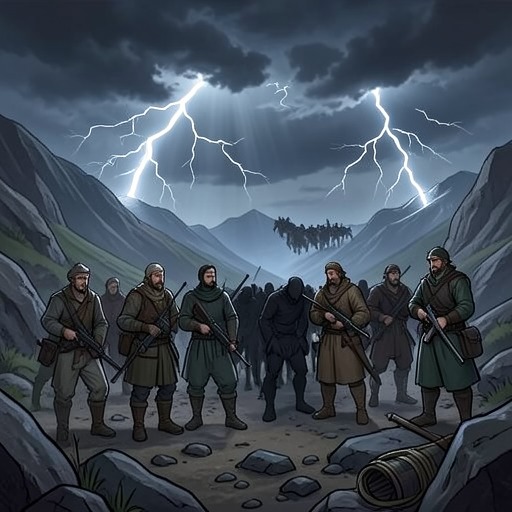
The first visible inhabitants are strange beasts with mottled gray flesh and an almost humanoid appearance. They prowl on all fours, pick at remains, and fight over what seems to be a deer carcass. Their large, jagged teeth and sloe-black eyes resemble the monsters of cautionary tales told to frighten children. Cadoc admits that he has never seen an actual nest; when Sylvaine asks what the creatures are, Neith identifies them as corpse-eaters.
This revelation changes Death Valley from an unpleasant wilderness into an active infestation. The corpse-eaters are not merely isolated predators encountered by chance. Their nest and their competition over carrion indicate a population established within the valley, while the putrefying remains suggest an ecological cycle in which death has become the region’s most visible form of abundance. The valley’s danger is consequently environmental and collective: it is a habitat shaped around decay, not a neutral landscape through which the expedition happens to pass.
A Landscape of Violence and Historical Aftermath
Death Valley’s ruin resonates with the wider history of Targgein. Sylvaine Abelan’s account of anti-elven persecution describes a society in which elves were forbidden to speak in official councils, lost the right to hold titles and land, and were forced toward cities subject to searches and curfews. Those who refused were branded fugitives, while humans could pay a taxation fee for licenses to hunt them for sport. The land that had held elven memories and generations of ancestors ceased to be home, and those who could escape fled toward safer shores.
The valley’s ecological danger therefore stands beside another form of dispossession. Elven lands were stripped of legal protection, while the history of the violence was preserved in human and dwarven narratives that cast them as heroes against ancient elves. The raids destroyed elven texts and sacred structures, leaving Sylvaine’s history to survive through spoken transmission from her father. Death Valley does not directly reproduce those raids, but its barren, death-saturated condition belongs to the same moral geography: landscapes and peoples are made vulnerable by decisions taken elsewhere, while the resulting danger is left for later travelers and inhabitants to endure.
The expedition also encounters the material residue of that history inside the dragon’s cave. A concealed room contains four barrels of black powder alongside aged dwarven whiskey and wine from the Western Isles. The use of saltpeter was outlawed after the dwarven alliance with humans during The Great Loss, when explosive material had helped win the war against the elves and was later judged inhumane. The black powder links the cave to the valley’s broader archive of violence: beneath the legendary destination lies a cache of prohibited technology whose existence preserves the contradiction between official condemnation and material survival.
Threshold to the Dragon’s Cave
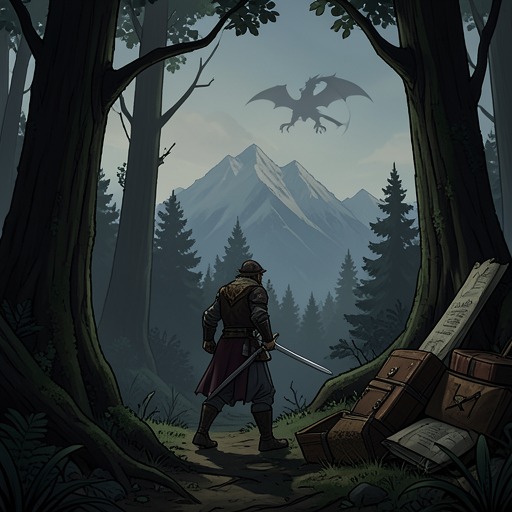
After the corpse-eater encounter, the cave entrance rises above the party as a dark, gaping opening in the heart of an unnamed mountain. Dead grass borders the narrow path as it curves upward along increasingly steep terrain. Clouds and mist interrupt the sun, while a few remaining trees and hardy pines stand along the rock face before gradually thinning into bare stone and dormant earth.
The approach makes the cave a threshold rather than a simple destination. The surviving vegetation briefly suggests resilience, but its gradual disappearance yields to unforgiving rock, mirroring the expedition’s movement from the inhabited world into a sealed space of traps, mechanisms, treasure, and concealed history. Sylvaine Abelan’s breathing grows difficult on the ascent, and Jaromir steadies her by telling her to keep it even rather than hold it or force it too quickly. The bodily strain of the climb thus accompanies the psychological pressure of entering the mountain.
Inside, the party finds walls of pulleys, cables, and mechanisms connected to traps and pressure plates. The room with the black powder and the remnants of elven religious history confirms that the cave is not an untouched natural refuge. It is a constructed archive of danger, prohibition, and loss, and Death Valley functions as its outer expression: the dead landscape leads toward a buried structure in which the past remains operational.
Narrative Significance
Death Valley gives the dragon quest a counterweight to heroic legend. Its threats are not limited to the imagined dragon at the journey’s end; they include institutional persecution, ecological collapse, inherited weapons, and creatures feeding on the dead. The expedition enters seeking a legendary hoard, but the route exposes the costs concealed beneath the stories that Targgein tells about war and heroism.
As a location, Death Valley also makes vulnerability visible across several overlapping conditions. Sylvaine Abelan travels as an elf, a woman, a displaced person, and a performer whose livelihood depends on movement through taverns and hostile public spaces. The same society that treats an elf as “gutter refuse” and permits hunters to pursue fugitive elves has also produced a world in which travel away from witnesses is dangerous and contaminated landscapes are approached by those with few safer options. The valley does not erase individual courage, but it shows how courage is demanded unequally.
Death Valley’s decisive function is therefore transitional and thematic. It is the point where the expedition’s outward movement through Targgein becomes a descent into the physical remains of its past. The corpse-eaters embody death in animal form; the black powder embodies violence preserved as contraband; the ruined forest embodies a land no longer able to sustain ordinary life. Together they make Bealucwelm a landscape in which the history of exclusion and war is not finished, only transformed into hazards that continue to feed, spread, and wait beneath the surface.