Death Valley’s corpse-eater infestation
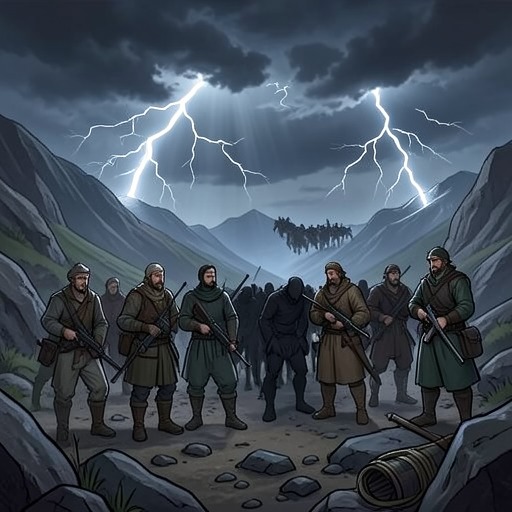
The Ballad of the Last DragonDeath Valley’s corpse-eater infestation is the predatory crisis that transforms an already ominous expedition into a struggle against an ecosystem shaped by death. The creatures are drawn to decay, consume the improperly buried dead, and gather in numbers large enough to threaten an entire traveling party. Their nest also exposes a wider history: the valley’s danger is not an isolated marvel of fantasy, but part of a world where war, persecution, poverty, and careless disposal of bodies have left hazards for vulnerable people to endure.
Causes and Background
The infestation is first foreshadowed through practical funeral customs rather than through a visible monster. When three attackers die after assaulting Sylvaine Abelan, Neith tells her that Neith and Cadoc burned the bodies so that nothing could be found and so the corpse-eaters would not be lured into the area. The explanation makes the creatures an immediate social and logistical threat: leaving corpses exposed could attract predators, while burning the bodies protects both the survivors and the surrounding settlement. Neith also promises that the disposal will not be traced back to Sylvaine Abelan, extending the group’s protection from physical danger to the suspicion that an elf would be blamed first.
The infestation is connected to a broader culture of rapidly managing death. Sylvaine Abelan remembers that in Hollowden, burial rites or funeral pyres began as soon as a medic confirmed a death, even without next of kin; in Bridgebarrow, guards removed people who died from disease or starvation so quickly that she never saw the same body twice. What she had understood as disease control may also have been a defense against corpse-eaters. The creatures therefore make an unseen rule of the landscape visible: the dead must be buried or burned before their remains become an invitation.
Death Valley’s other histories deepen that danger. The expedition travels through a region already associated with rot and death, and the party’s discovery of four barrels of black powder in the dragon’s cave recalls the violent material legacy of the dwarven alliance with humans during The Great Loss. Saltpeter and explosive powder had been outlawed after being used to defeat the ancient elves, yet the abandoned stores remain in the world. The corpse-eaters likewise represent an inherited danger whose immediate victims are not necessarily those responsible for its origins. In both cases, old violence persists as a material threat encountered by later travelers.
The Nest and Its Creatures
After three days of travel with the sun kept at the party’s left shoulder through midday, the smell of rot and death becomes so strong that Sylvaine Abelan heaves. The stench confirms the accuracy of her translations and turns the journey toward the valley into an approach toward danger that the body recognizes before the mind can fully name it. Cadoc, his face covered by a scarf, observes that the place may be empty because of its name; the joke cannot dispel the more concrete reason that no one settles there.
At the forest’s edge, the threat becomes visible. The creatures have mottled gray flesh and an almost humanoid appearance, but they prowl on all fours. They pick at remains, and two fight over what appears to be a deer carcass. Their large, jagged teeth and sloe-black eyes make them resemble the monsters of frightening children’s tales, yet the scene is not safely confined to story. Sylvaine Abelan cannot look away, while Cadoc recognizes the site as an actual nest and Neith identifies the animals as corpse-eaters.
Neith explains that corpse-eaters are said to have once been human. According to the tale, a plague destroyed the crops of an ancient civilization and left its people starving; they began eating their dead, then ceased waiting for death to select their next meal. Whether the transformation arose from diseased flesh or from the curse of consuming fellow humans, a new monster emerged. The explanation preserves uncertainty about the creatures’ origin while making their appetite legible as a corruption of human desperation. Sylvaine Abelan recalls a similar tale from Smarighad about living flesh changing the soul, but the immediate horror requires no supernatural justification: the monsters are real, and they are already at the party’s doorstep.
The creatures are indiscriminate in what they consume and will attack the living if they realize someone is nearby, but they are especially attracted to dead bodies that have not been properly buried or burned. This distinction explains the recurring urgency of funeral rites and gives the infestation a grim logic. Death does not end the danger; an unprotected corpse can extend it, drawing predators toward every nearby survivor.
The Attack in Death Valley
The party attempts to exploit the corpse-eaters’ behavior. Jaromir leads the group deeper into the forest and proposes that Sylvaine Abelan remain under the cover of the trees while Jaromir, Neith, and Cadoc draw the creatures toward the mountain entrance and pick them off one by one. The plan depends on separation, controlled movement, and the hope that the nest can be reduced without exposing Sylvaine Abelan to the full attack.
That control collapses when one beast’s cry echoes across the valley. The sound functions as a dinner bell, and dozens of corpse-eaters rush toward Jaromir, Neith, and Cadoc, who form a triangular formation so that none of them has an exposed back. The scale of the infestation changes the encounter from a hunt into a defensive battle. The group is no longer choosing which creature to approach; it is trying to survive a converging mass of predators.
Sylvaine Abelan contributes from a distance with the shepherd’s sling Neith had insisted she carry. Her first stone strikes the nearest corpse-eater in the back of the head, knocking it down and stunning it momentarily. The gesture matters because it joins her artistic and linguistic identity to a practical capacity for intervention. The same character who translates ancient history, hides her ears to earn coins, and performs beneath a red velvet cap can also act decisively when the party’s formation is threatened.
The valley’s physical environment magnifies the horror. Rot is encountered first through smell, then through carcasses, then through gray bodies and black eyes, and finally through the massed sound of snorts and growls. The infestation is thus revealed by stages: anticipation gives way to visible monstrosity, and visible monstrosity gives way to overwhelming numbers. The progression also makes the threat bodily rather than merely intellectual, producing nausea, panic, and the instinctive dread of becoming food.
Social and Thematic Significance
The corpse-eaters exist within a society already organized by unequal judgments of whose body, land, and testimony deserve protection. During the raids against the elves, elves lost the right to hold titles and land; those who refused removal into cities with searches and curfews were branded fugitives, while humans could pay a taxation fee for licenses to hunt them. The violence even produced hunters who wore elven ears as trophies. Against that background, the insult “knife-ear” and the claim that elves are “gutter refuse” are not isolated rudeness but part of a system that makes Sylvaine Abelan physically unsafe.
Her vulnerability is cumulative. She performs for coin while concealing her ears because visible elven heritage attracts prejudice, endures panic when confronted by hostile men, and is attacked in an isolated field after climbing a tree to avoid being seen alone. The corpse-eater infestation parallels this human violence without erasing the difference between them: the beasts consume flesh, while human institutions and customs turn identity into grounds for exclusion, pursuit, and assault. Both dangers make the body a contested site, but only the human danger is deliberately justified through law, superstition, and historical propaganda.
The infestation also reveals how environmental risk is distributed. Death Valley is avoided by settlers, while travelers such as Sylvaine Abelan, Jaromir, Neith, and Cadoc must enter it in pursuit of a larger quest. The abandoned nest, the rotten field, and the need to burn bodies show a landscape where danger accumulates away from ordinary habitation and is inherited by those with the fewest safe alternatives. The same world that drives elves from their ancestral land and restricts their escape to a single affordable boarding pass leaves later survivors to confront the consequences of old wars and neglected places.
Finally, the corpse-eaters complicate the boundary between story and history. Their origin is preserved as a whispered account of famine, plague, and cannibalism, while Sylvaine Abelan’s own elven history survives through spoken word after written texts and sacred structures were destroyed. Both traditions explain present danger through narratives handed down across catastrophe. Yet the nest also corrects the comforting distance of legend: the monsters of tales meant to frighten children are standing in the forest, and the ancient histories dismissed as superstition have become conditions that still determine who is safe, who is hunted, and who must clean up the dead.