Dwarves
The Ballad of the Last DragonDwarves are presented as a people whose visible place in everyday life conceals a turbulent historical legacy. They are associated with sturdy bodies, commercial travel, whiskey, metalwork, engineering, and hospitality, but also with the political consequences of alliance, war, technological catastrophe, and the suppression of other cultures. Their presence therefore links ordinary tavern scenes to the deepest historical conflicts of Targgein.
Identity and Everyday Presence
Dwarves appear first as an accepted part of public life. A barkeep at the Rusty Nail has a stocky build, thick shoulders, and a broad frame; only closer observation suggests dwarven descent. His appearance is not treated as unusual for a tavern keeper, and his presence contrasts sharply with the hostility an elven barkeep would likely provoke from rowdy drinkers. The contrast establishes that dwarven identity carries a degree of social safety that elven identity does not.
Dwarves are also connected with movement and commerce. Neith chats with dwarven merchants traveling the main roads to Bridgebarrow, recognizing that their contacts could spread news of the adventurers’ exploits. The merchants are not merely background travelers: they form part of the informal network through which reputation, trade, and stories circulate. Their mobility gives the group’s growing legend a practical route beyond the tavern where it was created.
The narrator’s response to dwarven whiskey is more intimate and comic. The drink burns going down and leaves her feeling submerged, while she praises dwarves for mastering whiskey, metalwork, and technology. She even recalls hearing of a dwarven inventor who discovered a fire that would never burn out, imagining the eternal flame as romantic material for a ballad. This fascination turns dwarven craft into both a material achievement and an imaginative resource for an artist.
Alliance, War, and Historical Reputation
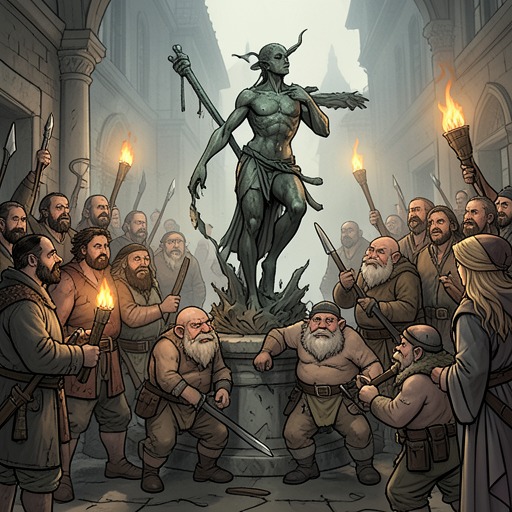
The dwarves’ position in Targgein was shaped by their relationship with humans during The Unification, known among elves as An Call Mòr, or The Great Loss. The alliance was not unanimous: dissent and infighting divided the dwarves, yet those who took up arms were rewarded with land and minor titles in Targgein. Their political advancement therefore emerged from a conflict that produced winners within dwarven society as well as devastation for the elves.
Human and dwarven histories preserved the two peoples as heroes who opposed the ancient elves, describing the elves as beings of power and malice. The narrator understands this heroic archive as part of a much older process through which fear and distrust were planted, sustained through an uneasy peace lasting more than a century, and eventually brought to fruition during the raids. Elven texts and sacred structures were destroyed, while elven history survived mainly through spoken word. Against that erasure, the narrator’s father’s transmission of the ancient elven alphabet and historical knowledge becomes an act of rebellion.
This history makes the ordinary ease surrounding dwarves politically meaningful. Dwarves can occupy public roles without the tension that would surround an elf because the dominant historical story has placed them on the side of the victors. Their relative acceptance is not presented as proof of a just society; it is one consequence of a narrative order that turned alliance into honor and elven survival into suspicion.
Engineering and Technological Memory
Dwarven engineering becomes central when the adventurers enter the Dragon’s Cave. The cave mouth contains thin pipes embedded in the stone, each emitting a soft hiss, and the signs of repeated fire consumption suggest that the entrance has been designed around dangerous mechanical systems. Jaromir identifies the square beneath the narrator’s foot as a pressure plate and calls it ancient dwarven technology; he intends to replace the pressure gradually so she can move away without triggering whatever mechanism is attached to it.
The technology is not understood as simple magic. Jaromir knows enough to recognize the danger, while the narrator has read about the engineering advances of Hawthok but knows that theory is safer than practice. Later, Jaromir explains that dwarven construction could include pipes running through stone, recalling an old ruin in which water was carried through walls so nobles would not have to draw it from wells. The cave’s hissing pipes, however, do not resemble that benign application, leaving the party unsure whether they are hearing an alarm, a weapon, or part of a larger mechanism.
The narrator recalls why such achievements became taboo. After the catastrophic death of Lady Margaret, the favored cousin of King Elvard, most dwarven architecture and related advances were banned. King Elvard had commissioned a Hawthokian engineer to build a palace inside a cave in the manner of the ancient dwarven kings, including mechanical doors heavy enough to withstand an army. When the pipes burst, the resulting flood prevented anyone from opening the doors to rescue Lady Margaret. The disaster gives dwarven technology a double inheritance: it represents extraordinary ingenuity, but also the fatal consequences of engineering placed beyond human control.
Weapons, Prohibition, and the Dragon’s Cave
The hidden chamber in the Dragon’s Cave contains mechanisms, pulleys, cables, books, and barrels marked with symbols for their contents. Among the stores are aged dwarven whiskey, wine from the Western Isles, and four barrels of black powder. The discovery changes the cave from a merely ancient site into a prepared technological environment containing both hospitality and explosive force.
The black powder carries its own political history. The use of saltpeter was outlawed after the dwarven alliance with humans during The Great Loss because the damage caused by the explosive material was judged inhumane, even though it had helped win the war against the elves. The prohibition therefore does not erase dwarven military innovation; it records the victors’ belated recognition that the methods of victory were morally destructive. The barrels in the cave become evidence that banned knowledge has survived in storage, hidden infrastructure, and mechanisms whose operation the travelers do not yet understand.
The chamber also contains a black prayer stone streaked with jade marbling. The narrator recognizes it as an object once housed in elven temples as a conduit for prayer and reverence to the goddess and Welkin’s guardians. Although the stone is not dwarven in origin, its survival inside a chamber built around ancient dwarven mechanisms places two suppressed histories in the same buried space: dwarven technology and the sacred remains of elven culture. The cave thus preserves what public history tried to outlaw or destroy.
Narrative Significance
Dwarves occupy a position between the familiar and the forbidden. In taverns they are barkeeps, merchants, drink-makers, and possible allies; in historical memory they are participants in the alliance that elevated them and helped establish anti-elven prejudice; beneath the Dragon’s Cave they are the makers of pressure plates, pipes, pulleys, mechanical systems, and explosive stores. The same culture that produces convivial whiskey also leaves behind technologies capable of flood, fire, entrapment, and war.
Their representation complicates any simple division between civilized progress and dangerous antiquity. Dwarven achievements are practical, elegant, and even romantic in the narrator’s imagination, yet their history includes factional conflict, imperial reward, battlefield explosives, and a palace disaster that killed a royal relative. The story’s treatment of Dwarves consequently makes technology inseparable from memory and responsibility: what a people can build shapes its political power, while what it chooses to ban reveals the cost of having built it.
Most importantly, Dwarves help expose how history is made unevenly visible. Their alliance is archived as heroism, while elven texts and sacred structures are destroyed; their engineering survives as a dangerous ruin, while elven religious objects survive only as fragments hidden among the machinery. Dwarves are therefore not simply a fantasy people defined by craft. They are a historical force whose public respectability, technological inheritance, and proximity to erased elven culture reveal how power determines which pasts are celebrated, which are prohibited, and which survive only through memory and story.