Elven displacement from Smarighad
The Ballad of the Last DragonElven displacement from Smarighad is not merely a change of residence but the formative condition of Sylvaine Abelan’s life: forced from her homeland by raids, separated from any secure community, and compelled to make belonging through movement and art. Her refugee experience shapes where she goes, how she earns a living, why home remains both desired and frightening, and why every encounter with anti-elf prejudice carries the weight of a much longer history.
Forced Departure and the Geography of Exile
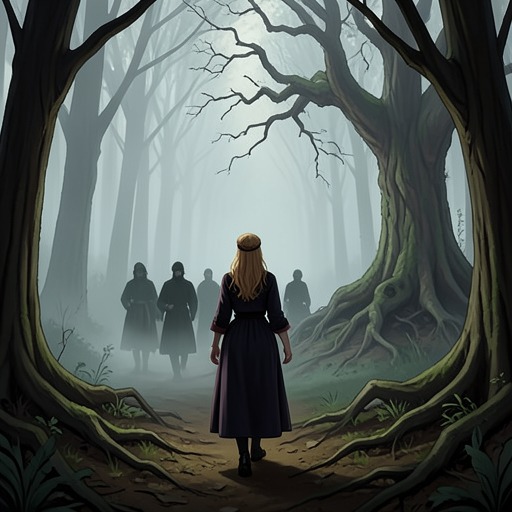
Sylvaine Abelan identifies Smarighad as her original home, but the elven raids drove thousands of elves from it. Her account compresses a mass displacement into an individual route: she hid aboard a merchant vessel, spent nearly five years in Bridgebarrow, and then saved enough money to travel through Mysture proper. Before settling temporarily in Hollowden, she passed through Elmwood and Birchfield. The sequence is neither a chosen tour nor a carefree artistic pilgrimage. It is a record of survival assembled from ships, roads, temporary rooms, and whatever work could be found along the way.
Her language deliberately softens the violence. When asked about her past, she maintains a cheerful manner and pushes childhood memories aside, presenting facts without exposing the full emotional cost behind them. Nothing in the account is false, yet its omissions reveal how displacement produces a second burden: the displaced person must continually translate catastrophe into an acceptable story for strangers. Her years of travel are described as adventure, but Sylvaine privately understands them as uncertainty, hunger, and pickpocketing.
Work, Poverty, and Self-Made Mobility
In the absence of a stable home or inherited security, Sylvaine turns performance into both livelihood and social access. She makes a name for herself in local taverns and suggests that, had she not been recruited when she was, she might have moved on to larger venues. Her artistic ambition therefore grows directly out of displacement: travel is dangerous and economically precarious, but it also offers a way to build a reputation that cannot be reduced to her elven appearance.
Hollowden becomes familiar enough to leave behind with difficulty, yet Sylvaine calls it a temporary reprieve rather than a final settlement. She needs time to refill her artistic well before attempting a city such as Lindale. The phrase expresses professional aspiration, but it also shows how unsettled her life remains. Even rest is provisional, and even artistic preparation is conducted under the pressure of the next departure.
Home as Longing and Threat
Displacement makes home an emotionally divided idea for Sylvaine. She misses Kingsley and Brigitta intensely, and their affection represents a genuine personal bond, but returning to the village would mean becoming its oddity again. The danger is not simply that she lacks a house there; it is that the community would make her difference the central fact of her existence. Until she establishes a name greater than the perceived sharpness of her ears, she believes there is no place for her in that village, and she fears there may never be one.
This conflict explains the force of Jaromir’s insistence that Hollowden is her home. To him, home is a place to which she can be brought back. To Sylvaine, home is bound to memory, affection, exclusion, and dread all at once. The exchange exposes the gap between geographical return and emotional belonging: displacement can end on a map while continuing in the mind.
Anti-Elf Prejudice and Gendered Vulnerability
The social consequences of displacement become explicit in the Rusty Nail when a patron seizes Sylvaine and calls her “knife-ear,” telling her that she is lucky to have been allowed into the tavern and threatening to show her what her kind deserves. The insult treats her presence as a tolerated intrusion rather than a person’s rightful participation in public life. Her body becomes the site where anti-elf hostility is enforced, and the threat immediately triggers a physical panic response: her throat tightens, her chest turns cold, her legs go numb, and the room begins to spin.
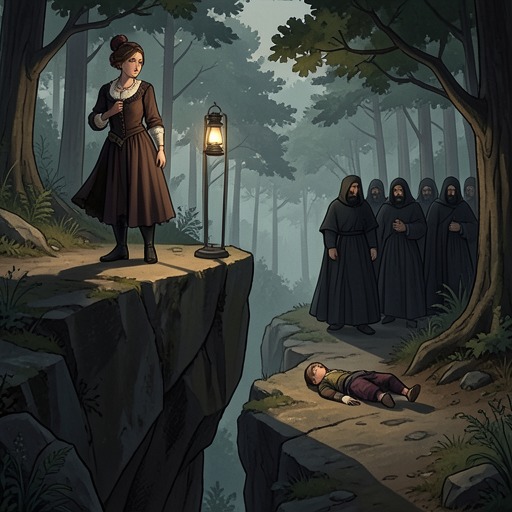
Her vulnerability is compounded by circumstances that are not reducible to species prejudice alone. As a woman, a poor performer, and a displaced person without reliable institutional protection, she has learned not to be alone with groups of loud men. In the pasture, she hears three tavern patrons approaching and climbs into a concealed tree branch rather than risk being seen. She carries a short sword at Neith’s insistence and keeps a shepherd’s sling in her pocket, but preparation cannot erase the structural danger surrounding her. When the men attack, they break her lute, seize her body, stuff her cap into her mouth, force her legs apart, and hold down her wrists and feet while she bites, claws, kicks, and struggles to resist. The scene makes displacement a condition of exposed life: she is mobile, resourceful, and armed, yet still denied the safety that settled belonging might provide.
Resistance and Narrative Significance
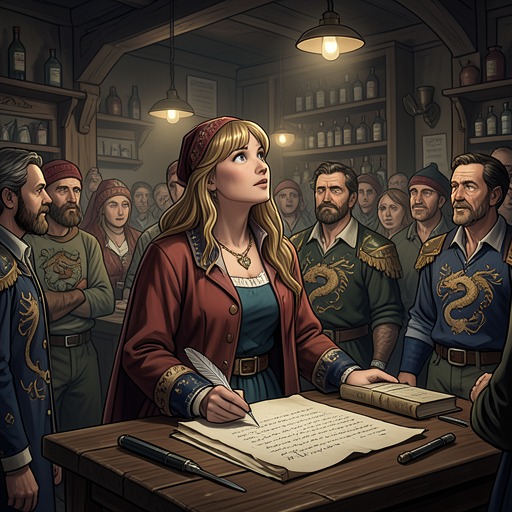
Sylvaine does not answer displacement by abandoning the identity that others use against her. At the magistrate’s meeting, she introduces herself as Sylvaine Abelan, an extraordinary bard, defender of written and spoken word, acting notary, formidable slinger of stones, and guide for a better tomorrow. Her self-description gathers artistic, practical, and combative abilities into a public identity she has built for herself. When Magistrate Ridion dismisses her as an elf who considers herself better than “gutter refuse,” she laughs rather than accept his definition, while Jaromir physically warns him to control his speech.
That confrontation captures the central tension of the elven refugee condition. Sylvaine is repeatedly treated as someone who must justify her presence, yet her skills make her indispensable; she is cast as an outsider, yet she becomes a guide; she is threatened as a racialized and gendered body, yet she answers through performance, wit, weapons, and public speech. Her displacement supplies the novel with a perspective from which taverns, villages, officials, and traveling adventurers can all be measured against the question of who is permitted to belong.
The condition also gives her movement a double meaning. Travel is the consequence of expulsion, but it becomes the means by which Sylvaine acquires cultural and symbolic capital: experience, artistic authority, alliances, and a name capable of competing with prejudice. Her story does not erase the loss of Smarighad or promise that return will restore what was taken. Instead, it presents belonging as something she must continually negotiate and partly create, even while the memory of forced exile remains active beneath her practiced cheerfulness.