Elven persecution and displacement
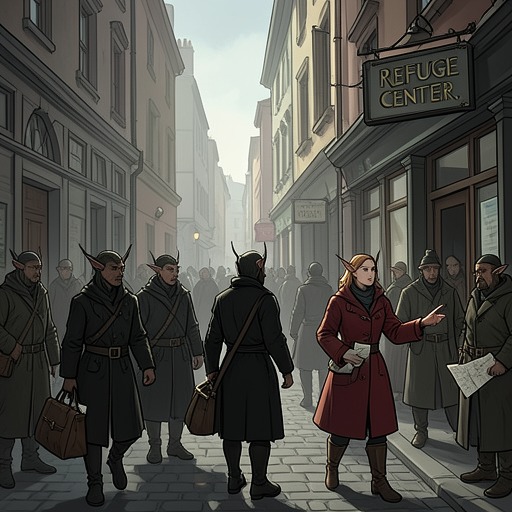
The Ballad of the Last DragonElven persecution and displacement is the system of exclusion and forced migration that reshapes every part of elven life in the narrative. It is not confined to isolated insults or individual cruelty: it operates through law, inherited historical narratives, economic exploitation, surveillance, hunting licenses, and physical attack. The result is a people driven from ancestral land and compelled to build precarious lives elsewhere, while those who remain face the constant possibility that ordinary human institutions will treat them as threats rather than citizens.
Historical Foundations
The condition is rooted in the human and dwarven account of The Unification, also called An Call Mòr or The Great Loss. Hawthok’s alliance with humans helped establish dwarves as rewarded participants in the victorious order: those who took up arms received land and minor titles in Targgein. Official histories preserved the human and dwarven side as heroic while representing the ancient elves as beings of power and malice. That narrative outlived the war and allowed fear to harden into common prejudice. Even after more than a century of tenuous peace, the old distrust remained available for renewed political use.
The persecution also destroys the means by which elves might contest that account. Elven texts and sacred structures were destroyed during the raids, leaving communal history to survive primarily through spoken word. Sylvaine Abelan’s father preserved knowledge of the ancient elven alphabet and elven history, making inherited memory itself a form of rebellion. The surviving tradition therefore carries more than cultural meaning: it resists the victors’ attempt to define elves solely through hostile human and dwarven records.
Law, Property, and Displacement
The turn from prejudice to organized persecution begins with disputes over land and the systematic denial of elven testimony. Elves are forbidden to speak in official councils because authorities fear that their stories might be true, or that elves might magically sway human minds. This legal silencing makes it easy for town magistrates to accept a human’s word over an elf’s, converting suspicion into an administrative habit. Fabricated accusations then give superstition a practical vocabulary, portraying ordinary disagreements, trade, or sexual encounters as evidence of elven magic.
The raids that follow remove the right of elves to hold titles, including titles to land. Elves who refuse to surrender their property and move into cities—where searches and curfews await them—are branded fugitives. The state then turns persecution into a profitable spectacle by allowing humans, in exchange for a taxation fee, to hunt fugitive elves for sport. Some hunters wear severed or artificial elf ears on chains as trophies, reducing a persecuted identity to evidence of conquest.
This displacement is especially violent because elves’ relationship to land is presented as generational and mnemonic rather than merely economic. Their homes contain the memories of ancestors and the accumulated claim of a people tied to place, yet legal force makes that home unsafe. Those who can flee leave for safer shores, but escape is expensive and few vessels will transport elves to the continent. Sylvaine’s family can afford only one boarding pass, forcing her to leave her parents behind while knowing that imprisonment, or something worse, may await them. Exile thus separates the living from both homeland and family, making survival inseparable from guilt and loss.
Everyday Precarity and Embodied Threat
Displacement does not end when an elf reaches a safer country. In Tarrgein, Sylvaine Abelan keeps her ears hidden beneath a crushed-velvet cap because her elven heritage is unwelcome, and she earns more appreciation during performances when listeners are not reminded of the identity they distrust. The concealment is both practical and coercive: removing the cap brings immediate physical relief from sweat, yet revealing herself risks reviving accusations that she might use “evil she-elf magic to bewitch them.” Her poverty narrows the room for refusal, since she would rather perform while uncomfortable than go hungry, turning artistic work into a negotiation with ethnic suspicion.
The same pressure appears in public space as direct intimidation. A tavern patron yanks Sylvaine Abelan by the shoulder, calls her a “knife-ear,” and tells her she is fortunate to be admitted at all before ordering her to fetch drinks and threatening to demonstrate what her kind deserves. The insult compresses ethnic contempt, economic vulnerability, and gendered physical danger into one encounter: she is treated as an unwanted outsider, expected to serve, and made to understand that the tavern’s permission to remain is conditional. Her body answers before her wit can; her throat tightens, her legs go numb, and panic threatens to overwhelm her. Later, when three men follow her into an isolated field, she climbs a tree rather than risk being seen alone with them, carrying the lute on her back and touching the short sword Neith insisted she carry, along with a shepherd’s sling. The precaution reveals how displacement has altered ordinary movement: distance from witnesses is no longer freedom but exposure, and self-defense becomes part of the equipment required to work and travel.
The threat becomes physical when the three men catch Sylvaine Abelan in the field. They seize her, strike her, force her to the ground, stuff her crushed cap into her mouth, and hold her wrists and legs while one man tries to overpower her. Her broken lute presses into her back as she claws, bites, kicks, and attempts to resist, binding cultural identity to bodily vulnerability: the instrument through which she earns a living is shattered in the same assault that treats her as disposable. The scene shows that displacement is not merely a condition of legal exclusion or social discomfort. It leaves an elven woman exposed to violence in spaces where protection is absent, while her attackers’ earlier presence in the tavern demonstrates how easily public hostility can follow her beyond the threshold of communal scrutiny.
Violence, Fear, and Moral Refusal
The assault leaves Sylvaine Abelan with a fear that does not disappear when the immediate danger passes. When she later holds a sword over one surviving attacker, she recognizes that power has briefly changed hands: after living powerless for so long, she could make him fear her and end his life at the pulse. Yet she lowers the blade rather than keep his death as a permanent companion. Her refusal is not surrender. It distinguishes survival from reproducing the logic of domination, even as shame and fear remain. In declaring that she is not human and does not want to be, Sylvaine rejects the identity imposed by the persecuting order while refusing to let its violence dictate the person she becomes.
The consequences also expose how prejudice governs interpretation after violence. Sylvaine expects that the disappearance of three men after newcomers arrive will make her the first person blamed, because any convenient explanation can revive the image of elves as the monsters described in ancient tales. Neith and Cadoc burn the bodies to prevent discovery and to avoid attracting corpse-eaters, then assure Sylvaine that the evidence will not be traced back to her. Their protection gives her immediate safety, but it also reveals the distorted conditions under which she must live: even after defending herself against an attack, she must fear that the authorities or the public will transform her survival into proof of elven criminality.
Resistance, Reform, and Collective Repair
Elven persecution does not remain only a history of injury; it also produces organized forms of resistance that reclaim memory, movement, and political agency. The preservation of the ancient elven alphabet by Sylvaine Abelan’s father demonstrates how cultural transmission can defy a regime that destroyed written texts and sacred structures. Later, Sylvaine turns her own command of language into practical authority. When Magistrate W. M. Ridion insults her as an elf who believes she is more than “gutter refuse,” she answers through public performance, legal knowledge, and deliberate theatrical control rather than retreating from the room. Her self-presentation as a bard, defender of written and spoken word, acting notary, and guide makes visible the capacities that prejudice tries to deny.
That performance becomes materially consequential in the dispute over Rhosyn’s home. Rhosyn demands that Ridion abolish the inheritance rule that can expel people from their homes after family tragedy and adopt Queen Dhara’s inclusive policies on land and titles. Sylvaine has already drafted the legislative document, and her notarial authority allows the demand to be converted into an immediate administrative act rather than an abstract appeal for kindness. The episode redirects resistance away from revenge against one offender and toward a change in the rule that produces vulnerability. It also links elven displacement to the insecurity of other marginalized inhabitants: the same political order that treats elves as inherently suspect can deprive anyone without protected inheritance of a home.
The reform’s significance is sharpened by Sylvaine’s own understanding of belonging. After losing her homeland, family security, and confidence that she could have value in the world, she discovers that artistic work can give her a voice but cannot by itself satisfy the need for home. She does not want charity from Kingsley and Brigitta or to be treated as a burden; she wants a place in which care is mutual and durable. The struggle over inheritance therefore externalizes a private longing. Securing Rhosyn’s right to remain in her home becomes part of a broader refusal to accept displacement as an inevitable condition for the vulnerable.
The future response to persecution extends beyond legal reform into rescue. Neith joins Cinna’s crew aboard The Sea Harpy, an elite group organized to extract people from neighboring countries, especially Smarighad. When Sylvaine learns that the crew is rescuing elves, she asks what they charge for transport. Neith’s answer is nothing: the people fleeing death and dismemberment will not be exploited for the privilege of escape. This choice counters the scarcity that made Sylvaine’s own departure so devastating. Where persecuting systems turn movement into a costly privilege, rescue transforms mobility into solidarity, allowing endangered elves to leave without converting their desperation into profit.
Resistance, Reform, and Collective Repair
Elven persecution does not remain only a history of injury; it also produces organized forms of resistance that reclaim memory, movement, and political agency. The preservation of the ancient elven alphabet by Sylvaine Abelan’s father demonstrates how cultural transmission can defy a regime that destroyed written texts and sacred structures. Later, Sylvaine turns her own command of language into practical authority. When Magistrate W. M. Ridion insults her as an elf who believes she is more than “gutter refuse,” she answers through public performance, legal knowledge, and deliberate theatrical control rather than retreating from the room. Her self-presentation as a bard, defender of written and spoken word, acting notary, and guide makes visible the capacities that prejudice tries to deny.
That performance becomes materially consequential in the dispute over Rhosyn’s home. Rhosyn demands that Magistrate W. M. Ridion abolish the inheritance rule that can expel people from their homes after family tragedy and adopt Queen Dhara’s inclusive policies on land and titles. Sylvaine Abelan has already drafted the legislative document, and her notarial authority allows the demand to become an immediate administrative act rather than an abstract appeal for kindness. The episode redirects resistance away from revenge against one offender and toward changing the rule that produces vulnerability. It also links elven displacement to the insecurity of other marginalized inhabitants: the same political order that treats elves as inherently suspect can deprive anyone without protected inheritance of a home.
Rescue, Reform, and the Possibility of Return
Elven persecution does not remain only a history of injury; it also produces organized forms of resistance that reclaim memory, movement, and political agency. The preservation of the ancient elven alphabet by Sylvaine Abelan’s father demonstrates how cultural transmission can defy a regime that destroyed written texts and sacred structures. Later, Sylvaine Abelan turns her own command of language into practical authority. When Magistrate W. M. Ridion insults her as an elf who believes she is more than “gutter refuse,” she answers through public performance, legal knowledge, and deliberate theatrical control rather than retreating from the room. Her self-presentation as a bard, defender of written and spoken word, acting notary, and guide makes visible the capacities that prejudice tries to deny.
That performance becomes materially consequential in the dispute over Rhosyn’s home. Rhosyn demands that Magistrate W. M. Ridion abolish the inheritance rule that can expel people from their homes after family tragedy and adopt Queen Dhara’s inclusive policies on land and titles. Sylvaine Abelan has already drafted the legislative document, and her notarial authority allows the demand to become an immediate administrative act rather than an abstract appeal for kindness. The episode redirects resistance away from revenge against one offender and toward changing the rule that produces vulnerability. It also links elven displacement to the insecurity of other marginalized inhabitants: the same political order that treats elves as inherently suspect can deprive anyone without protected inheritance of a home.
The reform’s significance is sharpened by Sylvaine Abelan’s own understanding of belonging. After losing her homeland, family security, and confidence that she could have value in the world, she discovers that artistic work can give her a voice but cannot by itself satisfy the need for home. She does not want charity from Kingsley and Brigitta or to be treated as a burden; she wants a place in which care is mutual and durable. The struggle over inheritance therefore externalizes a private longing. Securing Rhosyn’s right to remain in her home becomes part of a broader refusal to accept displacement as an inevitable condition for the vulnerable.
The future response to persecution extends beyond legal reform into rescue. Neith joins Cinna’s crew aboard The Sea Harpy, an elite group organized to extract people from neighboring countries, especially Smarighad. When Sylvaine Abelan learns that the crew is rescuing elves, she asks what they charge for transport. Neith’s answer is nothing: the people fleeing death and dismemberment will not be exploited for the privilege of escape. This choice counters the scarcity that made Sylvaine Abelan’s own departure so devastating. Where persecuting systems turn movement into a costly privilege, rescue transforms mobility into solidarity, allowing endangered elves to leave without converting their desperation into profit.