Jaromir
The Ballad of the Last DragonJaromir is a warrior, rider, and protector whose rough manner conceals a disciplined sense of responsibility. He enters the expedition as a skeptical guardian of its practical limits, treating danger, horses, supplies, and survival as matters that cannot be softened by bravado. Yet the same man who complains about unwanted weight carries the injured with extraordinary care, risks himself for his companions, and ultimately defines home not as a place or obligation but as his life with Sylvaine Abelan.
Identity and Introduction
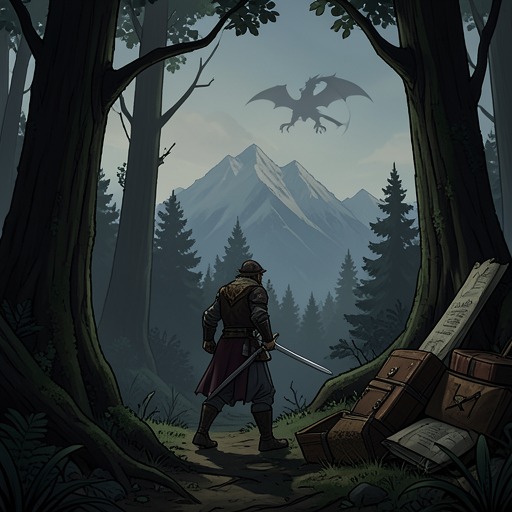
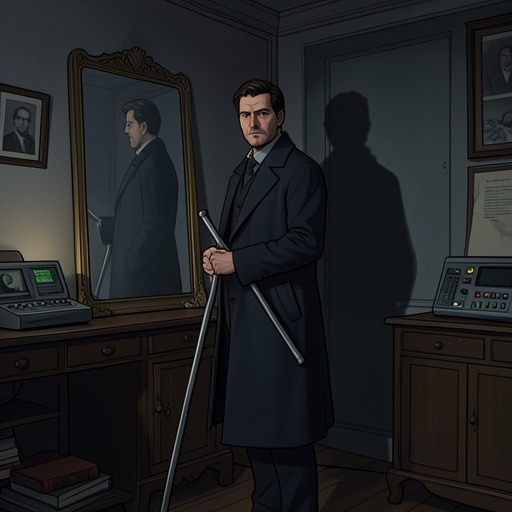
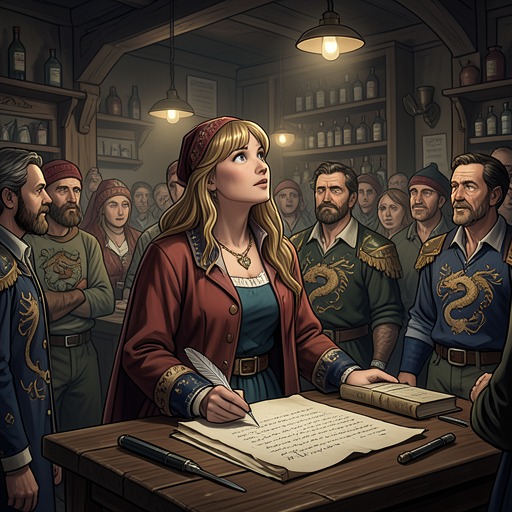
Jaromir is first distinguished by physical competence and an abrasive realism that places him at odds with Aeron Fowler. His deep, gravel-edged voice, hardened leather armor, broad chest, dark eyes, and evident strength establish him as someone shaped for violence and endurance rather than performance. When he drops a satchel containing pots and pans at the travelers’ feet, the metallic clatter makes his preparation tangible: he is thinking about provisions and burdens while others are thinking about who should join the journey.
His objections to Sylvaine Abelan’s presence are framed as logistics, but they also expose his instinctive distrust of unnecessary risk. He says that he is the faster rider if danger appears and refuses to sacrifice his horse merely so Aeron Fowler can feed his ego. He tells Sylvaine that the real issue is not fear of his actions but his ability to keep her alive, while simultaneously unloading his horse to demonstrate how much unwanted weight he believes she adds. The contradiction is central to his introduction: Jaromir speaks as though protection were an impersonal calculation, even when the force of that calculation is directed at a particular person.
His appearance also produces an immediate undercurrent of attraction. When Sylvaine hands him her most prized possession, he carries it across his back, the leather strap tight against his armor. Her prolonged attention to the way the armor fits his body does not escape him; his narrowed eyes and flushed cheeks show that the supposedly impassive warrior is capable of embarrassment and awareness. The scene makes his body both armor and evidence, presenting a man who tries to control circumstances while remaining vulnerable to being seen.
Life and Plot Trajectory
Jaromir’s competence becomes most persuasive when the expedition is endangered. After an attack, he finds Sylvaine injured, crouches beside her with a face of concern, and examines her jaw and chin while asking whether she is hurt. His voice combines harshness and softness, a verbal equivalent of his larger character: care arrives through a register that can sound like command. He then draws her toward his horse, arranges for Neith to ride with Cadoc, and plans an early camp at a safe distance from the nest so that Neith can preserve her strength. His protection is collective as well as romantic; he organizes the group around the wounded rather than treating individual heroics as sufficient.
When Aeron Fowler requires specialized medical attention, Jaromir identifies the need for a specialist near Astervale and decides that the injured man must be taken to Henry. He carries Aeron in his arms smoothly and more gently than Sylvaine believed possible. This action revises the first impression of him without erasing it. The same physical power that makes him intimidating becomes a means of transport, rescue, and preservation when the expedition’s survival depends on it.
His readiness for violence remains equally concrete. When danger reaches the camp, he seizes the sword belt Sylvaine had not noticed he had removed from his waist, draws his sword, and orders her to run back to camp. The instruction reveals a protective priority: he does not invite her to witness his courage or participate in a needless display, but removes her from the immediate threat. Later, he recognizes that her own skills can alter a fight, telling her that a well-placed shot or two can turn the tide of any battle. Jaromir therefore does not remain fixed in the role of a male protector who excludes Sylvaine from danger; he learns to understand her capacity as part of the group’s strength.
The expedition also forces him to confront the cost of his past. Jaromir explains that he once asked his brother Damir to help complete a land-squabble contract. The job involved burning a garden whose ownership had become entangled in a magistrate’s ruling on squatter’s rights. Damir’s wife was pregnant with twins and needed the money, but Damir’s pride prevented him from accepting it freely. Jaromir’s account joins mercenary practicality to family obligation: the contract was supposed to provide decent coin, yet its memory is inseparable from the burden of having drawn his brother into danger or compromise. His family responsibilities are not abstract virtues; they are debts created by specific choices.
Relationships and Conflict
Jaromir’s relationship with Sylvaine develops through a tension between force and restraint. In one early confrontation, he grips the back of her collar, spins her against a brick wall in a narrow alley, and crowds her until breathing becomes difficult. Her lute remains wedged between their bodies as a fragile boundary. Elsewhere, he presses her against a tree, bends down to meet her eyes, and lets his intent move visibly across her face before tipping her chin and kissing her. These scenes make his desire physically immediate and morally complicated: intimacy begins in a language of invasion, while Sylvaine’s instrument and notebook repeatedly create distance between them.
The relationship changes when Sylvaine actively answers his attention. She runs her fingers over his knuckles, notices his sharp inhalation, and repeats the touch. Jaromir’s body, which initially appears controlled and threatening, becomes readable through involuntary responses. His attraction is not dissolved into verbal explanation; it passes through breath, narrowed eyes, flushed cheeks, hands, and the shifting distance between two bodies. That physical language eventually supports a more reciprocal bond, even though the earlier encounters retain their force and ambiguity.
Jaromir is also capable of imposing limits when he believes discussion has become dangerous or futile. With an arm tightened around Sylvaine, he ends an argument by saying, “We’re done talking.” His protectiveness can therefore become controlling, particularly when fear or conflict overwhelms his willingness to explain himself. Yet he later tells Sylvaine that she is strong and that no shame follows from weakness, repeating the reassurance until it reaches her emotionally. The contrast matters: Jaromir’s growth does not consist of becoming gentle in every circumstance, but of learning that strength includes acknowledging vulnerability rather than punishing it.
His loyalty to family shapes the central conflict surrounding Rhosyn. Jaromir speaks of Damir’s wife and his two nieces with resigned obligation, saying that he owes them much. When the consequences of his prior commitments threaten his relationship with Sylvaine, he initially presents himself as someone who has already lost everything that could be sacrificed. His silence and harsh exhalation suggest a man attempting to convert heartbreak into resignation. Cadoc, however, makes the emotional cost explicit by telling Sylvaine that Jaromir is utterly devastated without her.
The revelation involving Thalon exposes another dimension of Jaromir’s past. His eyes widen with panic when he sees Thalon and asks why he is there, indicating that the encounter is not a neutral reunion but a breach in the guarded identity Jaromir has constructed. When another claim or threat approaches Sylvaine, Jaromir angles his body between them and rejects it with a low growl. His physical positioning repeatedly turns the body into a boundary: he stands between Sylvaine and danger, between the past and the present, and between her autonomy and the claims others attempt to impose.
Change and Ending
Jaromir’s decisive change is his refusal to continue a marriage with Rhosyn. He tells Sylvaine that he is not marrying Rhosyn, while acknowledging that the decision may make no practical difference and that he cannot expect Sylvaine to accept it simply because he has made it. The qualification is important. He does not present his choice as a demand for reward; he recognizes that his earlier obligations have caused damage and that Sylvaine retains the right to choose what follows.
His emotional honesty reaches its fullest expression when he tells Sylvaine that he has always loved her and that she will always be his home. The declaration reverses his original language of weight, speed, horses, and survival. At the beginning, Jaromir measures whether another person can be carried. At the end, he makes belonging the measure of his own life.
He extends that promise beyond a single destination. Jaromir says that he will follow Sylvaine anywhere and that she need only point to a place on the map. His condition is not a return to a fixed homeland but companionship: as long as he is with her, he is home. The map that once organizes quests and danger becomes an instrument of shared possibility. Jaromir’s ending is therefore not the abandonment of his practical identity, but its transformation from defensive survival into chosen movement.
Narrative Role and Significance
Jaromir functions as the expedition’s threshold guardian, combatant, caretaker, and emotional counterweight to Aeron Fowler’s more performative heroism. He repeatedly tests whether plans can survive contact with danger, yet his apparent obstruction often becomes the means by which the group endures. He carries supplies, protects the horses, arranges travel for the injured, transports Aeron to Henry, draws his sword when needed, and recognizes the tactical value of Sylvaine’s marksmanship. His usefulness is material before it is symbolic.
At the same time, Jaromir gives the narrative a sustained study of how care can be disguised as severity. His gestures often arrive before his explanations: a tightened arm, a hand along a jaw, a body placed between Sylvaine and another person, a lift that reveals unexpected gentleness. The story repeatedly asks the reader to distinguish protection from possession, obligation from love, and strength from the refusal to admit pain. Jaromir does not resolve those distinctions by abandoning hardness; he resolves them by making tenderness and accountability part of the same identity.
His final conception of home completes the character’s movement from guarded isolation to relational belonging. Family duty remains part of him, and the past remains capable of producing panic, silence, and loss. What changes is his willingness to let those obligations define the limits of his future. In choosing Sylvaine and promising to follow her, Jaromir turns the warrior’s familiar virtues—loyalty, endurance, and protection—toward a life that is not merely survived but shared.