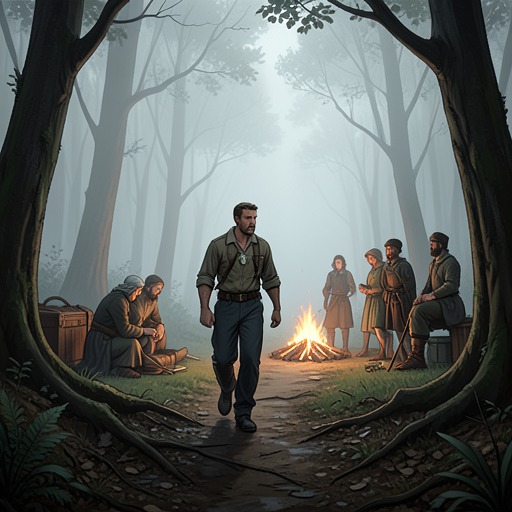
Jaromir and Damir
The Ballad of the Last DragonJaromir and Damir are brothers whose relationship remains active even after Damir’s death. Damir survives in Jaromir’s memories, obligations, nightmares, and moral decisions, making their bond one of the central forces shaping Jaromir’s conduct. The relationship is defined not only by affection but by responsibility: Jaromir believes he failed his brother and therefore tries to honor Damir through duty, even when that duty conflicts with his own desires and with his attachment to Sylvaine Abelan.
Brotherhood Shaped by Loss
Jaromir’s account of Damir reveals a relationship marked by intimate knowledge of suffering. When Sylvaine Abelan experiences an unexplained panic, Jaromir recognizes the physical terror because Damir used to suffer from similar episodes. He explains that the attacks became more frequent when Damir was stressed, yet remained unpredictable in their timing and triggers. Damir described the sensation as “death that never comes,” a phrase that gives language to the bodily terror Sylvaine cannot initially understand. Jaromir’s memory therefore turns his brother’s private pain into a form of recognition and comfort for someone else.
This recollection also shows Jaromir acting as a witness to Damir’s life rather than treating his brother’s distress as incomprehensible weakness. His knowledge is specific: stress could intensify the episodes, but no reliable pattern explained when they would arrive. By sharing that uncertainty while continuing to comfort Sylvaine, Jaromir preserves Damir’s experience as something real and particular. Damir’s suffering becomes part of the emotional vocabulary through which Jaromir cares for others.
Duty and Survivor’s Guilt
Damir’s death leaves Jaromir with an obligation he experiences as moral debt. In the conflict over his pledge to Rhosyn, Jaromir says that he had been prepared to live with the arrangement and do what was right after how much he had failed. Although the precise nature of that failure is not restated in the exchange, his words make clear that Damir’s death has altered the meaning of duty for him. The promise connected to Rhosyn is not presented as an independent romantic choice; it is part of Jaromir’s attempt to carry responsibility after losing his brother.
That burden makes Jaromir’s later love for Sylvaine Abelan feel, to him, like a breach in an ethical structure he had built around Damir’s absence. He declares that honor and duty to Damir would have been damned if he had known what he would find with Sylvaine before making his vows. The statement exposes the contradiction at the heart of his grief: Damir’s memory demands loyalty, but the life Jaromir wants cannot be reduced to repayment for the past. His brotherhood is therefore both a source of devotion and a force that keeps him bound to choices he no longer wishes to make.
Damir’s Widow and the Betrothal Conflict
The revelation that Rhosyn is Damir’s widow changes the significance of Jaromir’s agreement with her. Jaromir insists that he has no attachment to anyone but Sylvaine and that his arrangement with Rhosyn is no deeper than paperwork. Sylvaine rejects that distinction because the arrangement remains a pledge, regardless of whether it contains romantic feeling. The discovery that Rhosyn was Damir’s wife makes the situation more painful: Jaromir is not merely entangled in an unwanted betrothal but appears to be occupying a position created by his brother’s death and by the obligations left behind with Damir’s widow.
The revelation also intensifies Sylvaine’s anger over Jaromir’s earlier intimacy with her. She remembers that he pursued their encounter in the forest with eager hunger even though he already knew he was bound to another person. From Sylvaine’s perspective, Damir’s place in the arrangement does not excuse Jaromir’s concealment. From Jaromir’s perspective, however, his pledge was a duty he had accepted before he understood the depth of his connection with Sylvaine. The brothers’ relationship thus becomes the hidden structure beneath a romantic conflict: Damir is absent from the scene, yet his death determines who Jaromir believes he must protect and what he believes he is allowed to want.
Memory, Nightmare, and Continuing Presence
Damir returns to Jaromir not only through conscious explanation but through involuntary repetition. While suffering from venom poisoning, Jaromir tosses in his sleep, cries out “Damir, no,” and wakes reaching for nothing. His fevered body and disoriented awakening place Damir at the center of a traumatic recurrence. The nightmare is not a settled recollection that Jaromir can calmly narrate; it erupts as a cry, followed by a physical search for someone who is no longer there.
Sylvaine responds by placing a hand on Jaromir’s burning forehead and rubbing his back, repeating the kind of bodily reassurance Jaromir had earlier offered her. This parallel links the brothers’ history to the present relationship: Damir’s past panic teaches Jaromir how to recognize terror, while Jaromir’s own nightmare reveals how deeply his brother’s absence remains lodged in him. Care moves across the loss rather than resolving it. Sylvaine cannot restore Damir, but she can meet Jaromir in the moment when memory turns into fear.
Narrative and Thematic Significance
Jaromir and Damir represent the way family responsibility can survive the person who first created it. Damir’s absence does not end the relationship; it transforms it into remembrance, guilt, inherited obligation, and repeated bodily distress. Jaromir’s conduct toward Rhosyn is shaped by the need to do right after failing Damir, while his response to panic is shaped by having witnessed Damir endure an attack that could arrive without warning.
The relationship also complicates any simple opposition between duty and love. Jaromir does not treat Damir’s memory as meaningless, and he does not deny that his obligations matter. Yet his attachment to Sylvaine exposes the cost of making grief into a permanent command. Damir remains a beloved brother, a source of knowledge, and a moral presence, but the very loyalty meant to honor him threatens to govern Jaromir’s future. Through this tension, the brotherhood becomes a study of survivor’s guilt: love persists, but so does the demand to decide whether honoring the dead requires surrendering the life still available to the living.