Jaromir's survivor's guilt
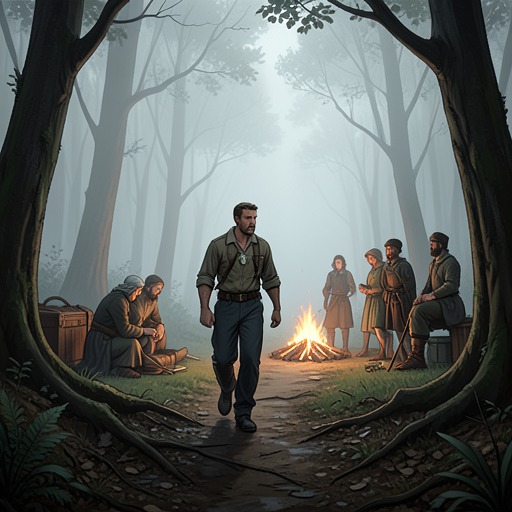
The Ballad of the Last DragonJaromir's survivor's guilt is the emotional and moral state produced by Damir's death during a dangerous contract Jaromir had initiated. It is not simple bereavement: Jaromir survives while believing that Damir died because he asked for help, and he therefore treats continued responsibility toward Damir's family as the only acceptable response to loss. His grief becomes a form of obligation, shaping both his journey and his resistance to intimacy.
Origin in Damir's Death
Jaromir returns to the subject reluctantly, identifying Damir's wife and their two nieces as the people awaiting him and acknowledging that he owes them much. Damir had died the previous summer, and Jaromir's grimace and reluctance to elaborate show that the loss remains active rather than settled. The family he names is not an abstract memory: Damir's wife was pregnant with twins when the brothers accepted the work, making the consequences of the death immediate and material.
The circumstances of the death explain why Jaromir experiences grief as personal responsibility. He had asked Damir to help complete what seemed to be an easy-money contract whose principal danger was imprisonment. The task concerned a land dispute: the brothers were paid to burn a garden claimed by former property owners after a magistrate recognized their neighbor's squatter's rights. Jaromir insists that he did not need Damir's assistance, but Damir's pride prevented him from accepting money without working for it. Their decision to proceed brought them to an arachnida nest, where a barb struck Damir in the heart and killed him before Jaromir could carry him back into town.
The accidental nature of the death does not free Jaromir from blame. In his reasoning, the chain remains clear: he proposed the contract, Damir came because of him, and Damir died before rescue was possible. The danger was not an intentional act of betrayal, but survivor's guilt rarely depends on legal responsibility alone. Jaromir converts an unforeseen encounter with the nest into a debt he must continue paying, because survival leaves him with the unbearable knowledge that Damir cannot act for his own family anymore.
Guilt as Duty
Jaromir's response is to assume practical responsibility for Damir's widow and daughters. The journey was meant to earn money for their needs, even though he admits that the payment would not cover the debt by many leagues. His aim was more modest and more revealing: to tend to the needs created by Damir's absence and lessen the family's burden. The trip therefore functions simultaneously as employment, penance, and an attempt to make an irreversible death yield some form of protection.
His language presents responsibility as a substitute for mourning. Jaromir says that the past is set in stone and that all he can do is ensure that Damir's wife and daughters want for nothing. The finality of the image matters. He does not imagine undoing the death or forgiving himself; instead, he confines his future to duties that can be performed on Damir's behalf. Care becomes the shape his grief is permitted to take, while personal desire appears almost like an unjustified distraction.
This burden also helps explain Jaromir's initial impatience with Sylvaine Abelan. Sylvaine recognizes that he may have viewed her as a means of delaying his return, and that such a perception would have given him reason to resist her. His urgency is not merely practical. Every additional attachment threatens to compete with the family he believes he failed, while every delay can feel like another abandonment of Damir's dependents. His reluctance to come home is therefore paradoxical: he is driven toward home by duty, yet the pain awaiting him there makes the return emotionally difficult.
Grief, Intimacy, and Consolation
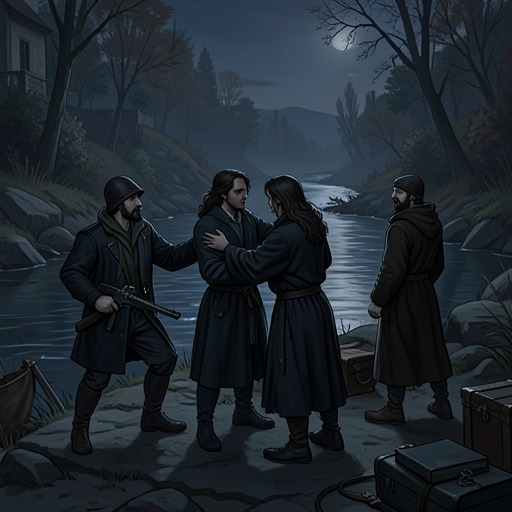
The disclosure occurs in an intimate exchange with Sylvaine Abelan. As Jaromir's breathing quickens with desperation, Sylvaine takes his hand; his fingers lace with hers, changing consolation into an intimate hold. The gesture does not erase his grief, but it creates a moment in which responsibility can be spoken rather than silently performed. Jaromir's body reveals the pressure beneath his controlled account, while Sylvaine responds not by demanding that he stop mourning but by refusing the conclusion that he must suffer alone.
Sylvaine directly challenges the moral equation at the heart of his guilt. She acknowledges that Damir's death was awful, but tells Jaromir that it was not his fault and that life is difficult enough without making the survivor bear guilt merely for remaining alive. She also points to the concrete good Jaromir has already done for Damir's family, treating his care as sufficient evidence of loyalty rather than as an endlessly inadequate payment. Her argument separates love from self-punishment: honoring Damir does not require Jaromir to condemn every part of his own continued life.
Jaromir's reaction remains guarded. When Sylvaine begins to withdraw her hand, he catches it and holds it in place, an action more eloquent than an explicit acceptance of her reasoning. He does not announce that the guilt has vanished, because the evidence gives no such resolution. Instead, he permits contact to continue. The hold suggests a temporary willingness to receive comfort without abandoning the duty that has defined him.
Wider Structures of Loss
Jaromir's private guilt exists within a world where loss is repeatedly produced by dangerous work, contested property, and inherited violence. The contract that led to Damir's death began as a land dispute adjudicated through unequal claims and ended in an arachnida nest. Later, the group encounters a nest of gray, humanoid beasts feeding on remains, a scene that makes death ecological and bodily rather than legendary. These creatures are not merely scenery: they turn the landscape into an active hazard and expose how human attempts to settle debts or property disputes can place vulnerable people in lethal environments.
The book also links personal bereavement to historical injustice. Human and dwarven histories preserve The Unification and The Great Loss as victories, while elven history remembers the same period through destroyed texts, ruined sacred structures, raids, dispossession, and flight. Elves lose titles and land, are forced into cities under searches and curfews, and may be hunted for sport under official licenses. Against this background, Jaromir's guilt is intimate rather than systemic, but it belongs to the same moral world: institutions and communities repeatedly convert vulnerability into someone else's burden, leaving survivors to manage consequences that cannot truly be repaired.
Even the abandoned mechanisms found later in the dragon's cave carry this inheritance. Four barrels of black powder remain among the traps, despite the prohibition on saltpeter after dwarven cooperation with humans during The Great Loss. The explosive material was condemned as inhumane only after it had helped win the war against the elves. Such remnants echo Jaromir's experience in miniature: the past is declared finished, yet its instruments and consequences remain active. His guilt is likewise a surviving mechanism, still triggered by memory long after Damir's death.
Moral Direction and Significance
The most important movement in Jaromir's survivor's guilt is not a clean recovery but a possible redirection. The story repeatedly distinguishes the desire to control fear through violence from the harder work of refusing to reproduce harm. Sylvaine, for example, has the power to kill an assailant but lowers her sword because she does not want his death on her hands or to carry it as a constant companion. Her choice provides a moral counterpoint to Jaromir's burden: responsibility can mean refusing both vengeance and self-destruction, then choosing actions that protect the living.
That principle later expands into structural action when Rhosyn demands that Magistrate William M. Ridion abolish the inheritance law that can expel people from their homes after family tragedy and adopt Queen Dhara's inclusive land and title policies. The reform addresses vulnerability before it becomes another private catastrophe. Jaromir's instinct is to compensate Damir's family personally; Rhosyn's demand seeks to change the law so that other families need not depend on such private rescue. The contrast gives survivor's guilt a broader significance: grief may begin as an individual's debt, but justice requires examining the systems that distribute danger, property, and protection.
Jaromir's guilt therefore remains unresolved in the narrow psychological sense, yet it is not static. He carries Damir's death as a wound, interprets survival as an obligation, and measures his future against the needs of those left behind. Sylvaine's compassion does not release him from love or responsibility; it offers a different way to inhabit them. The state is significant because it turns mourning into action while warning against mistaking endless self-punishment for fidelity. Jaromir cannot change what happened in the arachnida nest, but he can decide whether Damir's memory will govern him as a sentence or guide him toward care, connection, and protection of the living.