Kalinia Male-Heir Inheritance Law
The Ballad of the Last DragonKalinia Male-Heir Inheritance Law is the local inheritance regime that makes male succession a condition of secure property ownership. By allowing the town to absorb an estate when no suitable male heir exists, it turns family bereavement into a legal threat to the surviving household and sets the central conflict between Jaromir’s family duty, Rhosyn’s claim to her home, and Kalinia’s entrenched magistracy.
Definition and Operation
Kalinia’s rule remains an archaic exception to the broader reforms associated with Queen Dhara. Although the queen’s new by-laws popularize inheritance rights for next of kin, Kalinia has not accepted a system that would recognize every form of kinship, even through a will of testament. Its local magistrates continue to enforce a statute under which the town absorbs an inheritance if the deceased leaves no suitable male heir.
The law therefore governs more than the transfer of land. It determines who can remain in a home, who can establish a life there, and whose relationship to the dead counts as legally sufficient. Rhosyn’s repeated attempts to petition Magistrate W. M. Ridion fail because Kalinia’s local governing structure does not require him to adapt to Queen Dhara’s inclusive policies. The ornate office, the magistrate’s expensive furnishings, and his reliance on poor locks become visible signs of a comfortable authority defending an exclusionary order.
Effects on Rhosyn and Jaromir
The law’s human cost is made concrete through Rhosyn’s precarious position after Damir’s death. Damir built the family home, and Rhosyn associates its floorboards, including a nail he left imperfectly hammered into the third step, with his continuing presence. The property is also bound to generations of family history and to the future once imagined for their daughters. Losing it would not merely mean relocation; it would sever the household from the physical inheritance of Damir and his forebears.
Jaromir’s proposed marriage to Rhosyn is shaped by this legal danger rather than by mutual romantic desire. He offered his hand in title only so that she would be cared for if he died. Because Damir’s land, farm, and house passed to Jaromir, Rhosyn has no independent claim to the property under Kalinia’s rule. If Jaromir dies without heirs, the estate would pass to the town magistrate, leaving Rhosyn and her daughters vulnerable to expulsion.
This provision explains why Jaromir treats the planned winter union as a family obligation. He and Rhosyn agreed to remain unattached in practice and free to seek pleasure elsewhere, while intending to observe the marriage rites seriously once united. Rhosyn does not want to marry Jaromir, having regarded him primarily as Damir’s brother and her lifelong friend, but she has considered whether friendship and respect might eventually grow into love. The statute converts that uncertain personal arrangement into a property-preservation strategy.
Confrontation and Reform
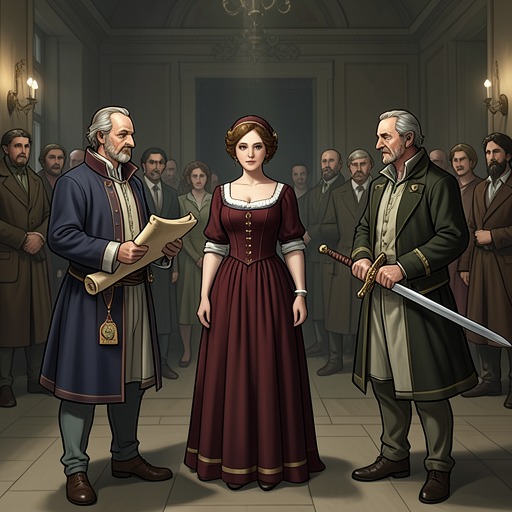
Rhosyn’s failed petitions lead to a more forceful intervention. Sylvaine Abelan verifies the situation with her and helps bring Jaromir before Magistrate Ridion. The magistrate assumes that Jaromir has come either to accept his claim to Damir’s inheritance or to sign it over to the town. Jaromir rejects both possibilities, making clear that the visit is not a private transaction over an estate but a challenge to the legal system itself.
Rhosyn then states the demand directly. She requires Ridion to dispense with the antiquated rule and amend it so that no person can be thrown from a home after family tragedy. She further demands that he serve the people rather than take property from them when they are most vulnerable, and that he enact Queen Dhara’s inclusive land and title ownership policies so that any person can establish a life in Kalinia.
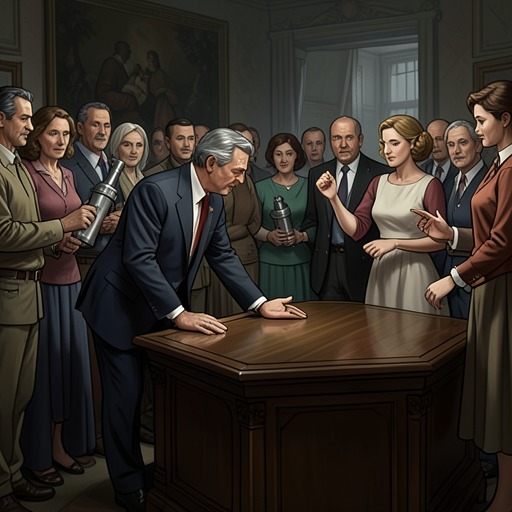
The reform is secured through a mixture of lawful procedure and intimidation. Sylvaine Abelan’s presence is intended to ensure that Ridion listens, while the threat that Sylvaine will sing of his conduct that night supplies public pressure. When Ridion objects that formal documents would require time, a scribe, and a notary, Sylvaine produces a legislative document written on Rhosyn’s table. She can witness his signature and the official stamp of his signet ring, turning the magistrate’s own administrative machinery into the instrument of change.
Family Duty and Legal Pluralism
The rule creates a collision between several forms of authority. Kalinia’s local statute favors a suitable male heir; Queen Dhara’s policy favors inclusive ownership; family duty asks Jaromir to protect Rhosyn and Damir’s daughters; and Jaromir’s promise functions as a personal contract even though it cannot secure Rhosyn’s property under the magistrate’s law. None of these systems is simply absent. They coexist, and their conflict determines the characters’ choices.
Jaromir’s responsibility is intensified by Damir’s death. He understands that the legal rule can strip Rhosyn of the home that preserves Damir’s memory, and that his own death without heirs would return the property to the magistrate. His commitment to a nominal marriage is consequently neither a straightforward romance nor a free domestic choice. It is an attempt to compensate for a legal structure that denies Rhosyn an independent claim.
Rhosyn, however, does not accept dependence on Jaromir as the only solution. Her demand reframes the problem from a family arrangement into a civic injustice. Instead of asking merely that Jaromir protect her, she calls for a change that would protect any person facing displacement after bereavement. The law’s significance thus expands from one household’s crisis to a test of whether Kalinia will recognize surviving kin as people with rights rather than obstacles to municipal acquisition.
Narrative Significance
Kalinia Male-Heir Inheritance Law is the institutional force behind Jaromir and Rhosyn’s betrothal arrangement, the threat to Rhosyn’s daughters, and the later confrontation with Magistrate Ridion. It exposes how property rules can shape intimate relationships long before the characters make emotional decisions, and how an apparently protective promise may itself be evidence of a society that withholds legal personhood from those it excludes.
Its defeat also marks a shift in the story’s understanding of inheritance. A home is not treated solely as an asset passing through a male line; it is a repository of labor, memory, family continuity, and imagined futures. Rhosyn’s account of Damir’s presence in the house gives the legal dispute its emotional foundation, while the enacted amendment transforms that private grief into public reform. The rule’s narrative function is therefore both oppressive and revealing: by threatening to erase a family’s home, it makes visible the difference between possessing land by statute and belonging to a place through lived history.