Kalinia's Allen Folk Song Premiere
The Ballad of the Last DragonKalinia’s Aeron Ballad Premiere is the performance in which Sylvaine Abelan first turns grief for Aeron Fowler into a public story. Staged under pressure, with Cadoc prepared to impersonate Aeron and Jaromir watching from the audience, the episode converts Sylvaine’s fear of failure into a shared act of remembrance. The ballad does not restore Aeron’s life, but it gives his name a continuing presence among people who know the song.
Circumstances and Preparation
The performance takes place in a tavern after Sylvaine Abelan has joined Aeron Fowler’s expedition and after Aeron’s death has left the company carrying both his memory and the burden of continuing his quest. Sylvaine arrives without her lute, a conspicuous disadvantage for a bard, and relies on a plan designed to preserve the appearance of Aeron’s continued presence. Cadoc is to playact as Aeron, while Neith distracts the barkeep long enough for Sylvaine to claim the stage and establish herself before the lack of an instrument draws attention.
The arrangement is complicated by Jaromir’s presence. He is recognizable in the area and is repeatedly approached by patrons, while Sylvaine fears seeing his soon-to-be wife and admitting how painful their relationship has become. Her performance therefore carries two kinds of risk at once: the public risk of failing as an artist and the private risk of confronting Jaromir’s changed circumstances. The planned impersonation also makes the ballad a deliberate act of narrative construction rather than a simple entertainment. The audience is being invited to receive Aeron through performance even though the man himself is absent.
The Performance and Its Value Shift
Sylvaine’s anxiety becomes physical before the song begins. She wipes her sweating palms on her blue-and-white striped trousers, nearly catches her foot on stacked barrels, straightens her cap, and struggles to breathe steadily. She checks that her ears remain hidden, takes her place at the center of the stage, and opens her mouth, but no sound comes. Her chest tightens, her stomach knots, and tears blur her vision as she imagines the crowd discovering that she is a fraud who cannot even begin the song.
The scene turns when Jaromir’s face becomes her anchor. His dark eyes remain fixed on her, and although he may no longer be hers, his presence still represents safety. Focusing on him allows her to clear her throat and act. The value at stake shifts from dignity threatened by public humiliation to dignity recovered through deliberate performance; the change is not produced by a speech of reassurance but by attention, rhythm, and the bodily steadiness Sylvaine finds in his gaze.
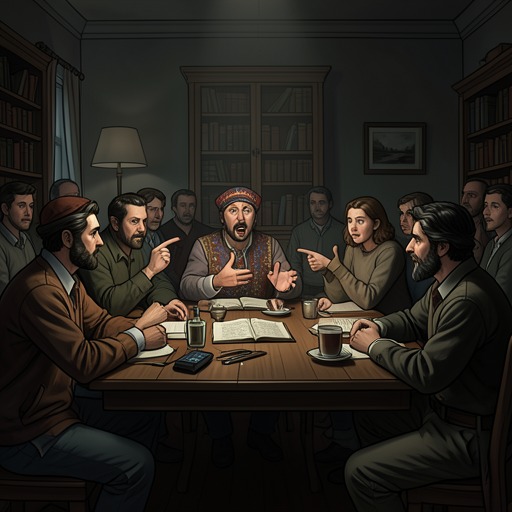
Without the lute, she creates the accompaniment herself. She stomps out a simple beat, then layers over it with faster, more intricate clapping. At first the rhythm disappears beneath conversation and laughter, but it gradually gathers attention. Voices fall quiet. The tavern’s separate sounds begin to organize around her beat, turning private spectators into participants. The performance’s central technique is therefore also its central meaning: Sylvaine does not wait for an ideal instrument or ideal confidence. She makes a structure strong enough for the story to enter.
She begins Aeron’s ballad with the opening lines, “A man there was / By the name of Aeron / All fire and gold,” and later sings of him coming “Riding the summer air.” As the familiar verses settle into place, other voices join her. Patrons strike tankards against their tables and slap their knees in time, extending her stomp and clapping into a communal accompaniment. The song’s subject is Aeron, but its immediate achievement belongs to the living: his name becomes something the tavern can carry together.
Audience Response and Personal Consequences
The completed song receives deafening cheers. Sylvaine sweeps off her hat and bows, and the response confirms that the ballad has moved beyond a private composition into a shared cultural object. She recognizes that people know Aeron’s name and know her ballad; the repetition of that realization gives the moment its emotional release. What began as a fear that the crowd would expose her becomes proof that the crowd has accepted the story and helped perform it.
Jaromir’s reaction remains distinct from the general applause. When Sylvaine rises from her bow, she finds warmth in his eyes, and the recognition revives her desire to cross the distance between them. She steps to the edge of the stage, leaps to the tavern floor, and stands before him with only a table separating them. The performance thus produces a public triumph without resolving the private pain that preceded it. Her exhilaration makes the separation feel temporarily bridgeable, but the scene preserves the contradiction: the ballad succeeds precisely while her relationship with Jaromir remains damaged and uncertain.
From Historical Mystery to Heroic Legend
The premiere is part of a larger process by which Aeron’s quest becomes legible as legend. Before the expedition fully understands what “dragon” means, Sylvaine hears Jaromir speak of one and recalls that dragons have not been sighted for more than a century. Tales place them in the dark times, when they prowled the land and flew through the skies; rumors also speak of a lost hoard, though forged maps are common. Her curiosity is inseparable from her vocation: if there is a story, she wants to commit it to memory, even while suspecting that the dragon might be a code name or moniker.
Aeron’s parchment deepens that uncertainty. Its hand-drawn representation of Targgein resembles familiar maps, but its landmarks bear archaic names, and its marginal directions to the dragon’s lair combine old Common Tongue, dwarven runes, and Ancient Elvish. Sylvaine can read the unusual mixture because her father required her to master Ancient Elvish, Dwarvish, Common Tongue, and forgotten human languages before allowing her to play in the forest. That linguistic history makes her more than the expedition’s singer: it gives her access to the map’s layered past and to stories preserved across languages.
The later discovery that the supposed dragon was a dying man who had played “the dragon” for three years changes the meaning of the quest without erasing its power. His letter explains that failing lungs led him to create the difficult map and lethal trials, while a dragon-fire formula in his desk was designed to ignite those entering the cave. The adventure had been engineered as a dangerous tradition rather than a confrontation with a surviving dragon. Aeron’s ballad consequently performs a second transformation: it does not report a straightforward dragon-slaying victory, but gives heroic form to a journey shaped by deception, mortality, friendship, and loss.
Afterlife of the Ballad
The song continues after the premiere, becoming part of the company’s daily life. Sylvaine plays the familiar tune in every tavern where they stay, in the privacy of inns shared with Jaromir, and beside their campfires at night. Its recurrence keeps Aeron present through words and memories even though the group has not literally lost him to a dragon. The performance is therefore not an isolated success but the beginning of a campaign of remembrance, repeated wherever the travelers can find an audience.
By the time First Fruits Day has passed and summer has given way toward Harvest Day, the ballad has acquired the title “The ballad of the last dragon. The ballad of Sir Aeron.” Seasonal change frames the song’s persistence: red banners and yellow ribbons have been replaced by burgundy fabric, pumpkins, and gourds, yet the tune remains. The altered tavern marks time moving forward, while the repeated melody holds Aeron within the company’s present.
The premiere’s lasting significance lies in its refusal to separate artistic success from emotional vulnerability. Sylvaine begins unable to make a sound, with no lute to shield her and shame close to overwhelming her. She ends with a crowd stamping, clapping, striking tankards, and shouting its approval. Aeron’s absence is not overcome, and Jaromir’s situation is not repaired, but both losses are given a form that can travel. Through Sylvaine’s performance, a dubious dragon story, a multilingual map, a deadly manufactured trial, and a dead companion become the materials of a legend whose survival depends on being sung again.